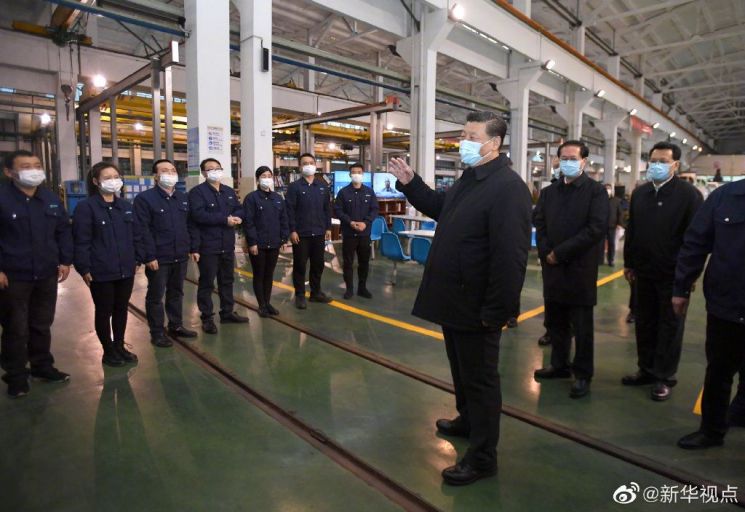
[Asia Economy Beijing=Special Correspondent Park Sun-mi] Chinese President Xi Jinping visited Zhejiang Province in eastern China over the weekend to inspect the status of resumed operations. This was his first local inspection since visiting Wuhan, Hubei Province on the 10th, and is interpreted as a clear message reflecting China's determination to normalize its economy.
On the 30th, China's Xinhua News Agency reported that President Xi visited Zhejiang Province the previous day, inspecting Chuanshan Port in Ningbo Zhoushan Port, which handles 1.12 billion tons of cargo annually, and an industrial complex densely packed with automobile parts factories to assess the status of resumed operations at the port and industrial park. Xinhua stated, "President Xi communicated with workers at the production sites and understood their efforts to resume operations," adding, "This visit by President Xi sends a clear message that China is restarting industrial production and social activities."
President Xi has emphasized that the resumption of operations at various enterprises should be promoted sequentially on the premise that quarantine measures are properly implemented. This is his first local government inspection since his visit to Wuhan, Hubei Province on the 10th. Notably, the Chuanshan Port in Ningbo, Zhejiang Province, which he visited this time, is a trade hub in eastern China, and the industrial complex is a concentrated area of Chinese automobile parts manufacturers, making the visit significant. Zhejiang Province is also a power base region where President Xi served as Communist Party Secretary for five years starting in 2002.
Among experts, the dominant opinion is that President Xi's inspection of Zhejiang Province should be interpreted as an important message revealing the Chinese government's determination to recover the economy.
Zhao Xijun, an economics professor at Renmin University, explained, "Ningbo in Zhejiang Province is an important part of China's export economy and a region where domestic and foreign companies gather," adding, "It is a clear signal that China is prioritizing economic growth after controlling COVID-19." He further stated, "It shows that China will continue to develop its economy and open its market."
On the 27th, at a Politburo meeting focused on economic management, China announced plans to "appropriately increase the fiscal deficit ratio, issue special government bonds, and expand the issuance scale of local government special-purpose bonds," indicating an aggressive fiscal policy. The 'China Fiscal Management 50 Forum,' a group of economic experts, publicly recommended last month raising China's fiscal deficit ratio from 2.8% last year to 3.5% this year and having the central government issue special bonds worth 1 trillion yuan (approximately 170 trillion won).
© The Asia Business Daily(www.asiae.co.kr). All rights reserved.
![Clutching a Stolen Dior Bag, Saying "I Hate Being Poor but Real"... The Grotesque Con of a "Human Knockoff" [Slate]](https://cwcontent.asiae.co.kr/asiaresize/183/2026021902243444107_1771435474.jpg)
















