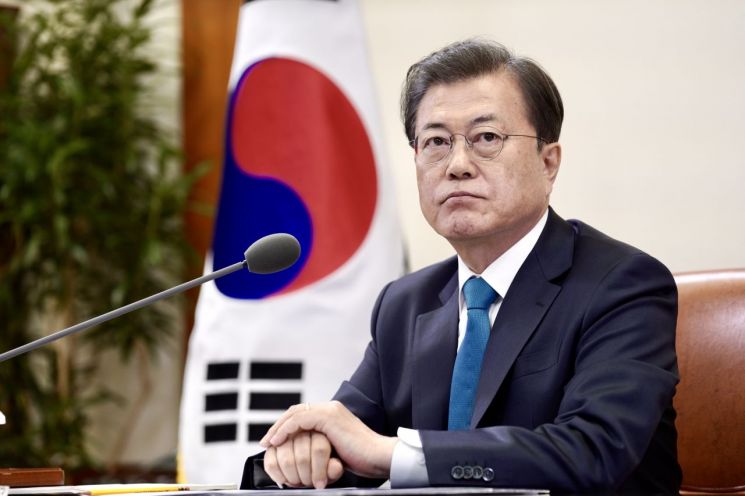
[Asia Economy reporters Kim Hyun-jung (Sejong) and Son Sun-hee] Ahead of the emergency economic meeting chaired by President Moon Jae-in scheduled for the 30th, where the government’s support measures for the public in response to the spread of the novel coronavirus infection (COVID-19) are expected to be announced, attention is focused on the specific target groups. Although the government has repeatedly stated that nothing has been finalized yet, it is known to be seriously considering a plan to provide benefits to 10 million households with middle income or below.
According to the National Assembly and the Ministry of Economy and Finance on the 29th, the government plans to place the “Emergency Disaster Livelihood Support Fund” on the agenda at the emergency economic meeting chaired by President Moon Jae-in on the 30th, discuss related matters, and disclose specific details.
So far, it is reported that there is a firm difference in position between the ruling party, the Democratic Party of Korea, and the government regarding the target recipients of the support. The ruling party proposes providing about 1.8 trillion won by giving 500,000 won per person to more than 70% of the population, while the government advocates providing up to 1 million won in the form of gift certificates or check cards to 10 million households with middle income or below, based on a four-person household. Middle income refers to the income of the household positioned in the middle when all households in the country are ranked by income. As of this year, the middle income is approximately 1.76 million won per month for a single-person household, 2.99 million won for a two-person household, 3.87 million won for a three-person household, and 3.75 million won for a four-person household.
The issue is the budget. Based on this year’s estimated population by Statistics Korea (51.78 million), assuming a support amount of 500,000 won, providing support to half of the population (25.89 million people) would require nearly 13 trillion won in total fiscal expenditure. If support is extended to 70% (36.24 million people) as the ruling party suggests, a total of 18 trillion won would be needed. This amount is more than 50% higher than the recently passed supplementary budget (11.7 trillion won). The Ministry of Economy and Finance, the responsible ministry, including Minister Hong Nam-ki, has repeatedly expressed the position that selective support is necessary for projects requiring large-scale direct fiscal spending due to concerns about fiscal soundness.
Before the emergency economic meeting, the ruling party, government, and Blue House plan to hold a closed-door high-level consultation meeting at the Prime Minister’s official residence in Samcheong-dong, Seoul, around 6:30 p.m. on the 29th to coordinate related matters. The meeting is expected to be attended by Democratic Party leader Lee Hae-chan and Prime Minister Chung Sye-kyun, while from the Blue House, Presidential Chief of Staff Noh Young-min, Policy Chief Kim Sang-jo, and Senior Secretary for Political Affairs Kang Ki-jung are expected to participate.
© The Asia Business Daily(www.asiae.co.kr). All rights reserved.
![User Who Sold Erroneously Deposited Bitcoins to Repay Debt and Fund Entertainment... What Did the Supreme Court Decide in 2021? [Legal Issue Check]](https://cwcontent.asiae.co.kr/asiaresize/183/2026020910431234020_1770601391.png)















