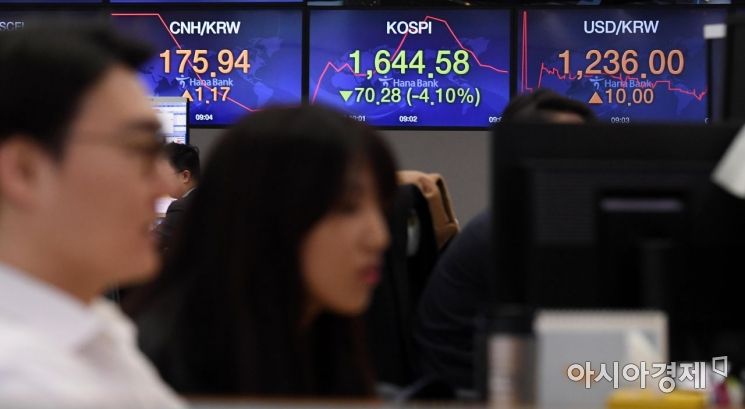
 Due to the impact of the novel coronavirus infection (COVID-19) pandemic, the global stock markets plummeted, and on the 17th, the KOSPI index opened at 1,640.84, down 74.02 points (4.32%) from the previous trading day (1,714.86). Dealers were busy working in the dealing room of Hana Bank in Jung-gu, Seoul. On the same day, the won-dollar exchange rate opened at 1,231.0 won, up 5.0 won from the previous trading day (1,226.0 won). Photo by Kim Hyun-min kimhyun81@
[Asia Economy Reporter Koh Hyung-kwang] This year, individual investors have purchased stocks worth over 23 trillion won in the domestic stock market. Despite the rollercoaster ride caused by the impact of the novel coronavirus disease (COVID-19), individuals have been steadily buying stocks. In contrast, the amount invested by pension funds, including the National Pension Service, in the stock market is only about 3 trillion won. While foreigners have sold off more than 15 trillion won, fueling the market crash, individual investors?not pension funds?are playing the role of saviors by preventing the index from falling further.
According to the Korea Exchange on the 29th, individuals have net purchased stocks worth a total of 19.9842 trillion won in the KOSPI market from the beginning of this year through the 27th. Following 4.483 trillion won in January, net purchases in February also reached 4.8974 trillion won. This month alone, individuals bought stocks worth 10.6038 trillion won, more than double the amount purchased in January and February combined. This is the largest monthly purchase amount by individuals since the Korea Exchange began compiling trading trend statistics by investor type in September 2001.
This is a completely different pattern from last year, when individuals net sold stocks worth 3.2295 trillion won in December alone and sold a total of 11.8012 trillion won in the KOSPI market throughout the year. In particular, although foreigners and institutions dumped stocks worth 15.0641 trillion won and 7.1263 trillion won respectively this year, accelerating the index decline, individual investors absorbed most of these sales, contributing to index defense.
Since the KOSPI index began to fall sharply on the 17th of last month through the 27th of this month, individual investors showed net buying dominance on all but two of the 30 trading days. Especially during the seven trading days from the 11th to the 19th, when the KOSPI index plunged more than 500 points, individuals bought stocks every day without fail, ranging from 240 billion won to as much as 1 trillion won daily. The net purchase amount during this period reached 4.7 trillion won.
Individuals also purchased stocks worth 3.0371 trillion won in the KOSDAQ market this year. Combining KOSPI and KOSDAQ, the net purchase amount rises to 23.0213 trillion won. Seo Sang-young, a researcher at Kiwoom Securities, explained, "It is extremely unusual for individual investors to buy around 5 to 10 trillion won every month," adding, "It appears to be a strategy of buying at low prices by taking advantage of the market crash."
Typically, when the stock market plunges, institutional investors such as pension funds step in to act as a safety net, but this year, individuals seem to be fulfilling that role. Although pension funds have increased their purchase volume since this month, it is negligible compared to the buying power of individuals. The net purchase amount by pension funds in the KOSPI this year is 3.1673 trillion won, only about 15% of the individual purchase volume (19.9842 trillion won). In the KOSDAQ market, pension funds have actually shown net sales of nearly 300 billion won (2.954 billion won). Kim Yong-gu, a researcher at Hana Financial Investment, said, "While pension fund buying power fluctuates in a crash market, individual buying power is steady," adding, "It seems to be a buying trend with an eye on a future rebound, but it certainly helped reduce the index's decline."
Individuals concentrated their purchases on semiconductor stocks. The top three stocks in terms of net purchases by individuals this year are Samsung Electronics, Samsung Electronics Preferred Shares, and SK Hynix, with amounts of 7.6421 trillion won, 1.5694 trillion won, and 882.3 billion won respectively. This totals 10.0938 trillion won, meaning individuals invested half of their total purchase volume this year (19.9842 trillion won) in semiconductors.
© The Asia Business Daily(www.asiae.co.kr). All rights reserved.

















