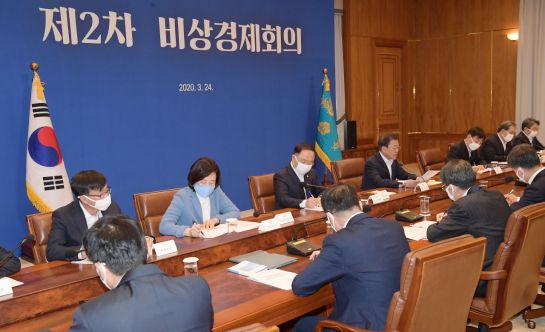
 The 2nd Emergency Economic Meeting related to the novel coronavirus infection (COVID-19). President Moon Jae-in is presiding over the Emergency Economic Meeting at the Blue House on the 24th. (Photo by Yonhap News)
[Asia Economy Reporter Kwangho Lee] The government is considering a plan to provide emergency disaster relief funds of 1 million KRW (based on a 4-person household) to 10 million households with middle income or below who are struggling due to the novel coronavirus infection (COVID-19). Households that receive benefits through the supplementary budget will be excluded, and the estimated funding size is between 5 trillion and 6 trillion KRW.
According to the Ministry of Economy and Finance on the 29th, the government plans to submit the 'Emergency Disaster Relief Fund Support Plan' as an agenda item at the emergency economic meeting chaired by President Moon Jae-in this week.
First, the government is reviewing a plan to provide emergency disaster relief funds to 10 million households with middle income or below, which accounts for half of all households, based on the number of household members.
The plan is to provide up to 1 million KRW for a 4-person household in a single payment. Households with 1 to 3 members will receive less, and households with 5 or more members will receive more.
Basic livelihood security households and legally designated near-poor households totaling 1.687 million households, which receive consumption coupons under the COVID-19 supplementary budget, are likely to be excluded. These households receive monthly payments ranging from 100,000 to 350,000 KRW for four months, with a maximum of 1.4 million KRW for a 4-person household, depending on the number of household members.
Median income refers to the income of the household that ranks in the middle when all households are ordered by income. According to the Organization for Economic Cooperation and Development (OECD) standards, households with less than 50% of median income are classified as poor households, those with 50% to 150% as middle-class households, and those exceeding 150% as high-income households.
Based on this year’s figures, the median income is 1.76 million KRW per month for a single-person household, 2.99 million KRW for a 2-person household, 3.87 million KRW for a 3-person household, 3.75 million KRW for a 4-person household, 5.63 million KRW for a 5-person household, 6.51 million KRW for a 6-person household, and 7.39 million KRW for a 7-person household. The funding for the emergency disaster relief fund is expected to be around 5 to 6 trillion KRW.
Meanwhile, the ruling party, the Democratic Party of Korea, reportedly holds the position that at least half of the population should benefit, and that the support scope should include more than 25 million people, including the middle class. The party is considering expanding the beneficiary target from 50% to 60% or 70% of the population.
Considering the estimated population of 51.78 million this year by Statistics Korea, if 50% (25.89 million people) receive 500,000 KRW per person, it would cost nearly 13 trillion KRW. Expanding to 60% would require 15.5 trillion KRW, and 70% would amount to 18 trillion KRW.
© The Asia Business Daily(www.asiae.co.kr). All rights reserved.

















