"Accountability for Financial Company Executives Lies with the Financial Services Commission," Court Rules; Financial Supervisory Service States "Will Clarify in Main Lawsuit"
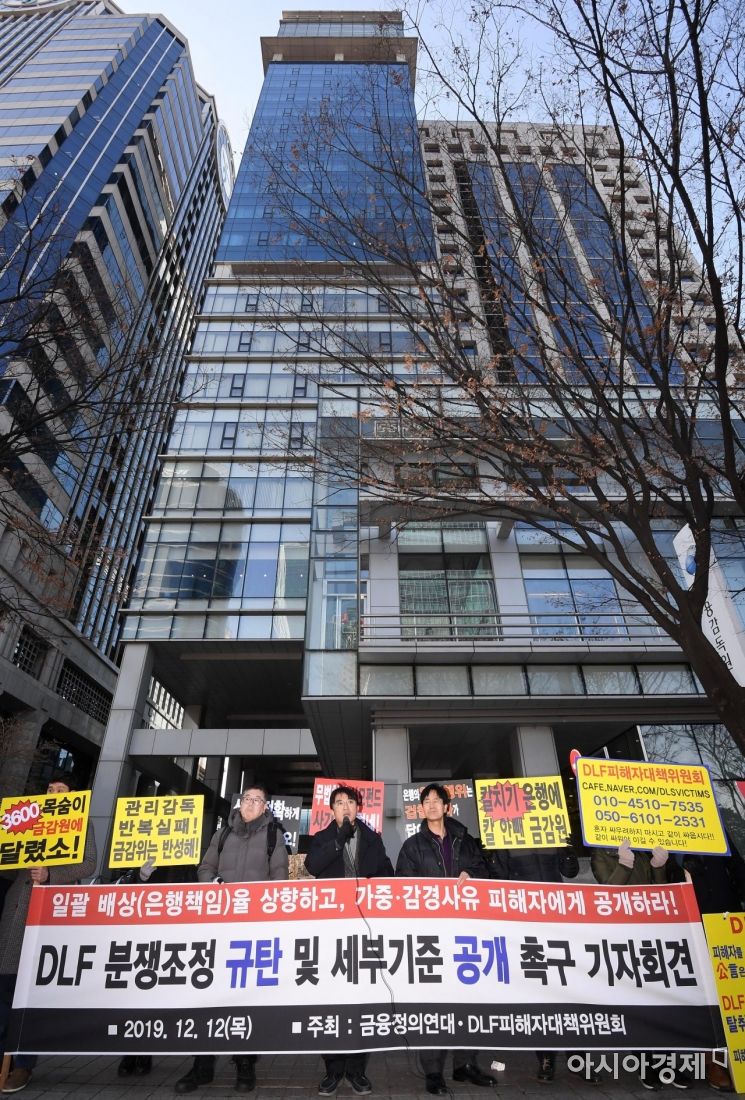 Representatives from the Financial Justice Solidarity and the DLF Victims Countermeasure Committee held a press conference on the 12th in front of the Financial Supervisory Service in Yeouido, Seoul, condemning the DLF dispute mediation and urging the disclosure of detailed standards. They demanded, "Raise the uniform compensation rate (bank responsibility) and disclose the reasons for increasing or decreasing the compensation rate to the victims." Photo by Kim Hyun-min kimhyun81@
[Asia Economy Reporter Jo Gang-wook] The administrative court's interpretation that the Financial Supervisory Service's (FSS) severe disciplinary actions against the CEOs of Woori and Hana banks in connection with the overseas interest rate-linked derivative-linked fund (DLF) scandal were 'beyond its authority' has sparked growing controversy.
Although the FSS appealed the court's decision, there is speculation that if the same judgment is made in the main lawsuit, the severe disciplinary actions against the bank CEOs could be invalidated.
According to the financial sector on the 28th, the Seoul Administrative Court Administrative Division 11 accepted the suspension of execution request filed by Chairman Sohn on the 20th, stating that the FSS's issuance of a 'reprimand warning' to the CEOs of banks that sold DLFs was beyond the FSS's authority.
Notably, the ruling explicitly states, "(According to the Governance Act) the authority to issue reprimand warnings lies with the Financial Services Commission (FSC)," delivering a significant shock.
An FSS official said, "This case was a decision on the provisional injunction to suspend the effect of the severe disciplinary action," adding, "We will prepare well for the main lawsuit to cancel the disciplinary effect and provide evidence."
Earlier, based on Article 30, Paragraph 1 of the Enforcement Decree, which delegates the authority from the FSC to the FSS to take cautionary measures, cautionary reprimand warnings, and reprimand warnings against financial company executives, the FSS issued severe reprimand warnings to Sohn Tae-seung, Chairman of Woori Financial Group, and Ham Young-joo, Vice Chairman of Hana Financial Group, for internal control failures related to the DLF scandal.
However, the court interpreted Article 35, Paragraph 1 of the Enforcement Decree to mean that the FSS can only issue reprimand warnings to executives of savings banks, not other financial company executives. The court stated in the provisional injunction ruling, "The authority to issue reprimand warnings to executives of financial companies other than mutual savings banks is still interpreted to lie with the FSC."
Especially as the issue of the FSS's authority was raised at the provisional injunction stage, there is a possibility that the main lawsuit will also unfold unfavorably for the FSS. Furthermore, there remains a possibility that the FSS's reprimand warning decisions against Chairman Sohn and Vice Chairman Ham could be invalidated.
Earlier, Chairman Sohn secured his reappointment as an inside director at Woori Financial's regular shareholders' meeting held on the 25th. Entering the 'second term system,' Chairman Sohn will lead Woori Financial for another three years until March 2023.
At the shareholders' meeting, the largest shareholder (17.25%), the Korea Deposit Insurance Corporation, along with the six major oligopoly shareholders (24.58%) including IMM Private Equity (PE), Fubon Life, Kiwoom Securities, Korea Investment & Securities, Hanwha Life, and Tongyang Life, voted in favor of Chairman Sohn's reappointment. The second-largest shareholder, the National Pension Service (7.7%), expressed opposition as initially announced, but no surprises occurred.
There have been many rumors in the financial sector regarding the awkward sanctions related to the DLF. The main criticisms focus on the ambiguous legal basis for CEO sanctions and whether the supervisory authorities interpreted regulations arbitrarily. Because of this, voices have emerged suggesting that the FSS is shifting responsibility onto the financial sector with 'diluted disciplinary actions.'
Additionally, the revealed conflict with the FSC during this process was problematic. There was even controversy over 'FSC passing' as important decisions regarding the reappointment of CEOs of government-owned financial companies were made without the FSC's consent. Financial Services Commission Chairman Eun Sung-soo, who had denied conflicts by saying "the FSS is a good partner," recently left a lingering remark about the FSS's disciplinary authority, saying, "I will consider it without direction as a product of history."
The Blue House's Civil Affairs Office launched an inspection of the FSS, and the Board of Audit and Inspection's upcoming audit of the FSS, along with requests for reports from financial companies about the FSS, is also an unusual development.
With the court's decision unfavorable to the FSS, there is even speculation that discussions on improving disciplinary procedures for financial company executives will accelerate.
Meanwhile, on the 26th, the FSS immediately filed an appeal against the Seoul Administrative Court's acceptance of Chairman Sohn's request to suspend the disciplinary effect.
© The Asia Business Daily(www.asiae.co.kr). All rights reserved.

















