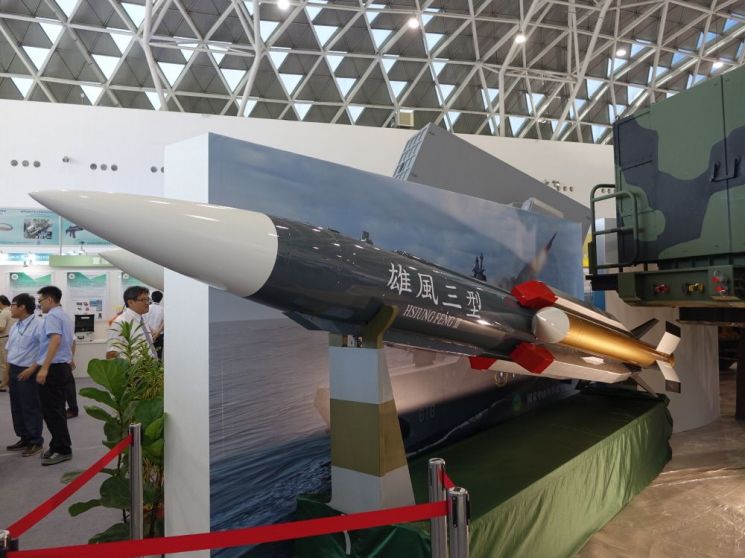
 The Hsiung Feng-3 is a supersonic anti-ship missile independently developed by Taiwan, nicknamed the "Chinese Aircraft Carrier Killer." Photo by Kim Daeyoung
[Military Analyst Kim Daeyoung] The Hsiung Feng (Xiong Feng)-3 is a supersonic anti-ship missile independently developed by Taiwan, nicknamed the "Chinese aircraft carrier killer." Supersonic anti-ship missiles fly at speeds of Mach 2 to 3, making them very challenging weapons to intercept from a defensive standpoint. They are especially useful for neutralizing aircraft carriers.
The Hsiung Feng-3 was developed by Taiwan's National Chung-Shan Institute of Science and Technology (國家中山科學?究院), abbreviated as "Chung Kuo Yuan (中科院)." Unlike South Korea's Agency for Defense Development, Chung Kuo Yuan is responsible not only for weapon development but also for production.
Chung Kuo Yuan began developing anti-ship missiles in 1975. Taiwan's first anti-ship missile, the Hsiung Feng-1, was a copy and improvement of Israel's Gabriel Mk 1 anti-ship missile. Mass production of the Hsiung Feng-1 began in 1979, with a range of 40 km, and it used a semi-active radar homing guidance system, identical to the Gabriel Mk 1.
The semi-active radar homing guidance system involves illuminating the target with radar and tracking the reflected signal to guide the missile to the target. The Hsiung Feng-1 anti-ship missile was used by the Taiwanese Navy until 2012 and has since been fully retired.
In the 1980s, the Hsiung Feng-2 was developed, boasting performance similar to the U.S. Harpoon anti-ship missile. Commissioned into the Taiwanese Navy on February 9, 1988, the Hsiung Feng-2 has a maximum range of 148 km and employs active radar and infrared guidance systems, achieving high accuracy.
Additionally, based on the Hsiung Feng-2, the Hsiung Feng-2E cruise missile was developed with a significantly extended range. The Hsiung Feng-2E is a ground-launched cruise missile with a range of 1,500 km, capable of striking important military facilities on the Chinese mainland. It was deployed to the Taiwanese military starting in June 2009. Following the Hsiung Feng-2, the supersonic anti-ship missile Hsiung Feng-3 was developed in the 1990s. The Hsiung Feng-3 project began based on the U.S. ALVRJ supersonic missile development program from the late 1960s.
In the 1980s, Taiwan acquired ALVRJ supersonic missile technology with tacit approval from the U.S. government and then began full-scale development. The resulting Hsiung Feng-3 supersonic anti-ship missile was first publicly unveiled during Taiwan's National Day military parade on October 10, 2007. The Hsiung Feng-3 has a range of 150 km and flies at speeds up to Mach 2.5.
It is known as the first supersonic anti-ship missile to be operationalized in the Western world. During testing, the missile was able to penetrate the hull of a large warship, such as a tank landing ship. In July 2016, an accidental launch incident occurred, destroying a fishing boat and causing the death of a fisherman aboard.
The Hsiung Feng-3 missile, accidentally fired from the Taiwanese Navy's 500-ton Jinjiang (金江) ship, accurately struck a fishing boat about 70 km away. Although a tragic event, it revealed the formidable capabilities of the Hsiung Feng-3 supersonic anti-ship missile to the world. Notably, the struck fishing boat was small and made of FRP (fiber-reinforced plastic), yet the missile precisely identified and targeted it, astonishing military experts worldwide.
© The Asia Business Daily(www.asiae.co.kr). All rights reserved.

















