Economic Crisis, The Way Out② Professor Inho Lee, Department of Economics, Seoul National University (President of the Korean Economic Association)
The central government considers national finances,
while local governments think about support from the central government.
Everyone can implement free support,
but ultimately the resources for the future decrease.
Economic recovery after COVID-19 may become difficult.
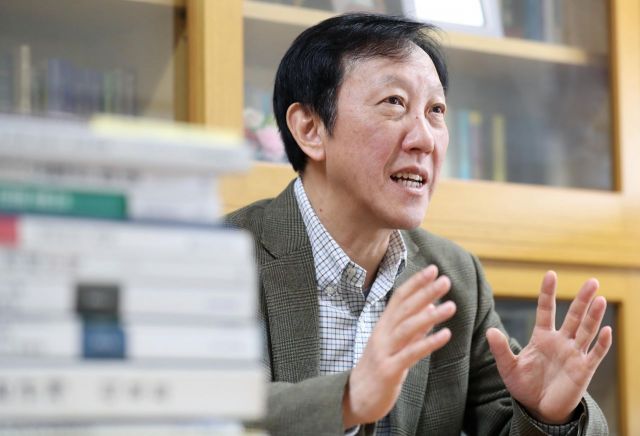 Professor Inho Lee, Department of Economics, Seoul National University / Photo by Honam Moon munonam@
Spring has come again this year without fail, but the world still feels dark and cold. An unprecedented infectious disease is spreading, causing everyone to withdraw. As people reduce their activities, the economy cannot function well. The real market is tightening, and the financial market is even more shocked, with financial product prices fluctuating wildly, making it impossible to predict where things will go next. The more this happens, the more we must stay alert and overcome this crisis.
In preparing countermeasures for this crisis, it is necessary to understand the cause and nature of the crisis. Unlike previous crises that originated in the financial market, this economic crisis stems from the real market. The 1998 foreign exchange crisis and the 2008 global financial crisis both began with problems in the financial market, and the main task was to prevent these problems from spreading to the real market.
However, this time, due to an infectious disease that makes face-to-face contact difficult, transactions have become impossible, sales have plummeted, and the real market has begun to collapse. The financial market is also rapidly destabilizing accordingly. In previous financial crises, problems occurred in some countries, while others were unaffected, allowing the unaffected countries to help with recovery. But this time, the infectious disease has spread worldwide, making such recovery difficult.
Since the cause of this crisis is the disappearance of transactions in the real market, overcoming the crisis fundamentally requires control over the infectious disease and the restoration of transactions in the real market. The problem is that most companies participating in the real market may not survive until then and face the risk of bankruptcy.
Therefore, countermeasures for the crisis must be prepared in two stages. First, support measures to help companies survive until control over the infectious disease is achieved. Second, support measures to help the market return to pre-crisis levels of economic activity once smooth transactions in the real market are possible.
Currently, as the first stage, it is urgent to prepare temporary support measures for companies. However, even though supporting companies and consumers in difficulty during the first stage is urgent, measures that could cause difficulties later when preparing the second stage should be avoided as much as possible. For example, excessively expansionary fiscal spending may help companies survive temporarily but can damage national fiscal soundness and cause greater difficulties during the recovery phase.
Currently, many countries around the world, including South Korea, are implementing almost every imaginable measure, all of which correspond to the first stage of countermeasures. These measures can be broadly divided into two types: one is free support, and the other is deferment of debt repayment and various costs.
Among these, free support requires caution because it involves direct fiscal expenditure. In the case of free support, recipients have a strong incentive to receive as much as possible since they do not have to pay privately later. Moreover, politicians sensitive to popularity have strong incentives to utilize this. The abuse of free support, such as disaster basic income, can lead to the so-called tragedy of the commons.
The tragedy of the commons refers to a situation where, in the case of shared resources, if others consume before me, there is nothing left for me, so everyone tries to consume first, resulting in rapid depletion of the resource. If the resource were private, people would consider the rate of resource regeneration and the utility of future consumption, allowing almost perpetual consumption. But with shared resources, even if I do not consume, if others do, the resource disappears, reducing incentives to consider the future.
While the central government has strong incentives to carefully consider the impact of such free support on national finances, local governments may competitively implement free support thinking they can later receive financial support from the central government. In this case, if one local government starts free support, others have strong incentives to follow. As pointed out in the tragedy of the commons, with shared resources, if others use them even if I do not, there will be no resources left for future consumption.
On the other hand, support for deferment of debt repayment can benefit from a more proactive and aggressive approach. If companies recover after overcoming the crisis and repay their debts, deferment of debt repayment itself does not cause fiscal expenditure. Moreover, if creditors expect difficulties in debt repayment, they may exert more pressure, causing even sound debtors to face difficulties. Therefore, financial authorities’ support for deferment of debt repayment should reassure creditors and prevent debtors from going bankrupt even if they can generate sufficient future profits.
Helping companies in difficulty during an economic crisis is essential for future economic recovery. Support for consumers is also desirable when it promotes the survival of companies. This is because this economic crisis originated from the disappearance of transactions, causing companies to face difficulties, so addressing the root cause is a more effective response.
© The Asia Business Daily(www.asiae.co.kr). All rights reserved.
![User Who Sold Erroneously Deposited Bitcoins to Repay Debt and Fund Entertainment... What Did the Supreme Court Decide in 2021? [Legal Issue Check]](https://cwcontent.asiae.co.kr/asiaresize/183/2026020910431234020_1770601391.png)















