Only Three Institutional Investors Submitted Shareholder Proposals This Year
Pressure Expected to Strengthen Voting Rights Next Year
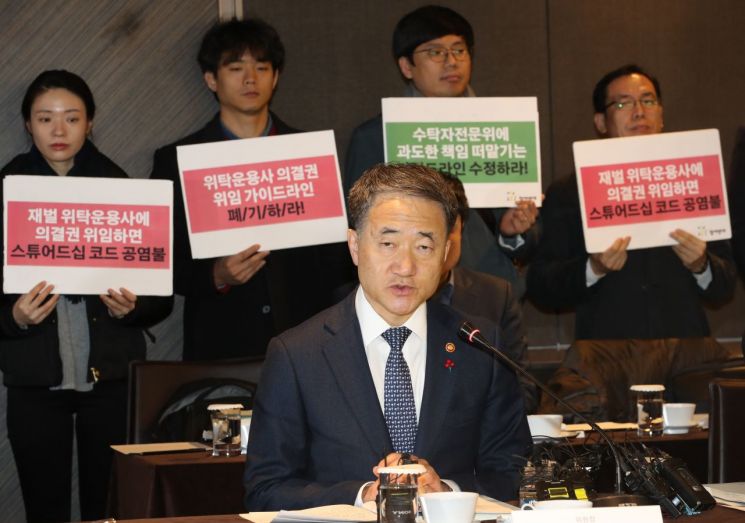
[Asia Economy Reporter Ji-hwan Park] As this year’s regular general meetings of shareholders (GMS) for companies are drawing to a close, the influence of institutional investors such as the National Pension Service (NPS) appears to be weaker than last year. This is attributed to delays in forming the NPS’s Stewardship Responsibility Committee and considerations related to the spread of the novel coronavirus disease (COVID-19). However, since institutional investors have been steadily strengthening their exercise of voting rights, it is expected that stronger pressure will be applied at next year’s GMS.
According to the Korea Exchange on the 27th, the number of shareholder proposals by institutional investors among KOSPI-listed companies this year was three, half of last year’s six. Last year, shareholder proposals were made by NPS, KCGI, SC Fundamental, Holdco Asset Management, Value Partners Asset Management, and Elliott Management, but this year they were limited to KCGI, Value Partners Asset Management, and Dalton Investment.
In particular, the NPS did not submit any shareholder proposals at all. Shareholder proposals can be made up to six weeks before the GMS, but due to delays in forming the Stewardship Responsibility Committee, the NPS had to postpone this. Instead, the NPS focused on exercising voting rights. This year, the NPS expressed opposition to 22 companies and 44 agenda items at regular shareholder meetings of listed companies. The agenda items with the most opposition votes were the appointment of outside directors and director remuneration proposals.
Korean Air succeeded in changing the “two-thirds rule” in its articles of incorporation at the GMS held that day, a rule that had blocked the reappointment of the late Chairman Cho Yang-ho last year. As a result, a green light was given for the reappointment of Cho Won-tae, Chairman of the Hanjin Group, as an inside director of Korean Air, whose term expires in March next year. The NPS had previously opposed this agenda, stating there was no justifiable reason to change the director appointment method.
In the financial sector, the NPS opposed the reappointments of Sohn Tae-seung, Chairman of Woori Financial Group, and Cho Yong-byeong, Chairman of Shinhan Financial Group, citing reasons of damaging corporate value. At the Hyosung GMS on the 20th, the NPS opposed the reappointments of Chairman Cho Hyun-joon, who was sentenced to prison for embezzlement and breach of trust, and President Cho Hyun-sang, who has a history of violating foreign exchange transaction laws. Ultimately, all agenda items opposed by the NPS were passed as originally proposed.
However, it is premature to interpret the NPS’s voice as weakened. Although the results were effectively a complete defeat, the message left in the market is also considered significant. Song Min-kyung, Senior Research Fellow at the Korea Corporate Governance Service, explained, “In Korea, the focus is only on whether proposals are rejected, leading to an underestimation of the impact of dissenting votes on voting rights. In foreign countries, agenda items with 20-30% opposition are difficult to resubmit even if they are not rejected and are regarded as failed proposals.”
Among companies, concerns about next year are already growing. This year, the impact of COVID-19, which no one anticipated, is seen as the reason why pressure from the NPS on companies was not strong. However, it is expected that from next year, the NPS is likely to submit a large number of shareholder proposals demanding comprehensive restructuring of companies. A business community official expressed concern, saying, “This year, many issues that could give companies some leeway were considered due to the situational factors caused by COVID-19, but next year the situation could completely reverse compared to this year.”
Voices opposing excessive management intervention by the NPS are also growing. According to a recent survey conducted by the Federation of Korean Industries targeting 43 legal and economic experts on the NPS’s corporate management intervention, 90.7% (39 experts) opposed the NPS’s management intervention. Regarding the independence of NPS management, 38 experts (88.4%) evaluated it as insufficient.
Yoo Hwan-ik, Director of Corporate Policy at the Federation of Korean Industries, emphasized, “This can be seen as experts’ perception that it is undesirable for the NPS, which lacks independence and expertise, to intervene in corporate management. The NPS should focus on its fundamental role of securing the public’s retirement.”
© The Asia Business Daily(www.asiae.co.kr). All rights reserved.

















