141 Failures Among 349 KOSDAQ Listed Companies
Challenges Also Plague KOSPI Market
More Rejections Expected Ahead of Super Shareholders' Meetings
[Asia Economy Reporter Minji Lee] On the morning of the 27th, Company A, a KOSDAQ-listed company that held its regular shareholders' meeting, ultimately failed to appoint an auditor. Only employees were present at the meeting venue, with a mere 18 shareholders attending. Despite having approximately 7,700 shareholders, the company had anticipated the failure to appoint an auditor even before the meeting. The electronic voting participation rate was only 1.5%, lower than last year's 3%. A company representative stated, "Because shareholders are dispersed, using proxy voting agencies is meaningless," adding, "We will continue to attempt auditor appointments through extraordinary general meetings, but we have no confidence that it will pass."
Company B, also listed on KOSDAQ, failed to appoint an auditor at its shareholders' meeting the day before. The quorum requirement (25%) was short by 8 percentage points, so the auditor appointment proposal was not put to a vote. Despite encouraging participation through electronic voting amid the spread of COVID-19, the electronic voting participation rate was only 0.4%. The company plans to attempt auditor appointment again through an extraordinary general meeting but is worried the same situation may repeat.
This year’s shareholders' meeting season has seen a real crisis in auditor appointments among listed companies. Every year, the number of KOSDAQ-listed companies failing to appoint auditors due to lack of quorum increases, and this year, the number of companies unable to appoint auditors has surged significantly due to the impact of COVID-19.
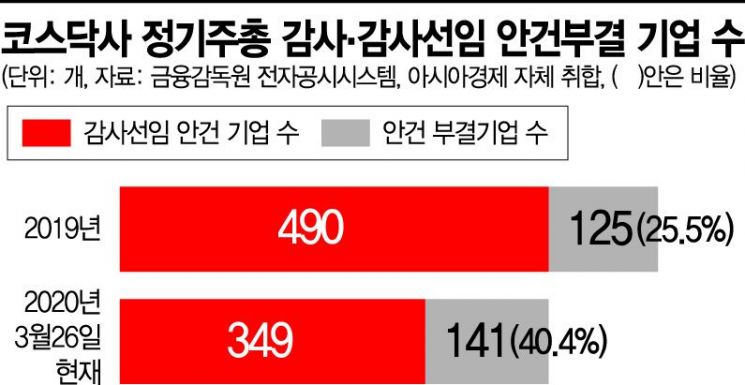
According to Asia Economy’s own tally of regular shareholders' meeting results for listed companies as of the 27th, there are 662 KOSDAQ-listed companies with December fiscal year-end that held meetings, of which 349 attempted to appoint auditors. Among these, 141 companies (40.4%) failed to appoint auditors, meaning that 4 out of 10 KOSDAQ-listed companies attempting auditor appointments failed.
Even though only about half of the KOSDAQ-listed companies have held their shareholders' meetings, the number of companies failing to appoint auditors has already far exceeded last year’s 125 companies. It is expected that the number of companies failing to appoint auditors will increase further. On this day alone, 395 KOSDAQ-listed companies, accounting for one-third of the total, held meetings, and 252 more are scheduled to hold meetings from the 29th to the 31st.
Companies listed on the KOSPI are also struggling with auditor appointment issues. Although the number of shareholders is less dispersed than in KOSDAQ-listed companies, the number of auditor appointment rejections has been increasing every year. In 2018, five companies failed to appoint auditors in the KOSPI market, but last year the number rose to 28. Considering that more than 15 companies, including Namkwang Construction, CS Wind, and Samick Musical Instruments, had failed to appoint auditors before the 'Super Shareholders' Meeting Day,' the number of rejections is expected to rise further.
A representative from the Korea Listed Companies Association said, "Initially, it was expected that 238 companies among all domestic listed companies would fail to appoint auditors, but due to the worsening shareholders' meeting environment caused by COVID-19, the number is expected to increase to more than 300."
Listed companies point to the '3% rule' as the cause of the auditor appointment crisis. Under the 3% rule, the voting rights of the largest shareholder and related parties on auditor and audit committee member appointment agendas are limited to within 3%. As long as this rule remains, companies believe that holding repeated extraordinary general meetings will not change the outcome. A KOSDAQ-listed company official emphasized, "To facilitate smooth auditor appointments, ultimately, the 3% rule needs to be revised," adding, "Despite many listed companies introducing electronic voting this year, the government needs to accurately understand why the number of failed auditor appointments is increasing."
Meanwhile, the number of listed companies receiving 'adverse' audit opinions on their audit reports has also increased this year. With the strengthening of accounting audits under the External Audit Act, the industry expects the number of companies receiving adverse opinions to reach an all-time high this year. According to the Korea Exchange, as of the day before, three companies on the KOSPI and 27 companies on the KOSDAQ have received adverse audit opinions, already surpassing last year’s total of 25 companies.
© The Asia Business Daily(www.asiae.co.kr). All rights reserved.

















