Previous Day Trading Volume 24.277 Trillion KRW
Record High Daily Trading Amount
Over 20 Trillion KRW Traded Four Times This Year
Investor Deposits Exceed 40 Trillion KRW
Adverse Factors Persist, Investors Should Be Cautious
Experts: "US Economic Uncertainty Has Unimaginable Impact on Korean Companies"
[Asia Economy Reporters Koh Hyung-kwang and Oh Ju-yeon] This year, stock market trading volume has surged by more than 50% compared to last year, and the standby funds in the stock market have also shown a steady increasing trend. It is interpreted that the funds flowing into the stock market have significantly increased due to the expanded volatility of the stock market caused by the spread of the novel coronavirus infection (COVID-19). There are concerns that investors should be cautious as the earnings of major domestic companies have deteriorated due to COVID-19, and the uncertainty of the US and European economies may persist for a considerable period.
According to the Korea Exchange on the 27th, the combined daily average trading volume of the KOSPI and KOSDAQ markets was 24.277 trillion won as of the previous day. This is the largest daily trading amount ever recorded. The KOSPI alone recorded 12.3741 trillion won, and the KOSDAQ recorded 11.9028 trillion won in trading on that day.
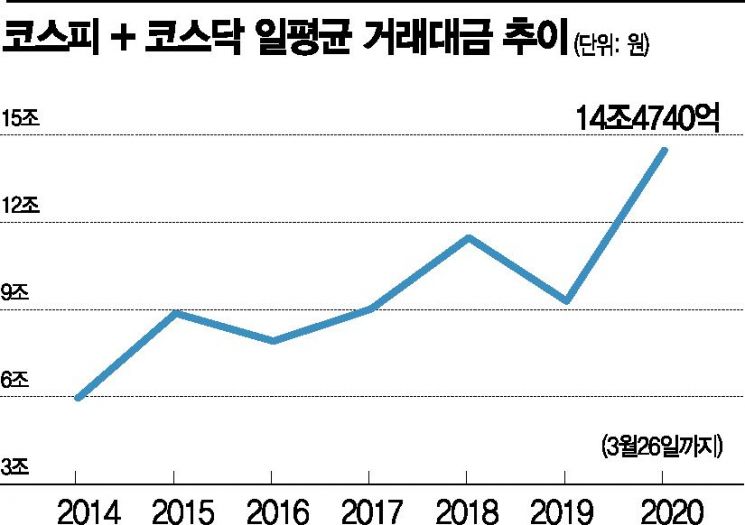
In the past, the combined trading volume of the KOSPI and KOSDAQ exceeded 20 trillion won only twice: on January 12, 2018 (20.8561 trillion won) and May 31, 2018 (20.3838 trillion won). However, this year alone, the trading volume surpassed 20 trillion won on four occasions: March 13 (21.5289 trillion won), March 19 (20.5076 trillion won), March 25 (22.2988 trillion won), and March 26 (24.277 trillion won).
Notably, the KOSDAQ trading volume on the previous day was the second highest ever since January 12, 2018 (12.084 trillion won). The KOSDAQ daily trading volume has exceeded 10 trillion won only five times, including November 21, 2017 (10.0322 trillion won), January 12, 2018 (12.084 trillion won), January 15, 2018 (10.7223 trillion won), January 17, 2018 (10.4814 trillion won), and the previous day.
With increased volatility in the stock market this year, the overall trading volume has risen. The daily average trading volume of the combined KOSPI and KOSDAQ markets this year is 14.474 trillion won, which is a 55.6% (5.1753 trillion won) increase compared to last year's daily average of 9.299 trillion won. It rose from 11.881 trillion won in January to 14.175 trillion won in February, and surged to 17.519 trillion won this month. This figure surpasses the trading volume of 15.81 trillion won recorded in January 2018 when the KOSPI index hit its all-time high of 2607.10.
The increase in trading volume was relatively larger in the KOSPI compared to the KOSDAQ. The daily average trading volume of the KOSPI this year was 7.9091 trillion won, up nearly 60% (58.5%) from 4.99 trillion won last year, while the KOSDAQ trading volume also increased by 52.3% to 6.5652 trillion won from 4.309 trillion won last year.
Investor deposits, which are standby funds left at securities firms either to buy stocks or funds not withdrawn after selling stocks, have also steadily increased.
According to the Korea Financial Investment Association, as of the 25th, investor deposits reached a record high of 41.44 trillion won. This is a 34.9% increase from 30.71 trillion won on February 25, one month earlier.
Deposits were maintained at around 23 to 24 trillion won until early December last year. However, as expectations for the domestic stock market grew this year and the stock price rose above the 2000-point level, deposits increased to the 30 trillion won range. In particular, deposits rose from 32.9 trillion won on the 10th to 33.02 trillion won on the 11th, 34.08 trillion won on the 12th, 36.19 trillion won on the 13th, 37.11 trillion won on the 18th, 38.36 trillion won on the 19th, and exceeded 40 trillion won on the 24th (40.99 trillion won).
Usually, when the stock market declines, investor deposits also decrease. However, this time is different. Despite the stock market panic caused by the COVID-19 impact, including the KOSPI plunging to the 1400 level, more than 10 trillion won in funds have flowed in compared to the beginning of the year. Since mid-month, investor deposits have increased by trillions of won daily, which is remarkable.
Market experts diagnose that the background for this is the increased liquidity due to the low-interest-rate environment combined with the volatile market caused by COVID-19 acting as a catalyst for the stock market. Seo Sang-young, a researcher at Kiwoom Securities, said, "Individual buying pressure and foreign investor selling pressure are evenly matched, resulting in large-scale trading," and added, "From an asset allocation perspective, this is a positive aspect."
There are also many opinions that caution is necessary as negative factors still remain in the domestic stock market. Lee Won, a researcher at Bukook Securities, pointed out, "The uncertainty of the US and European economies caused by the spread of COVID-19 and its impact on our companies could be beyond imagination," and warned, "We should not overlook the fact that the stock market may continue to experience high volatility for the time being."
© The Asia Business Daily(www.asiae.co.kr). All rights reserved.

















