Announcement Expected at Emergency Economic Meeting Scheduled for the 30th Next Week
Disaster Basic Income for All Citizens to Be Excluded
Controversy Over Populist Fiscal Measures Ahead of General Election Persists... Payments Possible Only in May
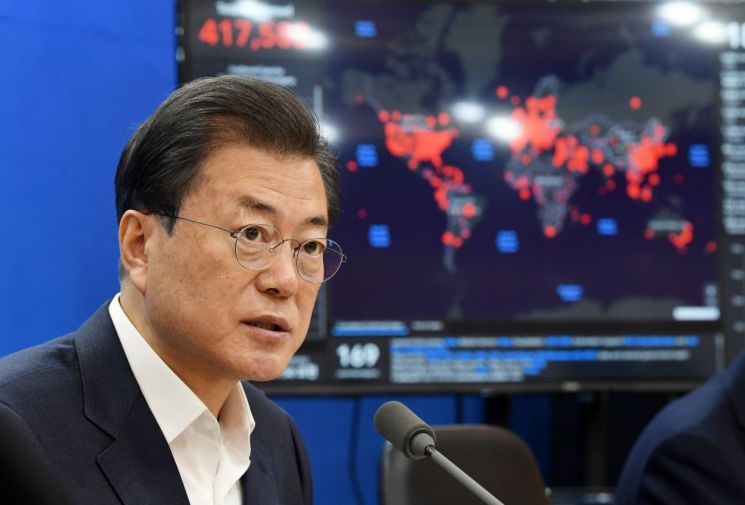
[Asia Economy Reporters Kim Hyun-jung (Sejong), Son Sun-hee, Jang Se-hee] The government has outlined support measures for livelihoods affected by the spread of the novel coronavirus infection (COVID-19), including a substantial reduction in health, employment, and industrial accident insurance premiums excluding the National Pension, and selective disaster basic income payments based on income levels. The related details are expected to be announced at the third emergency economic meeting scheduled for the 30th, following an agreement between the ruling party and the government.
According to government departments on the 27th, the Ministry of Economy and Finance held a closed-door meeting the previous day with officials from the Ministry of Employment and Labor, the Ministry of Health and Welfare, and other related agencies to discuss the reduction of the four major insurance premiums and their effects. At the meeting, participants agreed to temporarily reduce by half the insurance premiums for the bottom 50% of subscribers based on payment criteria for health, employment, and industrial accident insurance for three months to support low-income groups, while excluding the National Pension from the reduction. A government official explained, "We conducted an in-depth review of the reduction of the four major insurance premiums and their effects, and after final discussions, the outline will become clear next week."
The National Pension was also initially considered for reduction, but was ultimately excluded due to concerns over the potential decrease in pension amounts, which serve as a social safety net, and the high risk of depletion. According to the '2019-2060 National Pension Financial Outlook Report' published by the National Assembly Budget Office, the National Pension fund is expected to increase to 1,430 trillion won by 2039, then begin to decrease, and be depleted by 2054.
Regarding the disaster basic income, which has been a subject of ongoing controversy, there was consensus to exclude universal payments and instead provide selective payments based on income levels. This is the so-called Park Won-soon model. However, unlike Seoul City's approach targeting households with median income at or below 100%, the likely plan is to support around 500,000 won for the bottom 70-80% income bracket, with ongoing discussions to narrow differences regarding the amount and target recipients.
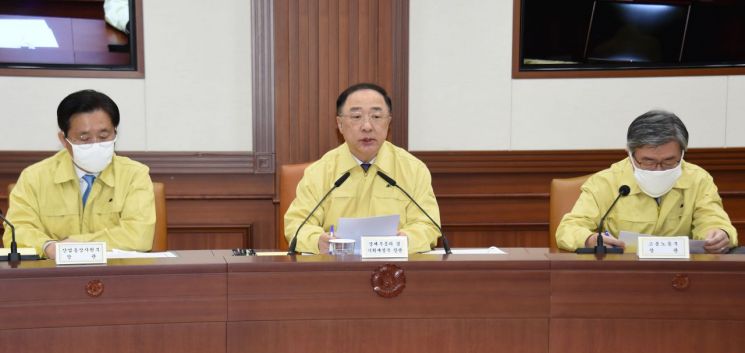
Initially, Deputy Prime Minister and Minister of Economy and Finance Hong Nam-ki repeatedly expressed a negative stance on the payment of disaster basic income due to concerns over fiscal soundness deterioration, but it is reported that he coordinated with the Blue House on the necessity arising from the spread of COVID-19. Recently, Ando-geol, Director General of Budget Review at the Ministry of Economy and Finance, appeared on a morning news program and said, "Disaster basic income is gaining persuasiveness," but also mentioned, "It is premature to give it to all citizens." Local governments such as Daegu, Gyeongbuk, as well as Chungbuk, Pohang in Gyeongbuk, and Incheon have also chosen selective support models and begun payments.
Some critics argue that discussions on disaster basic income have become politicized ahead of next month's general elections. Since trillions of won in budget are required and it is difficult to pay from existing budget reallocations or contingency funds, the second supplementary budget bill and its passage through the National Assembly are inevitable. The last extraordinary session of the National Assembly during this term is scheduled for May. There is controversy over the possibility that an agreement on disaster basic income will be announced before the election, but actual payments will be implemented after the election.
The government currently expects that the spread of COVID-19 will subside within the first half of the year, allowing the overall economy to enter a recovery phase. Considering this premise, payment in May is somewhat late in terms of timing. Lee Sang-min, Senior Research Fellow at the Nara Salrim Research Institute, explained, "Large-scale budgets inevitably become politicized," adding, "In the process of preparing a new budget, there is a possibility that the framework of selective support will be chosen over universal support, which is likely to face strong opposition due to inefficiency."
© The Asia Business Daily(www.asiae.co.kr). All rights reserved.
![User Who Sold Erroneously Deposited Bitcoins to Repay Debt and Fund Entertainment... What Did the Supreme Court Decide in 2021? [Legal Issue Check]](https://cwcontent.asiae.co.kr/asiaresize/183/2026020910431234020_1770601391.png)

















