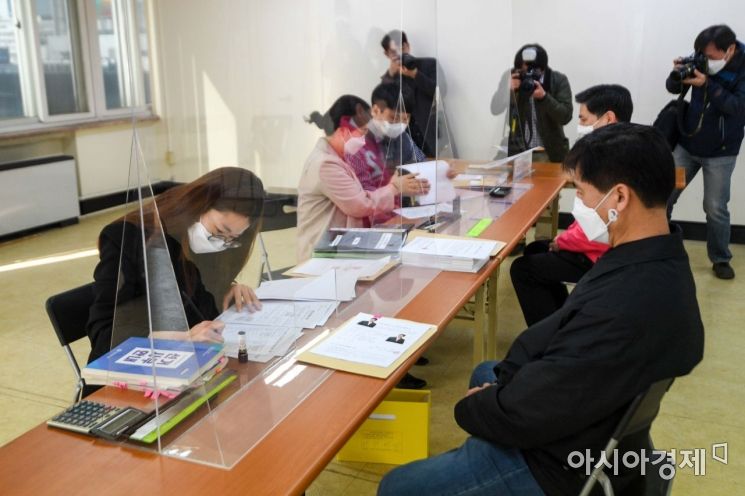
 On the 26th, about 20 days before the 21st National Assembly election, candidates running for the general election are registering at the Jongno District Election Commission in Seoul. Photo by Kang Jin-hyung aymsdream@
[Asia Economy Reporter Park Cheol-eung] Looking at those who registered as candidates on the first day of registration for the 21st general election, the average age is 55, and one out of three has a criminal record. In addition to backgrounds such as democratization movements, there are also a considerable number of criminal records related to violence and drunk driving. While many are politicians and lawyers, unique professions such as monks, Seodang teachers, and YouTubers also stand out.
According to the National Election Commission on the 27th, among the 906 candidates registered the previous day, 81% were male, and the average age was 54.7 years, which is 1.7 years higher than the general election four years ago.
Cha Dong-ik, a candidate from the National Revolutionary Dividend Party registered in the Seoul Nowon district, is the oldest at 80 years old. On the other hand, the youngest candidate is Shin Min-ju from the Basic Income Party, running in Seoul Eunpyeong at 25 years old.
By party, the Democratic Party had the most candidates with 233, followed by the United Future Party with 203. The National Revolutionary Dividend Party, led by Heo Kyung-young, also reached 190 candidates.
By occupation, politicians including members of the National Assembly accounted for the largest share at 61.7%. This is largely due to many incumbent lawmakers running again. For example, Lee Nak-yeon, the Democratic Party candidate running in Jongno, listed his occupation as "party member," and Hwang Kyo-ahn, the United Future Party candidate, recorded his occupation as "United Future Party leader."
Outside of politicians, lawyers were the most numerous with 52, followed by educators such as professors and lecturers (46), medical professionals including doctors and pharmacists (22), self-employed individuals (21), and company employees (12).
The occupations of candidates from the National Revolutionary Dividend Party are the most distinctive. Shin Hyo-ju, a candidate in Andong-Yecheon, Gyeongbuk, is a religious figure (monk), and Lee Seung-yul, running in Miryang-Uiryeong-Haman-Changnyeong, Gyeongnam, is a fortune-telling consultant. Han Ki-seon, a candidate in Gwangju Dong-Nam-gu Gap, is a form carpenter, and Jeong Sang-gyun, running in Wonju Gap, Gangwon, is a security guard. Other occupations include village bus driver, convenience store manager, and Seodang teacher. Hong Seok-jun, a candidate in Siheung Gap, Gyeonggi, even listed his occupation as YouTube creator. Graduate student candidates include Jang Hyung-jin from the Justice Party running in Namyangju Byeong, Gyeonggi, and Nam Dong-ho from the Minjung Party running in Suwon Jeong, Gyeonggi.
Seo Jung-hyun, an independent candidate running in Daegu Seo-gu, holds the record for the most runs with 14 previous candidacies in public office elections. Baek Cheol, an independent candidate registered in Gangseo Gap, Seoul, is running for the 12th time, and four candidates?Ahn Sang-soo of the United Future Party (Incheon Dong-gu-Michuhol-gu Eul), Kim Mi-hee of the Minjung Party (Seongnam Jungwon, Gyeonggi), Jeong Dong-young of the Minsheng Party (Jeonju Byeong), and Kim Doo-kwan of the Democratic Party (Yangsan Eul, Gyeongnam)?are running for the 10th time. The districts with the most candidates registered are Jongno in Seoul, Buk-gu in Ulsan, and Bundang Eul in Seongnam, Gyeonggi, each with seven candidates.
It was found that 36.5% of candidates have a criminal record. By party, the Democratic Party had the most with 92, followed by the National Revolutionary Dividend Party with 66, and the United Future Party with 52. Among the 67 candidates registered from the Justice Party, 34 have criminal records.
Most of the criminal records among candidates from the Democratic Party and Justice Party are related to violations of the National Security Act and laws concerning assemblies and demonstrations during democratization or labor movements.
These include Hong Young-pyo, who has three criminal records, and candidates Woo Sang-ho, Jeong Cheong-rae, and Song Young-gil with two records each. From the Justice Party, candidates Sim Sang-jung (two records) and Yoon So-ha (one record) also have criminal records. Lee Sang-ho, who has seven criminal records, was pardoned and reinstated but has two cases each of drunk driving and violations of the Public Official Election Act, as well as a special public official obstruction injury case.
Kim Seong-gi, a candidate from the National Revolutionary Dividend Party running in Busan Seo and Dong-gu, has one murder conviction, and Lee Kwang-hwi, from the same party running in Gunwi-Uiseong-Cheongsong-Yeongdeok, Gyeongbuk, has one conviction for injury to a family member. Candidate Noh Kyung-hwi has nine criminal records, including violence, drunk driving, and violations of laws preventing prostitution.
Candidate registration closes at 6 p.m. on the 27th, and the Election Commission will determine the district and party ballot numbers based on the number of seats per party.
© The Asia Business Daily(www.asiae.co.kr). All rights reserved.
![User Who Sold Erroneously Deposited Bitcoins to Repay Debt and Fund Entertainment... What Did the Supreme Court Decide in 2021? [Legal Issue Check]](https://cwcontent.asiae.co.kr/asiaresize/183/2026020910431234020_1770601391.png)
















