[Nam Dohyun, Military Columnist] If you think about it, the period immediately after the 1.4 Retreat was a time when both sides overestimated each other due to a lack of proper understanding. Our forces, caught off guard by the unfamiliar tactics of the Chinese Communist Forces (CCF), which combined night mountain warfare with advanced psychological warfare, were excessively fearful. Therefore, after abandoning Pyongyang, they essentially fled without engaging in proper combat. That is why when the CCF appeared again, they were ready to abandon even the 37th parallel without hesitation.
However, when the US forces rapidly retreated north of the 38th parallel and even gave up Seoul without hesitation, the CCF actually hesitated after crossing the Han River. Having passed the point of offensive exhaustion, the CCF had not received proper supplies since their entry into the war, making further southward advancement difficult due to lack of strength. Moreover, knowing the strong firepower of the US forces, they suspected they might be walking into a trap.
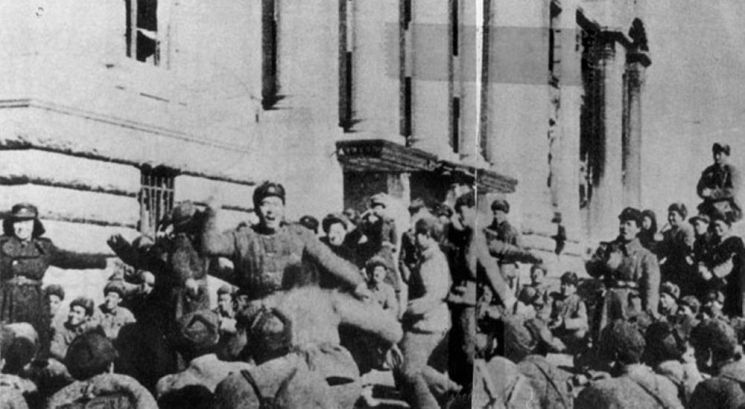 Photo of communist soldiers enjoying themselves in front of the Central Government Building after occupying Seoul. Although supplies were depleted and further advancement was difficult, if they had launched one more offensive at this time, the war might have ended.
Although the CCF held the initiative, they had no information about the US forces’ situation. Instead, they only remembered the nightmare during the December evacuation of Hungnam, when the UN forces were surrounded in the Hungnam area but could not advance even a single step due to being blocked by barrages. Commander-in-Chief Peng Dehuai (彭德懷) was unaware of the golden opportunity that could have ended the war if, after occupying Seoul, the CCF had simply shown their presence without pursuing further, as the CCF was immobile at that time.
It was precisely at such a moment that Operation Wolfhound became a decisive turning point, allowing the UN forces to clearly identify the weaknesses of the CCF and gain confidence that they could fight effectively. The CCF’s tactics, which had pushed our forces with unprecedented methods since their entry, turned out not to be mysterious but merely unfamiliar, and it was also realized that they had a critical weakness in logistics. In other words, the defeat was not because the CCF was strong, but because they were unknown.
This newfound confidence immediately bore fruit, and by the end of January, the UN forces were able to gradually defeat the exhausted CCF and create a foothold to push the front line back near the Han River. Consequently, the Washington authorities, who had already accepted the abandonment of the Korean Peninsula as a fait accompli, reconsidered the situation. Miraculously, the Republic of Korea was able to survive again. If General Ridgway had known Washington’s resolve, he might not have planned Operation Wolfhound.
Thus, after the chaotic start to January 1951, when Seoul was lost and the coldest and bleakest days began, our forces began to see a glimmer of hope. However, there was not enough time for this confidence from the command to fully spread to the frontline soldiers. The sound of the CCF’s flutes and gongs echoing at midnight still unsettled them, and the nightmare of being helplessly defeated on North Korean soil remained vivid in their minds.
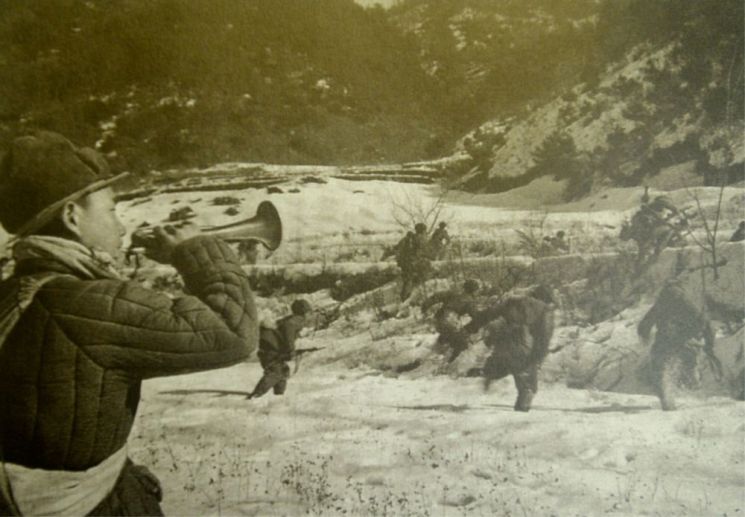 The Chinese People's Volunteer Army excelled at night attacks using difficult terrain and was also skilled in psychological warfare. The reason our forces faced considerable difficulties in the early stages of the Chinese intervention was because this approach was unfamiliar.
Operation Wolfhound became an opportunity for reversal, but it was not like the Inchon Landing in September of the previous year, which instantly reversed the tide of war and allowed our forces to advance beyond the 38th parallel. As evidenced by the fact that Seoul was still occupied by communist forces, overall, our forces were still at a disadvantage. However, the UN forces gained confidence that they could adequately confront the enemy, and Ridgway needed to amplify this momentum.
Therefore, even if not a full-scale offensive, a visible victory to regain control of the battlefield was required. Ridgway turned his attention to the central front, where it was easier to find a breakthrough than the western front, where both sides were facing each other across the natural boundary of the Han River. He judged that if the CCF gathered around the Hongcheon area in the center of the front could be annihilated, it would boost our forces’ morale and create a favorable situation for the recapture of Seoul.
© The Asia Business Daily(www.asiae.co.kr). All rights reserved.


















