Gwacheon Jeonse Prices Drop 0.59% This Week with Significant Decline
'Strong Stability' in Gangnam Breaks Synchronization
Large Complex Move-ins and Policy Changes Are Causes
Market Contraction Due to COVID-19 Also Plays a Role
[Asia Economy Reporter Lee Chun-hee] The real estate market in Gwacheon, known as the "Gangnam of Gyeonggi Province," is showing unusual signs. Recently, both sale and jeonse prices have fallen simultaneously, causing the market to shrink rapidly. The usual correlation with the soaring jeonse prices in Seoul's Gangnam area is breaking down, drawing attention to the underlying reasons.
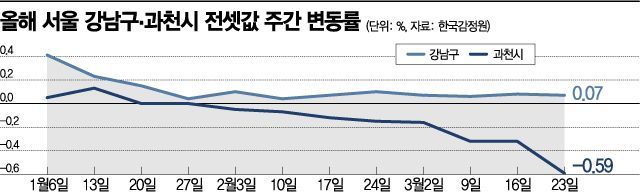
According to the weekly apartment price index by the Korea Real Estate Board on the 27th, jeonse prices in Gwacheon have declined for eight consecutive weeks. In particular, the survey for this week (as of the 23rd) showed a 0.59% drop, expanding the decline compared to the second (-0.32%) and third (-0.32%) weeks of this month.
Due to the impact of the novel coronavirus disease (COVID-19) and the December 16 real estate measures last year, high-priced residential areas such as the Gangnam 3 districts and Gwacheon apartments have both experienced a downward trend in sale prices. According to the Korea Real Estate Board's weekly apartment price index, sale prices in both the Gangnam 3 districts and Gwacheon have fallen for 10 consecutive weeks since January 20.
However, the jeonse market shows a completely different pattern. While jeonse prices in the Gangnam 3 districts have maintained a slight upward trend and remained firm during the same period, Gwacheon's jeonse prices have struggled to recover since March 3 last month. Generally, when sale demand weakens, jeonse demand tends to increase, pushing up jeonse prices, making this situation unusual.
Experts and frontline real estate agencies cite the main reasons for the simultaneous decline in sale and jeonse prices in Gwacheon apartments as ▲ large-scale complex move-ins ▲ government policy changes ▲ and the spread of COVID-19.
The Korea Real Estate Board analyzed the Gwacheon jeonse market, stating that "the decline continued due to the impact of new move-in volumes." This year, Gwacheon is scheduled to have move-ins in three complexes totaling 2,988 households. 'Gwacheon Prugio Summit' (1,571 households) in Jungang-dong and 'Gwacheon Centreville' (100 households) in Galhyeon-dong are scheduled for move-in next month. This is the first move-in in over two years since 'Raemian Central Suite' in Byeolyang-dong in July 2018. In December, 'Gwacheon Central Park Prugio Summit' (1,317 households) will be completed.
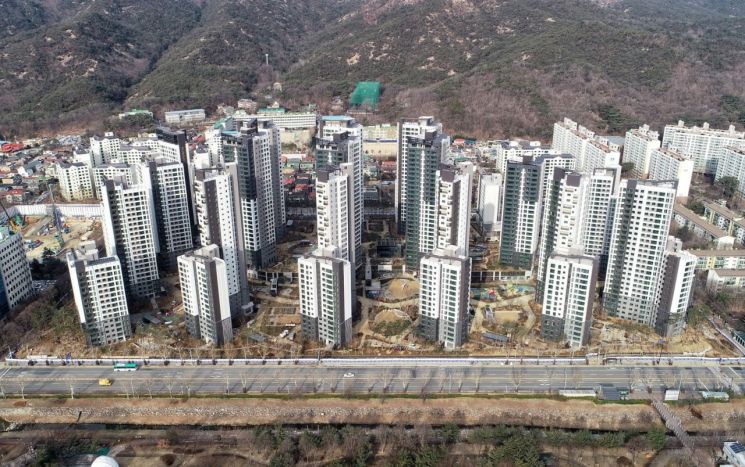 ▲ Construction site of 'Gwacheon Prugio Summit' in Gwacheon-si, Gyeonggi-do (Provided by Daewoo E&C)
The reason why move-in volumes of less than 2,000 households shake the Gwacheon jeonse market is that the market size itself is small. According to the Ministry of the Interior and Safety's 'Resident Registration Population and Household Status,' as of February, Gwacheon City's total resident population is 57,377, and the number of resident households is 20,859. The 1,671 households moving in next month account for about 8.0% of the total households.
This contrasts with Yangcheon-gu, where jeonse prices fell last week by 0.04%, the only district among Seoul's 25 autonomous districts to experience a decline, due to the move-in of the 3,045-household 'Mokdong Central I-Park We’ve' starting on the 31st. The move-in volume of Mokdong Central I-Park We’ve accounts for only 1.8% of Yangcheon-gu's total 173,405 resident households.
On the ground, there is an analysis that government policy changes have also influenced the decline in jeonse prices. The partial amendment to the 'Housing Supply Regulations,' which extends the required local residence period for first-priority subscription in speculative overheated zones or large-scale land development districts in the metropolitan area from one year to two years, is about to be implemented. This is seen as a correction following the external influx that influenced the rise in Gwacheon's jeonse prices last year, driven by the sale of the Gwacheon Knowledge Information Town. Byeolyang-dong B Real Estate Agency's representative said, "The extension of the residence period, which many thought would never happen, is becoming a reality, and jeonse inquiries are somewhat decreasing."
The impact of COVID-19 also plays a role. Ham Young-jin, head of Zigbang Big Data Lab, analyzed, "Along with large-scale complex move-ins and the government's extension of the residence period, the reduction in jeonse demand in Gwacheon has been compounded by the market contraction due to COVID-19." He added, "Normally, when sales weaken, jeonse prices should rise, but the combined effects of low interest rates and a decrease in newlyweds due to COVID-19 are pulling down jeonse prices in Gwacheon."
© The Asia Business Daily(www.asiae.co.kr). All rights reserved.


















