
[Asia Economy Reporters Hyewon Kim and Soyeon Park] As the global demand contraction caused by the novel coronavirus infection (COVID-19) pandemic spreads across all industries, Korean companies have pulled out the 'production cut' card. After sales channels were blocked not only in their main market China but also in the US and Europe, they have voluntarily responded with production cuts to control inventory levels.
Several Samsung Electronics officials said on the 26th, "The biggest management challenge ahead in the COVID-19 situation is that the whole world is facing a 'demand cliff,'" adding, "There is no other option but production cuts when demand shrinks due to the global economic slowdown." Samsung Electronics has stopped operations at 5 production lines producing TVs and smartphones out of its 18 overseas factories. Samsung Electronics is flexibly managing inventory by monitoring production and sales volumes at domestic and overseas production bases in real time. LG Electronics, although having fewer factory shutdowns compared to other companies, has shifted to a strategy of reducing production volume as overseas product sales have noticeably declined since this month.
The automotive industry, which has been hit directly by COVID-19 among manufacturing sectors, has also started adjusting production volumes. In particular, the automotive industry is causing a chain impact on companies supplying about 30,000 materials and parts needed to produce one vehicle. Hyundai Kia Motors is adjusting factory operating rates around 30% due to the rapid collapse of its domestic sales network in China. A local official said, "We have planned production at about 30,000 units per month in April," adding, "We will artificially adjust production volumes between 30,000 and 40,000 units throughout the first half of this year." If production and sales slumps continue in the second half of this year, there is a possibility that the annual production system of 600,000 units in China could collapse. On the same day, the Korea Institute for International Economic Policy forecasted that the production and consumption shocks caused by COVID-19 would be greater than those during the 2008 financial crisis and expected that it would take more time for China's production volume to recover to pre-COVID-19 levels.
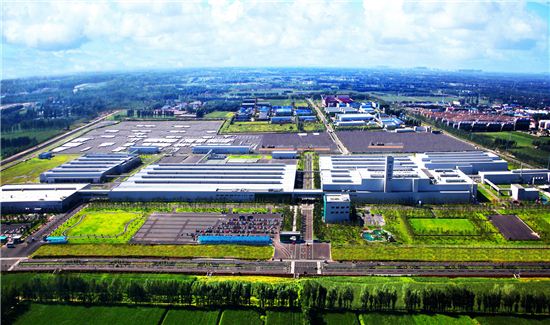 Beijing Hyundai 3rd Plant Overview
Hanwha Solutions' Advanced Materials division, which supplies lightweight materials to Hyundai Kia Motors, is also adjusting factory operating rates at its US and European subsidiaries. Its Chinese factory has stopped some lines due to weak demand. A Hyosung official said, "We are checking global demand in real time and lowering operating rates at some factories."
POSCO expects a clear decline in global steel demand starting from the second quarter, including automotive steel sheets. Overseas factories have been forced to cut production as they shut down one after another, but voluntary production cuts seem inevitable from April. Hyundai Steel has stopped operations at multiple lines due to shutdowns at Hyundai Kia Motors' overseas factories.
Refineries, which were the first to cut production before and after the COVID-19 outbreak, have lowered factory operating rates by as much as 10 to 15 percentage points and are reportedly considering additional cuts depending on market conditions. According to monthly petroleum supply and demand statistics from the Korea National Oil Corporation, the operating rate of domestic refineries' crude oil processing plants, which was about 86% in January this year, fell to 82.8% last month. The refining industry estimates that the operating rate dropped to the 70% range this month.
Semiconductor factories, which suffer astronomical losses if they stop operations even for a day, are currently operating normally, but the world's top three semiconductor equipment manufacturers?US-based Lam Research and AMAT, and Dutch ASML?are experiencing production disruptions, so the situation is being closely monitored. Ki-hyun Ahn, Executive Director of the Korea Semiconductor Industry Association, said, "The problem is supply risk," adding, "There are still concerns about shutdowns, so semiconductor companies are under considerable tension."
© The Asia Business Daily(www.asiae.co.kr). All rights reserved.

















