Self-Employed Businesses Collapsed Due to Social Distancing
University Districts Lost Various Gatherings and Events
Sales Down 90%, Leading to Closures
Cafes Near Schools Desperately Await Reopening
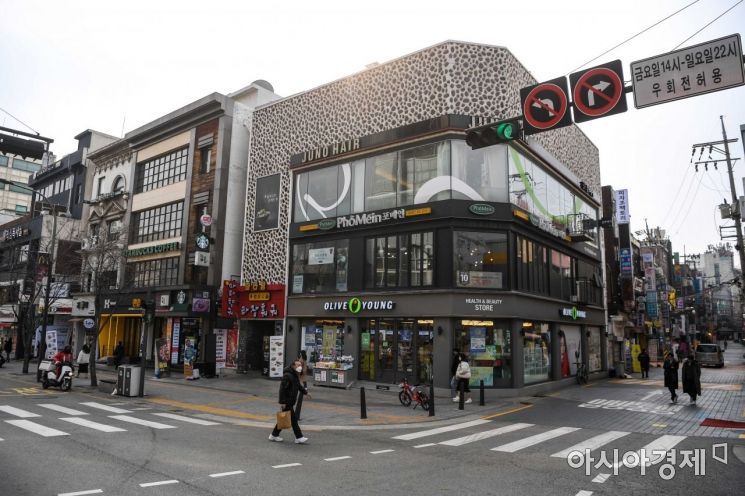 As the start of the school year for elementary, middle, and high schools nationwide, as well as university semesters, has been postponed to prevent the spread of the novel coronavirus infection, Yonsei-ro in Seodaemun-gu, Seoul, appeared quiet on the 4th. Photo by Jinhyung Kang aymsdream@
[Asia Economy Reporter Seungjin Lee] As the government continues to emphasize strict 'social distancing' measures until April 5, before the start of elementary, middle, and high schools, self-employed business owners are wearing worried expressions, saying, "We are concerned whether we can survive this week." Especially in special commercial districts like university areas with fixed customers, many stores have posted indefinite closure notices or remain empty with only their signs left. The backbone of the common people's economy, self-employment, was already collapsing.
On the afternoon of the 25th, we visited self-employed business owners near Kyung Hee University in Dongdaemun-gu, Seoul. Due to rumors that "many students have returned from China," it was difficult to find people walking around near the university area. Normally, the streets would be bustling with students, but nearby universities postponed the start of the semester by a week and implemented online lectures as part of social distancing, causing student foot traffic to drop sharply. Kang (37), who runs a pub nearby, sighed deeply and said, "The university decided to extend online lectures until April 12, but I have no confidence that I can survive until then."
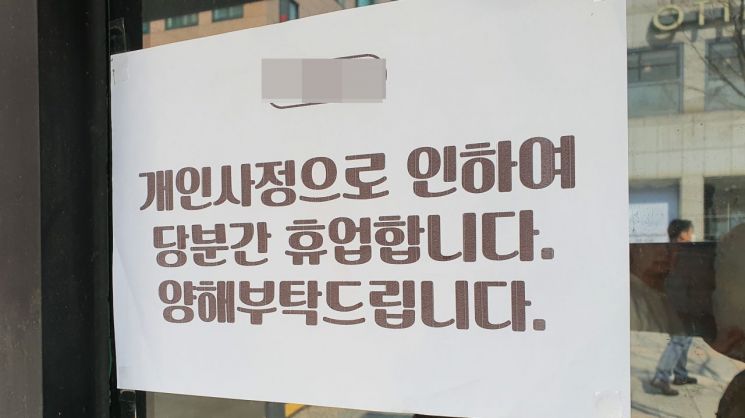 On the 25th, a notice informing of a temporary closure was posted at the entrance of a cafe in Seongdong-gu, Seoul.
In university commercial districts, sales that sharply declined during the vacation period are supposed to be compensated by the 'semester opening boom' in March and April, but all such opportunities have disappeared. Pubs are hit even harder as various gatherings and events that usually take place at the beginning of the semester have vanished. As a result, some pubs have shortened their nighttime operating hours and started lunch services. An employee at a hof (Korean pub) said, "We started lunch service last month trying to survive somehow, but since there are no students, sales remain the same," adding, "I come to work every day, but I am worried whether I will receive my salary this month."
General restaurants are facing similarly difficult situations. It was easy to find shops posting notices saying "Closed temporarily due to COVID-19." Some stores had only a paper sign saying "For Rent" under signs that looked recently hung. These were places that were operating normally just a couple of months ago, but overlapping effects of the vacation and COVID-19 caused sales to plummet by 90%, and they ultimately could not hold on.
A neighboring shop owner sitting alone in an empty hall explained, "Some places are closing to reduce employee wages even if they have to forgo rent, and many shops that opened recently have completely shut down," adding, "In my case, rent is a significant portion of expenses, so I come alone to work, but sales have been almost nonexistent for two months."
Although food delivery services have increased somewhat since the COVID-19 outbreak, many places still find it difficult. Ha Mo (38), who runs a noodle shop, recently considered introducing delivery services but ultimately gave up. Ha said, "After calculating the agency fees and the cost of purchasing various containers, the additional burden was too great, so I postponed it for now," adding, "I will monitor the situation and consider delivery if things do not improve in April."
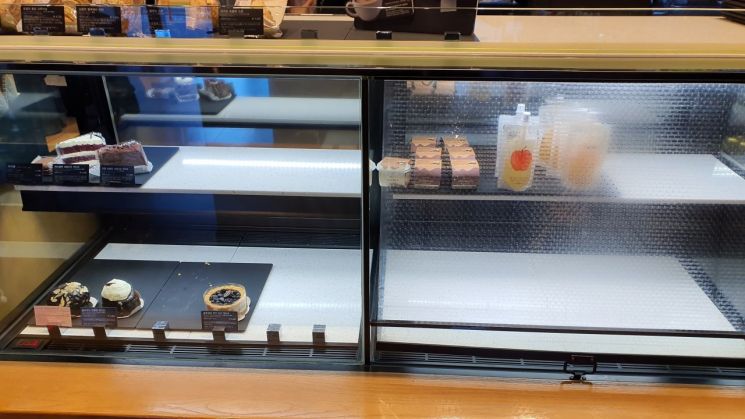 On the 17th, a display at a Starbucks store in Dongdaemun-gu, Seoul. Sales plummeted as the nearby school's opening was postponed, leading to a reduction in order volume by more than 50%.
Commercial districts around elementary schools, so-called 'Haksegwon' (school zone) areas, have also been severely depressed as the school opening was postponed to April 6. Among them, small cafes are in crisis as the demand from parents, which accounted for most of their sales, has disappeared.
Jeon Mo (43), who runs a cafe in front of an elementary school in Seongdong-gu, said, "Every morning, parents gather at the cafe after sending their children to school, and that sales were significant," adding, "There are talks that online classes may continue for a while after school starts, and I am feeling hopeless and looking into loans." The Ministry of Education previously stated that schools might open differently by region, either with in-person or online classes.
School-front cafes have shaken not only small self-employed business owners but also Starbucks, the number one domestic brand. In one Starbucks store occupying the first to third floors of a building, the third floor was completely darkened. Some stores near schools where the semester or school opening was postponed saw customer numbers drop by more than half, leading to order volumes being cut by over 50%. As a result, some store shelves appeared completely empty without displayed products. Regarding this, a Starbucks representative explained, "We plan to increase order volumes if customer numbers rise as we monitor the situation."
© The Asia Business Daily(www.asiae.co.kr). All rights reserved.
![User Who Sold Erroneously Deposited Bitcoins to Repay Debt and Fund Entertainment... What Did the Supreme Court Decide in 2021? [Legal Issue Check]](https://cwcontent.asiae.co.kr/asiaresize/183/2026020910431234020_1770601391.png)

















