Seoul Apartment Price Increase Rate 0%
Gangnam Decline Continues... Purchase Inquiries Down
Gyeonggi-do Including Suwon Sees Reduced Increase
Incheon, Sejong, Daejeon Also Sluggish
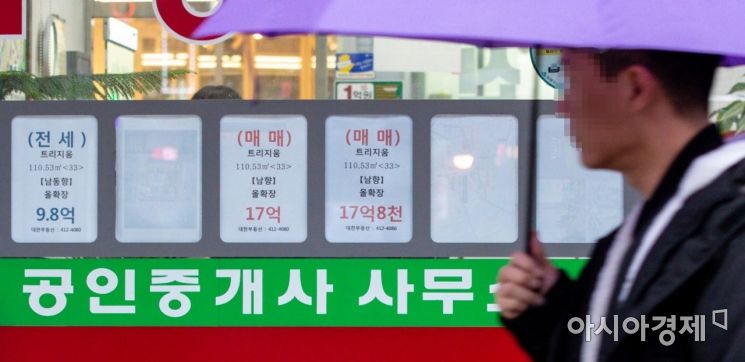 A price list is posted at a real estate agency office in Songpa-gu, Seoul. Photo by Kang Jin-hyung aymsdream@
[Asia Economy Reporter Moon Jiwon] Amid the ongoing economic downturn caused by the spread of the novel coronavirus infection (COVID-19), apartment prices in Seoul remained flat for the second consecutive week. Apartment prices in the Gangnam area, hit by negative factors such as the 'property tax bomb' and loan regulations, saw a larger decline than the previous week, while the rate of increase in Gyeonggi Province and Sejong also narrowed.
According to the Korea Real Estate Board's "Weekly Apartment Price Trend for the 4th Week of March 2020" data on the 26th, as of the 23rd, the apartment price increase rate in Seoul remained at 0%, the same as the previous week.
The Korea Real Estate Board analyzed, "Due to the domestic and international economic crisis caused by the impact of COVID-19, the increase in publicly announced prices, and strengthened proof of funding sources, buying sentiment has weakened, and the decline has expanded mainly in high-priced housing with increased property tax burdens."
The three Gangnam districts?Gangnam (-0.14%), Seocho (-0.14%), and Songpa (-0.10%)?also saw a continued decline mainly in complexes priced over 1.5 billion KRW due to loan regulations and increased property tax burdens from rising publicly announced prices, with the rate of decline increasing compared to the previous week. In the Gangnam area, the number of urgent sale listings has increased and buyer inquiries have decreased, leading to an analysis that housing prices will continue to fall for the time being.
Gangdong District (0.00%), which rose 0.01% last week, showed mixed trends by price range and turned flat. Outside the Gangnam 4 districts, stability generally continued south of the Han River, with Geumcheon District (0.04%) rising mainly in areas near subway stations and new buildings, and Gwanak District (0.04%) rising mainly in Bongcheon and Sillim-dong areas.
All 14 districts in northern Seoul, including Mapo (0.03%), Yongsan (0.01%), and Seongdong (0.00%), either saw a slowdown or maintenance of their upward trends. Nowon (0.05%), Dobong (0.06%), and Gangbuk (0.06%), which have many mid- to low-priced apartment complexes and development prospects and had shown relatively high growth rates, also saw a reduction in their rate of increase.
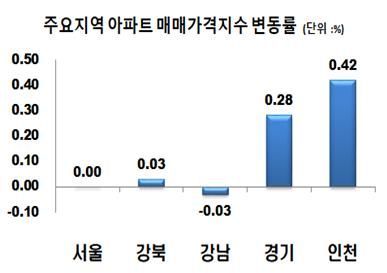
Incheon and Gyeonggi Province showed similar trends. In Incheon, the rate of increase narrowed to 0.42% from 0.53% the previous week. Michuhol District (0.51%) rose mainly in newly built and semi-new buildings in Yonghyeon and Hakik-dong, which have favorable living conditions, while Namdong District (0.49%) rose mainly in Ganseok, Guwol, and Nonhyeon-dong areas with expectations of transportation network expansion (GTX-B, 2nd Gyeongin Line, etc.) and progress in redevelopment projects.
Gyeonggi Province's rate of increase dropped sharply to 0.28% from 0.40% the previous week. Suwon City (0.25%), which had a high rate of increase due to the extension of the Shinbundang Line and its status as a non-regulated area, saw a significant decrease in buying sentiment due to strengthened regulations, the COVID-19 situation, and fatigue from rapid price rises, resulting in a large drop in the upward trend.
Uiwang City (0.38%) and Anyang City (0.33%), newly added to the adjustment target areas, either maintained or slightly reduced their rate of increase. Gunpo City (0.80%) saw price increases mainly in Sanbon and Geumjeong-dong due to transportation-related positive factors, but the increase narrowed. Osan City (0.96%) rose due to development prospects near Osan IC (Unamteul complex) and expectations for improved transportation conditions (Pilbong Tunnel).
Daejeon also rose only 0.37% compared to 0.46% the previous week. Dong District (0.66%) rose mainly in Yongjeon and Gayang-dong areas with expectations of attracting an innovation city, Yuseong District (0.36%) rose mainly in relatively undervalued areas such as Wonnae and Munji-dong. Seo District (0.33%) and Jung District (0.31%) rose mainly in older complexes affected by redevelopment projects, and Daedeok District (0.31%) rose mainly in Seokbong and Sintanjin-dong areas with good accessibility to Sejong City.
Sejong City saw a significant narrowing of its rate of increase to 0.27% from 1.00% the previous week. The Korea Real Estate Board explained, "Although the increase was mainly in relatively undervalued complexes within the Happy City, the rate of increase narrowed compared to the previous week due to a contraction in transaction activity caused by the spread of COVID-19 and fatigue from the price rise."
© The Asia Business Daily(www.asiae.co.kr). All rights reserved.
![User Who Sold Erroneously Deposited Bitcoins to Repay Debt and Fund Entertainment... What Did the Supreme Court Decide in 2021? [Legal Issue Check]](https://cwcontent.asiae.co.kr/asiaresize/183/2026020910431234020_1770601391.png)

















