Abuse by Internal Employees Reaches 84.3%
74.4% of Internal Employee Abuse by Middle Managers or Higher
'Downward Bullying' Also Significant... 4 out of 5 Cases Involve Lower-Level Interns and Contract Workers
"Job Insecurity Exploited, Lower-Level Employee Abuse More Frequent"
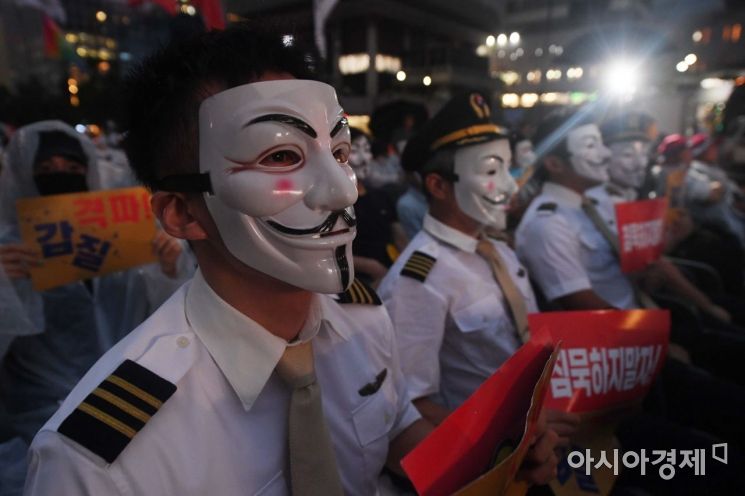
[Asia Economy Reporter Moon Chae-seok] Last year, two out of three public officials who were caught for power abuse or received disciplinary actions of 'reprimand' or higher were middle managers or above. The majority of the power abuse involved internal employees, mostly 'downward bullying' by middle managers or higher.
On the 26th, the Anti-Corruption and Civil Rights Commission (ACRC) announced this through an analysis of disciplinary actions against perpetrators of power abuse under the 'Code of Conduct for Public Officials' and efforts to eradicate power abuse across various public institutions.
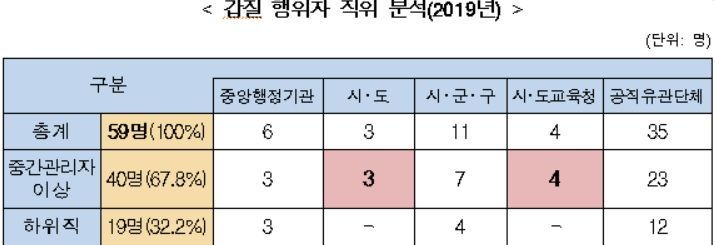
According to the analysis, 59 public officials were caught by the ACRC or received disciplinary actions of 'reprimand' or higher from various institutions last year for power abuse. Among them, 40 officials, accounting for 67.8%, were middle managers or higher.
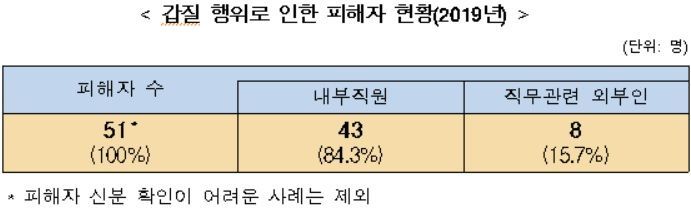
The fact that most perpetrators of power abuse were middle managers or higher is due to the high incidence of power abuse against internal employees. Among 51 cases where the victim's status could be identified, 43 cases (84.3%) involved power abuse against internal employees.
Among public officials who abused power against internal employees, 32 (74.4%) were middle managers or higher, about three times more than lower-ranking staff. Even interns and contract workers were victims, with 4 out of 5 internal employees in these categories experiencing power abuse from lower-ranking staff. The ACRC analyzed that lower-ranking staff tend to abuse power more frequently by exploiting the instability of employment conditions.
By affiliation, 35 out of 59 officials (59.3%) belonged to public-related organizations. Public officials from basic local governments accounted for 11 (18.6%), followed by 6 (10.2%) from central administrative agencies.
Disciplinary actions for power abuse across various institutions are becoming stricter. Cases of severe disciplinary actions outnumber those with minor disciplinary actions.
Among the 51 officials disciplined for power abuse, 29 (56.9%) received severe disciplinary actions such as suspension, demotion, or dismissal. Twenty-two officials (43.1%) received minor disciplinary actions such as reprimand or salary reduction.

The ACRC analyzed that the revision of the 'Code of Conduct for Public Officials' in December 2018, followed by government-wide amendments to the 'Enforcement Rules of the Public Officials Disciplinary Act' and the 'Disciplinary Rules for Local Public Officials,' has shown effects.
The explicit provision limiting the reduction of disciplinary measures for violations of the power abuse prohibition under the Code of Conduct was effective.
Frontline public institutions are also steadily making efforts to eradicate power abuse. Each institution has appointed a Code of Conduct Officer according to Article 23 of the 'Code of Conduct for Public Officials.' These officers provide education and counseling on the code of conduct and handle reports of violations.
Last year, Code of Conduct Officers at various public institutions conducted about 12,200 counseling sessions. Among these, 117 were related to power abuse.
Based on this analysis, the ACRC plans to encourage self-inspections of power abuse by institutions at all levels and reflect the inspection results in anti-corruption policy evaluations.
Additionally, to completely eradicate power abuse in the public sector, the ACRC intends to strengthen education and publicity regarding the Code of Conduct system.
They also plan to promote active reporting and ensure that perpetrators of power abuse are punished under a zero-tolerance policy.
Im Yoon-joo, Director of the Anti-Corruption Bureau at the ACRC, said, "The problem of power abuse in the public sector mostly arises from public officials uncritically continuing past wrongful practices. We will continue government-wide efforts to strengthen education and publicity to eradicate power abuse against public officials and citizens, and to eliminate embedded factors of power abuse in laws and systems."
© The Asia Business Daily(www.asiae.co.kr). All rights reserved.
!["The Woman Who Threw Herself into the Water Clutching a Stolen Dior Bag"...A Grotesque Success Story That Shakes the Korean Psyche [Slate]](https://cwcontent.asiae.co.kr/asiaresize/183/2026021902243444107_1771435474.jpg)


















