Kim Yong-beom, 1st Vice Minister of Economy and Finance, Holds Macroeconomic and Financial Meeting
Temporary Relaxation of Foreign Currency LCR Ratio
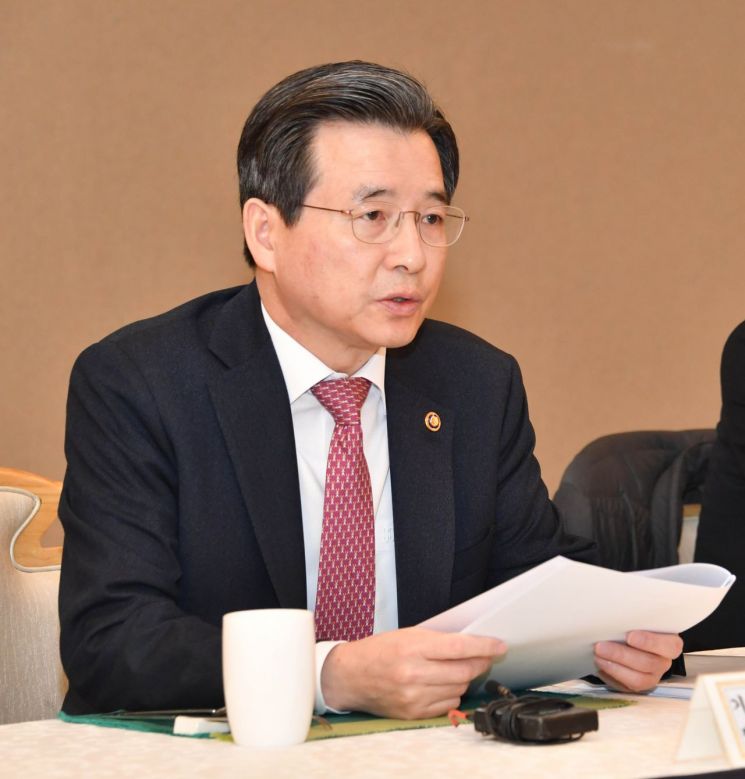
[Sejong=Asia Economy reporters Kim Hyunjung and Jang Sehee] The government will temporarily relax the foreign currency Liquidity Coverage Ratio (LCR) regulation for domestic banks to 70% for three months until the end of May. This measure aims to expand the capacity of financial institutions to supply foreign currency funds in response to the increased volatility in the global financial market caused by the novel coronavirus disease (COVID-19) outbreak.
On the 26th, Kim Yongbeom, the 1st Vice Minister of Strategy and Finance, announced this at the Macroeconomic and Financial Meeting held at the Bankers' Hall in Seoul. The LCR is the ratio of liquid assets that can be converted into cash within the next 30 days to the net foreign currency outflows during the same period. It is a soundness regulatory indicator that gauges whether a financial institution can overcome liquidity crises on its own. Lowering the regulatory ratio allows banks to supply foreign currency funds more smoothly to the market or companies.
The related regulation began to be applied in 2017. Since then, the standard for general banks has been raised by 10% annually: ▲60% in 2017 ▲70% in 2018 ▲80% in 2019. Now, it will be relaxed back to 70%. For example, if a bank has cash liabilities of 10 billion dollars to be paid within one month, it was required to hold liquid assets worth 8 billion dollars during the same period, but this will be lowered to 7 billion dollars.
Vice Minister Kim expressed concerns about the global economy amid the spread of COVID-19 and emphasized measures to ease the supply-demand imbalance in the domestic foreign currency fund market. He said, "Countries such as the United States and Europe are implementing strong movement restrictions, including stay-at-home orders, so the global economy will contract more than initially expected," adding, "We will continuously supply foreign currency liquidity to ease the supply-demand imbalance in the foreign currency fund market." He further explained, "We will also promptly and sufficiently provide liquidity directly to companies and financial institutions by utilizing the Korea-US currency swap funds and foreign exchange reserves."
The government also decided to exclude financial institutions from the foreign exchange soundness charge for the next three months. For the charges confirmed last year and scheduled for collection this year, payment deferrals will be allowed through expanded installment payments. The temporary exemption of the foreign currency soundness charge reduces the cost for financial institutions such as banks, securities firms, insurance companies, and card companies to borrow foreign currency.
Vice Minister Kim emphasized, "Efforts to stabilize the foreign exchange and foreign currency fund markets and supply foreign currency liquidity may temporarily reduce foreign exchange reserves," but added, "We have accumulated sufficient foreign exchange reserves, and with the strengthened external safety net through the Korea-US currency swap agreement, our external soundness will remain solid without change."
Additionally, Vice Minister Kim urged commercial banks to respond more actively and boldly. He said, "The establishment of a 1.07 trillion won Securities Market Stabilization Fund was a result of the government and financial industry joining forces with the determination to prevent the COVID-19 crisis from spreading to the entire financial system," and stressed, "Considering that banks are the backbone of the credit system, I hope commercial banks will respond actively and boldly to companies temporarily facing difficulties due to COVID-19."
© The Asia Business Daily(www.asiae.co.kr). All rights reserved.

















