Foreign Currency LCR Regulatory Ratio Raised Annually... 60% in 2017, 70% in 2018, 80% in 2019
[Asia Economy Reporter Jang Sehee] The government will announce this week a plan to temporarily exempt the foreign exchange soundness charge for financial companies to ease the cost of foreign currency borrowing and to temporarily ease the foreign currency Liquidity Coverage Ratio (LCR) regulation (currently 80%) burden to encourage banks to supply trade finance smoothly. The purpose is to expand the capacity of financial companies to supply foreign currency funds in response to the volatile global financial market caused by the COVID-19 pandemic.
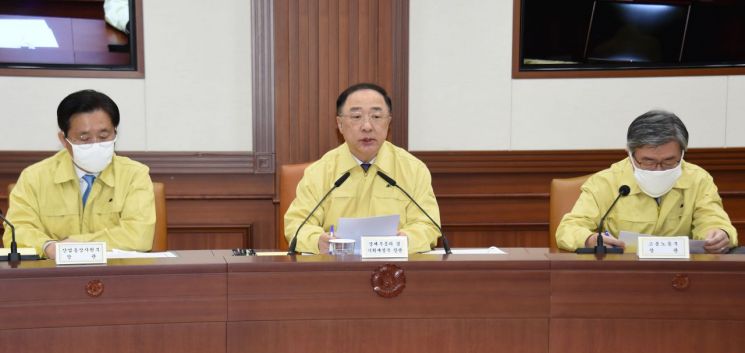
Hong Nam-ki, Deputy Prime Minister and Minister of Economy and Finance, announced this at the 2nd Crisis Management Meeting held on the 25th.
Deputy Prime Minister Hong said, "We will actively support the private sector's efforts to raise foreign currency by easing macroprudential regulatory measures in the foreign exchange sector introduced after the 2008 financial crisis." He explained, "Our current foreign exchange reserves and net external debt scale show a clearly different external soundness situation compared to past financial and foreign exchange crises. It is important for the government, banks, and companies to thoroughly prepare and take preemptive measures to avoid being shaken by domestic and international market volatility while restraining excessive anxiety and overreaction."
He continued, "The government will monitor the domestic foreign currency liquidity situation daily and proactively establish a multi-layered foreign currency liquidity supply system to ensure that companies and financial institutions do not face difficulties in securing foreign currency liquidity, implementing it in a timely manner."
First, to facilitate foreign currency procurement by the private sector, the government will temporarily exempt the foreign exchange soundness charge imposed on financial companies. The foreign exchange soundness charge is a system introduced in August 2011, where the government imposes a certain rate of charge on non-deposit foreign currency liabilities held by financial institutions. The charge is calculated by multiplying 10 basis points by the non-deposit foreign currency liabilities with a remaining maturity of one year or less.
The temporary exemption of the foreign exchange soundness charge will reduce the cost for financial institutions to borrow foreign currency. A Ministry of Economy and Finance official said, "Financial institutions will have reduced burdens from foreign currency borrowing and will be able to operate borrowed foreign currency at lower interest rates. Also, temporarily lowering the charge may create incentives to borrow more foreign currency."
To ensure smooth supply of trade finance by banks, the foreign currency LCR burden will also be temporarily eased. The foreign currency LCR is an indicator measuring the foreign exchange soundness of financial companies by the ratio of high-liquidity foreign currency assets to net foreign currency outflows over the next 30 days.
Lowering the foreign currency LCR regulatory ratio will enable banks to supply foreign currency funds more smoothly to the market or companies. Various methods are being discussed to temporarily ease the LCR burden, including lowering the regulation to the 60% range. The LCR regulation was applied in 2017. Since then, for general banks, it has been raised by 10% annually: ▲60% in 2017 ▲70% in 2018 ▲80% in 2019.
Due to global financial market instability and increased dollar demand, the domestic foreign exchange market is also showing signs of instability. Meanwhile, the exchange rate has fallen sharply for two consecutive days. In the Seoul foreign exchange market that day, the won-dollar exchange rate started at 1,235.7 won, down 13.9 won from the previous trading day (1,249.6 won).
© The Asia Business Daily(www.asiae.co.kr). All rights reserved.
![User Who Sold Erroneously Deposited Bitcoins to Repay Debt and Fund Entertainment... What Did the Supreme Court Decide in 2021? [Legal Issue Check]](https://cwcontent.asiae.co.kr/asiaresize/183/2026020910431234020_1770601391.png)
















