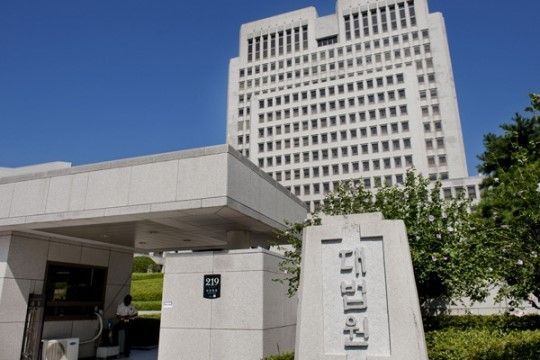
[Asia Economy Reporter Kim Hyung-min] The Supreme Court has ruled that if there are special circumstances preventing the state from properly exercising its tax claims, it may exceptionally file a lawsuit to prevent the expiration of the statute of limitations.
The Supreme Court's 3rd Division (Presiding Judge Min Yoo-sook) announced on the 25th that it upheld the lower court's ruling in favor of the plaintiff in the final appeal of a lawsuit filed by the government against Japanese company A, requesting confirmation of the existence of a tax claim.
The court stated, "Although the defendant (Company A) has assets abroad and none domestically, making seizure or other measures impossible, and despite efforts such as mutual agreements for collection delegation, corporate tax and surcharges could not be collected, and with the statute of limitations nearing completion, it is reasonable to consider that this lawsuit has exceptional legal interest to suspend the statute of limitations."
It continued, "The lower court's conclusion recognizing the legal interest of this lawsuit is appropriate. There is no error in misunderstanding the legal principles regarding the suspension of the statute of limitations for national tax collection rights."
Japanese corporation A transferred 32,000 shares to a Korean corporation located in South Korea during 2006-2007 and received 9.78 billion yen (approximately 110 billion KRW) as payment.
Following this, the Korean tax authorities conducted a tax audit on Company A, confirmed unpaid corporate taxes, and in March 2011, notified Company A to pay over 22.3 billion KRW in corporate taxes.
However, Company A refused to pay the corporate tax. In May 2011, it filed an appeal with the Tax Tribunal against the corporate tax imposition, but it was dismissed. Despite repeated demands, Company A did not pay the tax, and the statute of limitations for the government's tax claim (five years from the day after the payment deadline of March 31, 2011) was approaching. The government found it difficult to enforce collection as Company A had no assets in Korea. In urgency, the government finally filed a lawsuit.
Company A argued that "the Korean government's filing of a lawsuit does not constitute a reason to suspend the statute of limitations, and therefore the government has no legal interest in the lawsuit," claiming the lawsuit should be dismissed.
The key issue in the trial was whether "filing a lawsuit" can be recognized as a reason to suspend the statute of limitations for tax claims. Article 28 of Korea's Framework Act on National Taxes stipulates that the statute of limitations for tax claims can be suspended by "tax payment notices, demands, payment orders, delivery requests, or seizures" only. "Filing a lawsuit" is not included.
The first trial court ruled in favor of the government, stating that "'filing a lawsuit' can be recognized as a reason to suspend the statute of limitations for tax claims."
The appellate court also ruled, "Despite the government having appropriately taken all necessary collection measures such as sending demand letters after tax payment notices, proceeding with international tax administrative cooperation procedures, and sending payment orders, the tax claim has not been collected," and "In this case, it should be considered that there is an exceptional legal interest in the lawsuit." The Supreme Court affirmed this ruling without error.
© The Asia Business Daily(www.asiae.co.kr). All rights reserved.

















