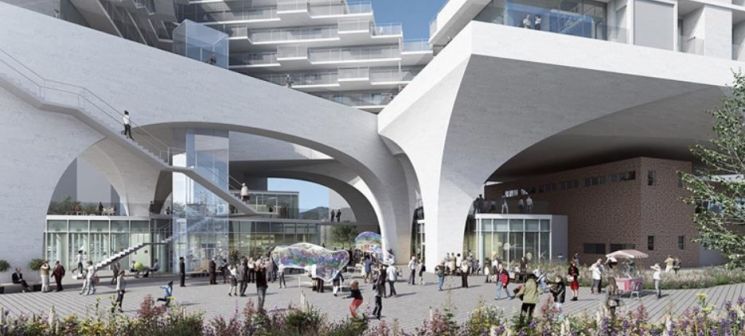
[Asia Economy Reporter Kim Yuri] The traffic island and rainwater pump station site, which had been left unused, will be redeveloped in the second half of this year into a 'Youth-tailored Compact City' that combines housing for university students and young people, youth support facilities, and living SOC.
On the 25th, Seoul City announced that it had approved the district plan and housing construction business plan for the 'Yeonhui·Jeungsan Public Housing Complex Facility' and finalized the project plan. With this, only the detailed design phase remains before construction begins. Seoul City plans to proceed with the project aiming for full-scale construction in the second half of this year and occupancy in the second half of 2022 after completing the detailed design.
The 'Yeonhui·Jeungsan Public Housing Complex Facility' consists of two sites: the idle traffic island site (4,887㎡) around Yeonhui-dong, where the Gyeongui Line Forest Trail ends, and the site (6,746㎡) including the upper part of the Jeungsan rainwater pump station in front of Digital Media City Station. This is one of the core pilot projects of the 'Reinventor Seoul' project, which was announced by Seoul City at the end of 2018 as one of the five major innovation plans for housing supply, aiming to innovate underutilized idle urban spaces and expand living SOC. These sites are located in station areas and near several universities, making them ideal locations to realize a compact city for university students. However, they were surrounded by roads, isolated from their surroundings, and inefficient in space utilization.
According to the finalized project plan, moving away from the traditional concept of household numbers, a total of 320 units (474 residents) of 'youth housing' such as shared housing and single-person housing will be established. Youth support facilities such as youth startup support spaces and youth restaurants, living SOC such as swimming pools, fitness centers, and libraries, and flood control facilities like rainwater pump stations will be developed in a three-dimensional and compact manner.
Seoul City and the project executor, Seoul Housing and Communities Corporation (SH Corporation), previously held the 'Yeonhui·Jeungsan Innovation Hub Design Competition' to prepare design proposals and selected winning entries. The design by architect Jominseok (Mass Studies Architectural Office) was selected for the Yeonhui district, and the design by architects Jin-oh Lee and Sejin Kim (SAAI Architectural Office, Schema) was selected for the Jeungsan district.
The Yeonhui Public Housing Complex Facility, which will be reborn as 'public housing on a traffic island,' will leverage its location as a pedestrian hub connecting the Gyeongui Line Forest Trail, Gajwa Station (Gyeongui-Jungang Line), and Hongjecheon Stream, where many young people pass through, to become a university student community housing combining student activity facilities and living SOC. With a total floor area of 14,378㎡ and seven stories above ground, it will accommodate 198 university students and include a startup support center, library, youth restaurant, market, rooftop garden, swimming pool, and exercise facilities arranged in a three-dimensional layout. A new rainwater pump station will be installed, and the disaster prevention facility will be utilized to create various floors that harmonize with the housing while offering views of Hongjecheon Stream.
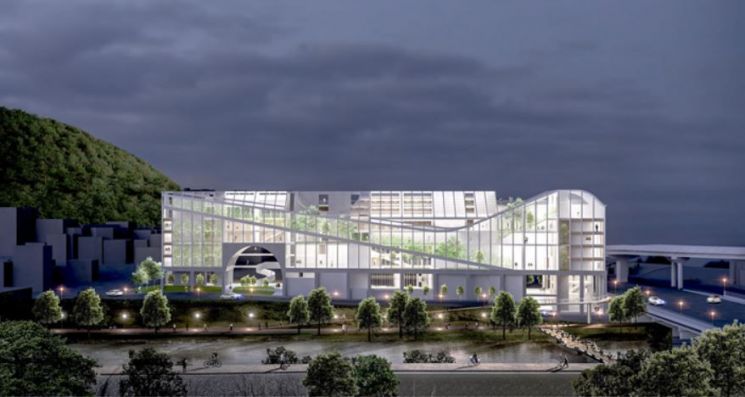
Living SOC for young people and shared housing will be organically connected across different areas, and various sizes of common spaces are planned. The existing bicycle path along Hongjecheon Stream will be extended, and cafes and restaurants will be placed on the first floor to serve as a 'bicycle hub.' To mitigate noise from the internal circulation road located in front of the building, residential spaces will be placed at the rear, while living SOC facilities such as indoor gardens, swimming pools, and fitness centers will be located at the front.
A new rainwater pump station will also be installed to discharge excellent runoff from Seodaemun-gu into Hongjecheon Stream. This aims to improve the drainage system in low-lying flood-prone areas such as Mapo-gu (Mangwon-dong, Yeonnam-dong) and Seodaemun-gu (Yeonhui-dong). Regarding concerns about noise, vibration, and odor from the rainwater pump station, expert advisory meetings held before the design competition concluded that countermeasures could be established. The city plans to develop optimal solutions through expert participation and consultation during the detailed design phase.
The Jeungsan Public Housing Complex Facility will be developed as university student housing with enhanced community facilities on the artificial ground above the existing Jeungsan rainwater pump station, adjacent to Digital Media City Station, which serves three railway lines: Line 6, Airport Railroad, and Gyeongui-Jungang Line. An artificial deck will be installed above the existing rainwater pump station to create a new floor, and a complex facility with a total floor area of 14,602㎡ and 13 stories above ground is planned. A total of 276 university students will be accommodated by combining 111 single-person housing units and 55 shared housing units. Shared housing combines private and shared spaces, allowing residents to selectively experience close relationships with peers and looser personal connections.
In addition to purely residential spaces, auxiliary welfare facilities such as a resident-use facility (Icon Hall), laundry room, shared kitchen, and seasonal storage, as well as living SOC facilities like an arts complex center, will be included. The arts complex center will provide spaces for exhibitions, experiences, and small-scale performances on various themes. The residential spaces are planned to face the direction of Bulgwangcheon Stream and southward to maximize natural light and views, and terrace-style housing will be arranged in a stepped manner so that terraces can be used as shared spaces such as rooftop gardens.
Although not included in this project plan, improvements to the pedestrian environment and access to Bulgwangcheon Stream for local residents will also be pursued. This includes covering part of the Jeungsan underpass to widen the existing sidewalk and installing open stairs on the slope of Bulgwangcheon Stream to create an underground passage connecting to Digital Media City Station on Subway Line 6. The city plans to reflect these in the project plan after consultations with related organizations.
Seoul Mayor Park Won-soon said, "To efficiently recreate underutilized urban spaces, we selected top architects to jointly create living SOC essential for youth and local communities, thereby revitalizing the area."
SH Corporation President Kim Se-yong said, "This project is a leading compact city project that breathes new life into disconnected urban spaces and pursues sustainable development in the city center. We will continue to promote complex development that integrates infrastructure, public facilities, housing, and living SOC in underutilized urban spaces."
© The Asia Business Daily(www.asiae.co.kr). All rights reserved.


















