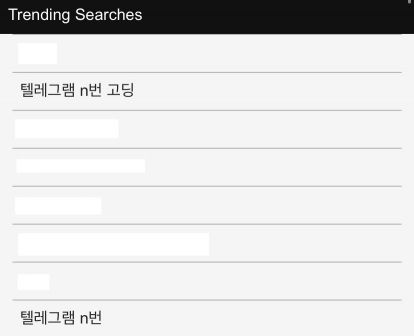
[Asia Economy Reporter Yoon Shin-won] Amid ongoing investigations into the so-called Nth Room and Doctor's Room cases, where women were sexually exploited through Telegram chat rooms, controversy has arisen as search terms like 'Telegram Nth Room' and 'Telegram Doctor's Room' have appeared in the popularity rankings on adult websites.
Recently, on the world's largest porn streaming site, terms such as 'Telegram Nth' and 'Telegram Doctor's Room' appeared in the 'Trending Searches' list. Since search terms vary by country of access, this indicates these were the most searched terms in South Korea. Although access to these sites is blocked domestically by the Korea Communications Standards Commission, it is not difficult to access them using a Virtual Private Network (VPN).
These search terms emerged after news broke on the 16th that Jo Joo-bin, the 25-year-old operator of the Doctor's Room, was arrested by the police on charges including violations of the Act on the Protection of Children and Juveniles from Sexual Abuse.
 Jo Joo-bin (25), who was arrested on charges of threatening women to film sexual exploitation materials and distributing them on the mobile messenger Telegram, is seen leaving the courtroom after the warrant hearing at the Seoul Central District Court in Seocho-dong, Seoul on the afternoon of the 19th.
 Photo by Yonhap News
A petition on the Blue House website demanding the disclosure of personal information related to individuals involved in the case has garnered over 2.55 million signatures (as of 3 p.m. on the 24th), the highest number ever recorded, while some netizens appear unable to suppress their malicious curiosity and interest amid the situation.
Similar controversies arose during last year's Burning Sun scandal. After it was revealed that illegal videos were shared in a KakaoTalk group chat involving multiple celebrities including Jung Joon-young, search terms like 'Burning Sun' and 'Jung Joon-young' appeared on the site.
However, such excessive curiosity constitutes clear secondary harm. Both the act of watching the videos and requesting their distribution exacerbate the victim's suffering as secondary harm. Yet, there is currently no legal basis to punish secondary harm, especially for merely viewing the videos. Consequently, petitions calling for institutional measures to enable punishment for secondary harm are continuously being submitted.
© The Asia Business Daily(www.asiae.co.kr). All rights reserved.


















