Decline in Manufacturing Production and Steel Demand Hits
Container Ship Demand Expected to Plummet Due to Decreased Cargo Volume
BDI Drop Comparable to 2008 Financial Crisis Level
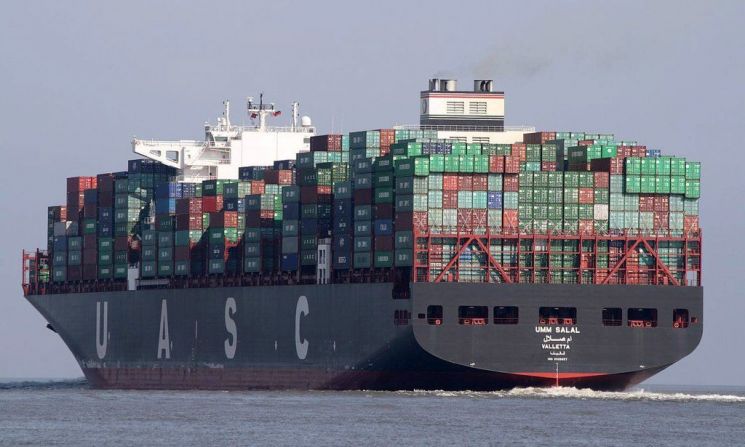
[Asia Economy Reporter Hyunwoo Lee] An analysis has emerged suggesting that the earnings before interest, taxes, and amortization (EBITA) of global shipping companies could decrease by 25-30%. This reflects concerns that global freight transport demand will sharply decline due to the impact of the novel coronavirus disease (COVID-19). The short-term shock to the shipping industry is comparable to the 2008 financial crisis, and pessimistic forecasts dominate, warning of more severe damage if the COVID-19 situation prolongs.
International credit rating agency Moody's recently published a shipping industry outlook report, predicting that the EBITA of global shipping companies could decrease by up to 30% compared to the previous year due to the COVID-19 shock. Even under optimistic assumptions that the COVID-19 shock will not be prolonged, they analyzed that EBITA would still decline by about 6-10% compared to last year. Moody's evaluated that the shipping industry's EBITA grew by 39% year-on-year last year.
Regarding the background of this outlook, Moody's explained, "The COVID-19 situation has impacted Chinese manufacturing production and demand for steel and iron ore, leading to an expected sharp decline in demand for container ships and bulk carriers in the first half of this year." They also warned that if the COVID-19 shock intensifies in the US and Europe, causing a sharp drop in cargo volume, the shipping industry will suffer significant damage.
For oil tankers, where charter rates have risen despite low oil prices, Moody's analyzed, "Stable prospects are maintained recently due to Saudi Arabia's demand for oil tankers, but if the COVID-19 situation continues long-term, demand will eventually be affected." However, they forecast that the short-term shock to the shipping industry will be limited as the recent plunge in oil prices reduces fuel costs, offsetting losses.
The shipping industry's downturn is used as an indicator of economic recession because it is closely linked to global cargo volume. The International Monetary Fund (IMF) also reported earlier this month that the shipping industry's slump due to COVID-19 is intensifying. The IMF analyzed that the Baltic Dry Index (BDI) decline over two months before and after the COVID-19 outbreak is as severe as during the 2008 global financial crisis. The BDI is a standard index for international maritime freight rates. From January 11 this year, the BDI fell by 71.8% over two months before and after, approaching the 74.8% drop over two months before and after September 15, 2008. Gita Gopinath, IMF Chief Economist, stated, "Due to unprecedented global lockdowns and economic activity contraction, the BDI plummeted to levels comparable to the global financial crisis," adding, "Such a sharp decline was never seen during the 2001 9/11 attacks or the 2003 SARS (Severe Acute Respiratory Syndrome) outbreak."
There is also analysis that environmental regulations, which are being strengthened from this year, will further pressure the shipping industry. The Baltic and International Maritime Council (BIMCO) pointed out that the International Maritime Organization (IMO) announced environmental regulations effective January 1 this year, limiting sulfur content in ship fuel from 3.5% to 0.5%, and that the number of idle container ships not operating in the first quarter to install desulfurization devices is significantly increasing. French shipping research agency Alphaliner announced earlier this month that the volume of idle container ships reached 2.46 million TEU (twenty-foot equivalent units), accounting for 10.6% of all container ships. They added that this volume is comparable to that during the 2008 global financial crisis.
© The Asia Business Daily(www.asiae.co.kr). All rights reserved.

















