Korean Film Council Official Tally Shows Daily Minimum Audience Plummeting to 20,000s... No Sign of Recovery Since 24th of Last Month
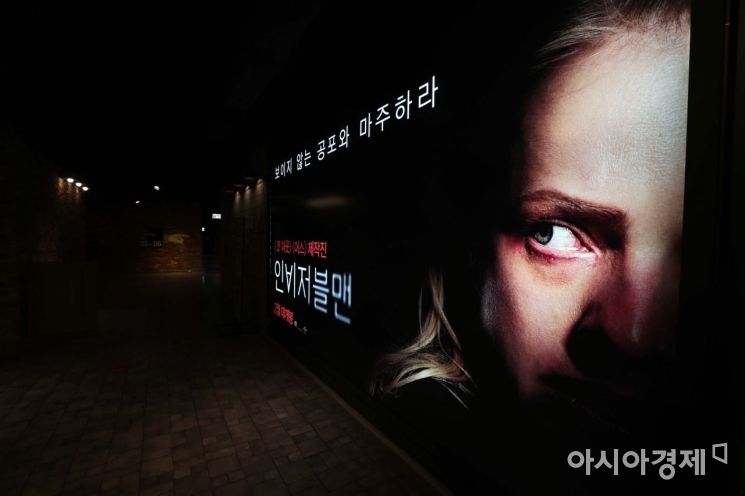 On the 22nd, when the government strongly urged for 'social distancing' to overcome COVID-19, a movie theater in Yeongdeungpo-gu, Seoul was quiet. Photo by Mun Ho-nam munonam@
[Asia Economy Reporter Lee Jong-gil] After an endless decline, it finally hit rock bottom. The daily number of movie theater attendees has recorded the lowest figure ever in the official statistics of the Korean Film Council.
According to the Korean Film Council's integrated ticketing system on the 24th, the number of visitors to theaters the previous day was 25,873. This is 877 fewer than the previous record low of 26,750 on March 29, 2004. The situation is far more dire compared to 16 years ago. In 2004, only 70% of theaters nationwide participated in the survey. The number of screens was only 220 (1,163 screenings). Currently, the number of operating screens is about 18.7 times higher at 4,124 (6,731 screenings).
The repeated slump is attributed to the spread of the novel coronavirus (COVID-19). Theaters barely managed to stay afloat until the 17th of last month, when confirmed cases were only thirty. On the 15th (630,258 attendees) and 16th (582,285 attendees) of last month, when the situation seemed to be calming down, daily attendance even exceeded 500,000. However, as the number of confirmed cases increased exponentially from the 19th of last month, attendance sharply dropped. On the 24th of last month, it plunged to the 70,000 range (77,118 attendees), and on the 9th of this month, it fell to the 50,000 range (51,615 attendees). Between the 16th and 19th, attendance hovered in the 30,000 range for four days before finally plummeting to the 20,000 range. According to the Korean Film Council's data, days with attendance in the 20,000 range have only occurred six times, including this day.
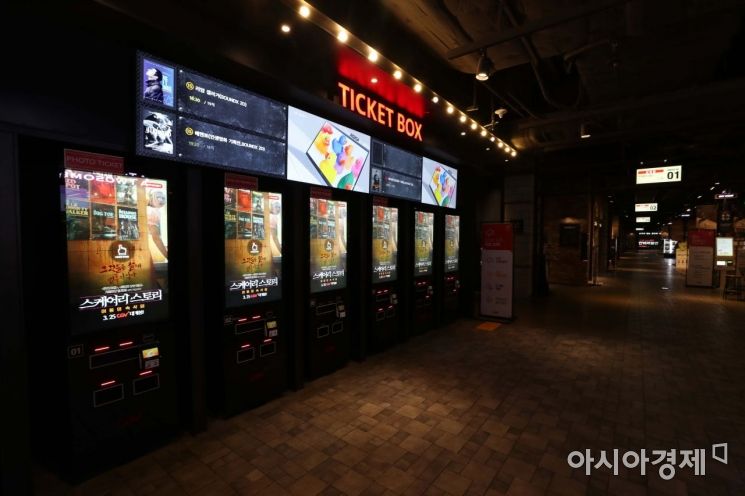 On the 22nd, when the government strongly urged 'social distancing' to overcome COVID-19, a movie theater in Yeongdeungpo-gu, Seoul was quiet. Photo by Mun Ho-nam munonam@
There are no signs of a rebound. As COVID-19 spreads worldwide, not only Korean films but also Hollywood movies from the U.S. have been postponing their release dates one after another. The anticipated film "Time to Hunt" announced the day before that it would be released on Netflix. Due to the difficulty of investing an additional 1.3 to 1.5 billion KRW in promotion and marketing, it has switched to an internet video streaming service. With no signs of the COVID-19 situation calming down, the slump is expected to continue for some time.
Theaters have long since fallen to the level of being rented out by just two or three people. The overall seat occupancy rate is only 2.3%. Only two films, "About Time (3.7%)" and "The Truman Show (3.6%)," which secured more than 10,000 seats and exceeded a 3% occupancy rate, have achieved this. They were originally released in 2013 and 1998, respectively, and were re-released this time. Since the few new releases are barely making an impact, older films are being screened again. Major theaters such as CGV, Lotte Cinema, and Megabox are struggling to operate. They have removed half of the seats in participation with the "social distancing" campaign to prevent the spread of COVID-19.
Under these harsh conditions, "The Invisible Man" attracted the most viewers with 5,909 attendees. It was followed by "1917 (4,671 attendees)," "Dark Waters (2,350 attendees)," "Honest Candidate (1,313 attendees)," and "Beasts Clawing at Straws (1,024 attendees)." Among re-released films, "A Star Is Born" drew the largest crowd with 889 attendees.
© The Asia Business Daily(www.asiae.co.kr). All rights reserved.


















