Opinions Differ on the Possibility of Defamation Being Established
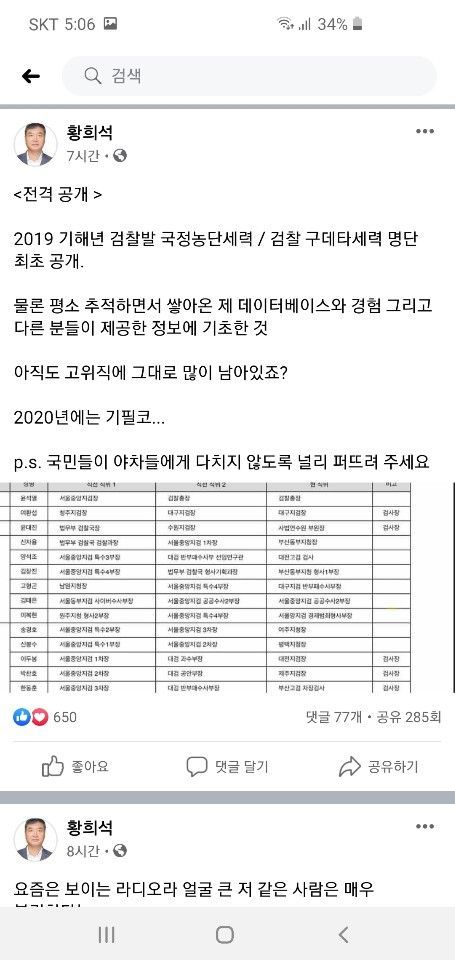
[Asia Economy Reporter Choi Seok-jin] The former head of the Human Rights Bureau at the Ministry of Justice, Hwang Hee-seok, who was appointed as the head of the Prosecution Reform Promotion Support Group during former Minister of Justice Cho Kuk’s tenure, has been criticized both within the prosecution and the legal community for his designation of 14 current prosecutors, including Prosecutor General Yoon Seok-yeol, as a ‘coup faction,’ which has been deemed an ‘inappropriate conduct.’
Even considering Hwang’s current situation as a candidate for the Open Democratic Party’s proportional representation in the April 15 general election, there are concerns that a former Ministry of Justice official publicly naming current prosecution executives, including the Prosecutor General, and treating them as targets for purge is problematic.
Legally, opinions are divided on whether his actions could constitute defamation or abuse of authority charges, such as those applied in the ‘blacklist’ case.
On the 23rd, negative opinions dominated within the prosecution and legal circles regarding Hwang’s Facebook post from the previous day.
On the previous day, Hwang posted on his Facebook, identifying Prosecutor General Yoon Seok-yeol and 14 other prosecutors as the ‘prosecution coup faction,’ writing, “Many of them are still in high positions. In 2020, we will definitely...” ▶Refer to our March 22 report <"‘Prosecution Coup Faction’ Hwang Hee-seok Reveals List of 14 Members of Yoon Seok-yeol’s Faction on Facebook Controversy">
Kim Hyun, former president of the Korean Bar Association, pointed out, “The Ministry of Justice supervises the prosecution, and especially amid the Cho Kuk incident and various issues causing conflicts, criticizing the prosecution immediately after leaving the Ministry is very inappropriate and makes one doubt the Ministry’s true intentions during his tenure.”
He added, “There is a high possibility of defamation, and attacking prosecution executives who are conducting various investigations appears to threaten the rule of law.”
Na Seung-chul, former president of the Seoul Bar Association, said, “It is not appropriate for someone who was in the Ministry of Justice, no matter how political they become,” and criticized, “This behavior suggests that the Ministry’s personnel decisions regarding prosecutors were made with certain intentions or motives.”
The reactions from prosecutors were even more negative.
A current chief prosecutor, Mr. A, said, “Although Hwang expressed his own value judgment, treating the investigation of former Minister Cho Kuk as if it were a national scandal shows how distorted the Ministry of Justice’s perspective is regarding a series of prosecution investigations, including the allegations of Yoo Jae-soo’s inspection cover-up.”
Another prosecutor, Mr. B, said, “It seems unlikely that the prosecutors named will file lawsuits, but the family of Jo Gwang-jo might sue for defamation because Hwang compared former Minister Cho Kuk to Jo Gwang-jo.”
This is because comparing former Minister Cho Kuk, who was prosecuted over suspicions of private equity fund allegations and his children’s admission irregularities, to Jo Gwang-jo could be offensive to Jo Gwang-jo’s family.
Attorney C, a former chief prosecutor, said, “Hwang’s remarks are something that only civic groups would make,” adding, “Taking legal action now might only give Hwang more publicity and help him become more well-known.”
Meanwhile, the prevailing view is that the prosecutors named in the list are unlikely to actually sue Hwang. Even if they do, there could be controversy over the truthfulness of the statements, and since it could be seen as a politician’s personal opinion about a public figure, prosecution might be difficult.
A prosecution official said, “There is a possibility of defamation, insult, or crimes related to blacklists,” but added, “While many believe civil and criminal actions are possible, it is another matter whether the parties themselves raise the issue, and the prosecution will not respond to every statement made by politicians.”
© The Asia Business Daily(www.asiae.co.kr). All rights reserved.
![User Who Sold Erroneously Deposited Bitcoins to Repay Debt and Fund Entertainment... What Did the Supreme Court Decide in 2021? [Legal Issue Check]](https://cwcontent.asiae.co.kr/asiaresize/183/2026020910431234020_1770601391.png)















