[Asia Economy Reporter Buaeri] Mr. A, who worked in a non-development position at Pearl Abyss, recently received a notice of recommended resignation. He expressed frustration, saying, "I was told to leave on the same day. I have also seen six people quit from one team all at once." He lamented the culture of routine recommended resignations, stating, "This is not an unusual occurrence in the game industry."
Recently, Pearl Abyss sparked controversy by notifying employees of recommended resignations on the same day, bringing the issue of job insecurity in the game industry to the forefront.
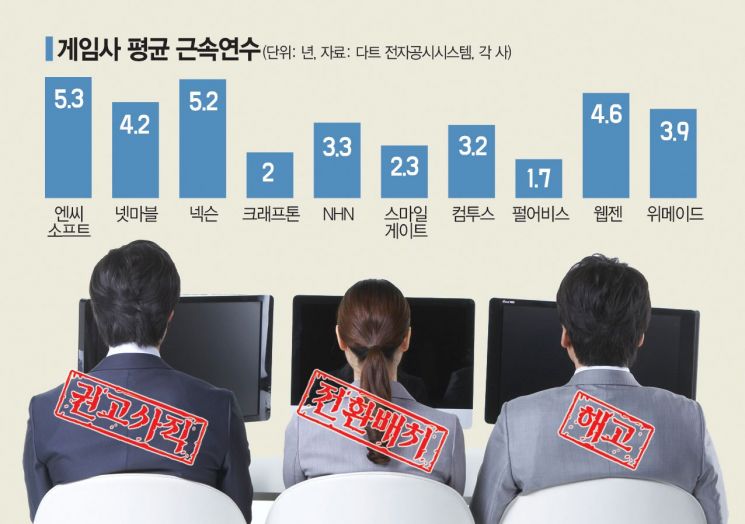
◆Average length of service 3.57 years= On the 23rd, Asia Economy analyzed quarterly reports and internal statistics from 10 domestic game companies and found the average length of service to be 3.57 years. The longest was NCSoft (5.3 years), and the shortest was Pearl Abyss (1.7 years). This is less than one-third of the average length of service in general companies. According to CEO Score, among the top 500 companies, the average length of service for 312 companies submitting quarterly reports is 11.1 years.
The consensus in the game industry is that job insecurity remains a chronic problem. Bae Suchan, head of the Nexon labor union branch, said, "It is common for game companies to recommend resignation when a team project is dropped." Cha Sangjun, head of the Smilegate labor union branch, added, "The biggest problem is that the game industry structure operates in a way that is not truly regular employment despite being labeled as such," and said, "In some malicious cases, companies deliberately create subsidiaries, transfer employees there, and then close them down."
In fact, according to the 'Labor Study of Game Producers' report released by the Korea Creative Content Agency in January, a survey of 1,000 game workers showed that 51.6% expected measures such as 'reassignment, standby orders, recommended resignation, dismissal' following the suspension of game projects. The research team diagnosed, "With the recent shift to mobile games, the continuity of projects has seriously weakened, and the problem of job insecurity is worsening."
◆Silence for job change= Domestic game companies mainly dismiss employees through recommended resignation. Unlike 'dismissal,' which involves complicated legal procedures, recommended resignation is basically an agreement between the company and the employee. Although legal action is possible if the employee feels the recommendation is unfair, very few oppose the company's measures. Due to the interconnected nature of the game industry, reputation damage can be fatal.
Mr. B, working at a major game company, said, "People in game companies leave quietly if they have to accept recommended resignation," adding, "The higher-ups are connected through networks, and when changing jobs, reputation checks are made with the previous company. People just leave quietly to avoid trouble at the new company."
Attorney Choi Jaeyoon of Taeil Law Firm explained, "Even with recommended resignation, there is an option to file an unfair dismissal relief application with the local labor board. If unfair personnel transfers occur, relief applications can also be made to the labor board," but he added, "In reality, many accept recommended resignation, and companies exploit this to use recommended resignation instead of dismissal, creating a vicious cycle."
There are also calls for structural approaches such as establishing labor unions to resolve the issue. Branch head Cha said, "In the case of Smilegate, after last year's rally, the company responded that 'such things will not happen in the future.' But in cases like Pearl Abyss, where there is no union, there is no way to respond," and added, "Ultimately, unions are necessary, and I believe that in addition to company-level unions, industrial unions are also needed."
© The Asia Business Daily(www.asiae.co.kr). All rights reserved.

















