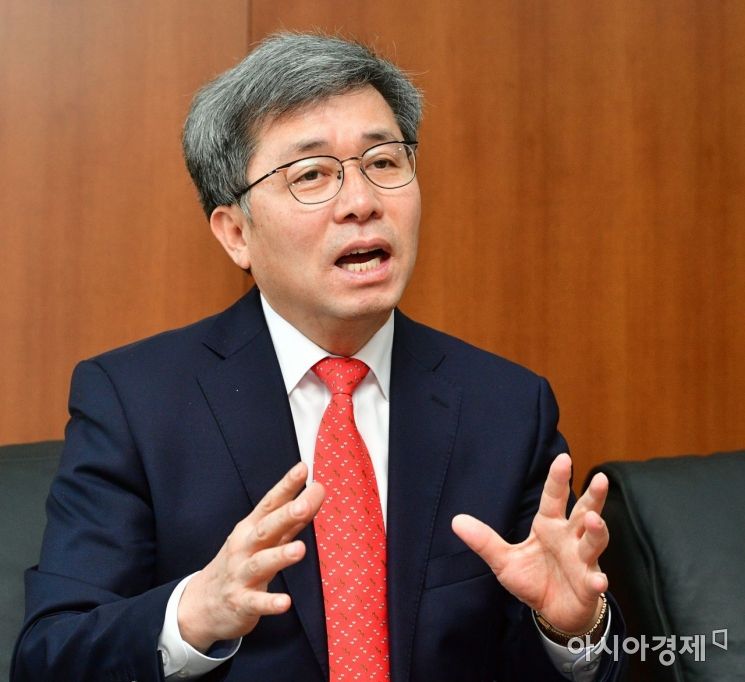
 Jung Yang-ho, President of the Korea Institute for Advancement of Technology. / Photo by Dongju Yoon doso7@
[Asia Economy Reporter Moon Chaeseok] Jeong Yang-ho, President of the Korea Evaluation Institute of Industrial Technology (KEIT), emphasized that for Korea's materials, parts, and equipment (SoBuJang) industry to overcome Japan, it must not only increase its localization rate but also grow to the extent that it can surpass Japan in cost competitiveness. In an interview with Asia Economy on the 20th, President Jeong said, "It is not enough to have equivalent quality; if there is an area where Japan is number one, we must achieve cost competitiveness better than Japanese companies."
Achieving self-reliance in core SoBuJang technologies is a challenging task. President Jeong stated that SoBuJang technology must transcend merely following Japan. Since the market size is small and many fields are specialized, only the world’s number one can survive. He said, "For example, although a significant portion of hydrogen fluoride, one of Japan’s export-restricted items, has been replaced, semiconductor components that require high quality still need further improvement. KEIT has established a 'planning, evaluation, and post-management' system that includes identifying which items can catch up with advanced countries and how to connect small and medium-sized enterprises’ products with demand companies (large corporations) to achieve results."
According to him, KEIT signed memorandums of understanding (MOUs) with more than 20 organizations related to SoBuJang last year. On December 27 last year, the "Special Measures Act for Strengthening the Competitiveness of the Materials, Parts, and Equipment Industry (SoBuJang Special Act)" passed the National Assembly. Accordingly, KEIT plans to actively manage R&D projects of small and medium-sized enterprises, as well as quality assurance and matching with demand companies. President Jeong said, "We have revised the system so that small and medium-sized enterprises that submitted R&D projects together with government public institutions such as the Public Procurement Service can have their quality verified and be matched with demand companies."
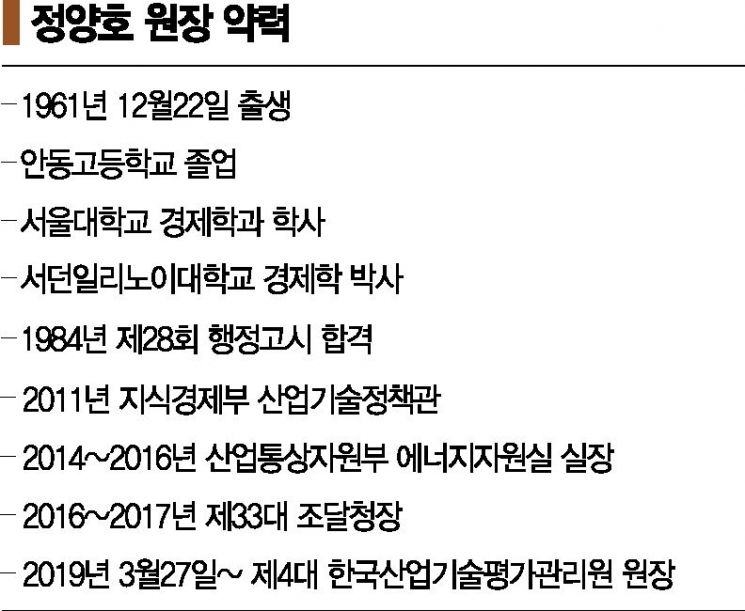
He disagreed with the criticism that government R&D has low effectiveness relative to budget input. Holding a mobile phone on the table, he said, "Among the dozens of core technologies contained in this device, about a quarter came from government R&D." According to him, this year’s government and private R&D investment amounts to about 100 trillion won, with a private-to-government ratio of 3:1. President Jeong explained, "After entering public service in 1985 as the 28th Administrative Examination class, the first project I was in charge of was the 30 to 40 billion won scale 4MB DRAM development project (in 1987, Samsung Electronics’ memory division developed the world’s first), and there was no part where government R&D was not involved." He added, "Although government R&D’s final results are sometimes difficult to see, I believe it has fulfilled its basic role. Going forward, we need to build a solid system, including legal frameworks, so that the public and private sectors can create synergy in R&D."
© The Asia Business Daily(www.asiae.co.kr). All rights reserved.
![User Who Sold Erroneously Deposited Bitcoins to Repay Debt and Fund Entertainment... What Did the Supreme Court Decide in 2021? [Legal Issue Check]](https://cwcontent.asiae.co.kr/asiaresize/183/2026020910431234020_1770601391.png)
















