COVID-19 Pandemic... Borders Closed Worldwide
Korean International Students Rush to Return Home
Some Worry About Re-entry Restrictions
All Arrivals from Europe to Undergo COVID-19 Testing Starting the 22nd
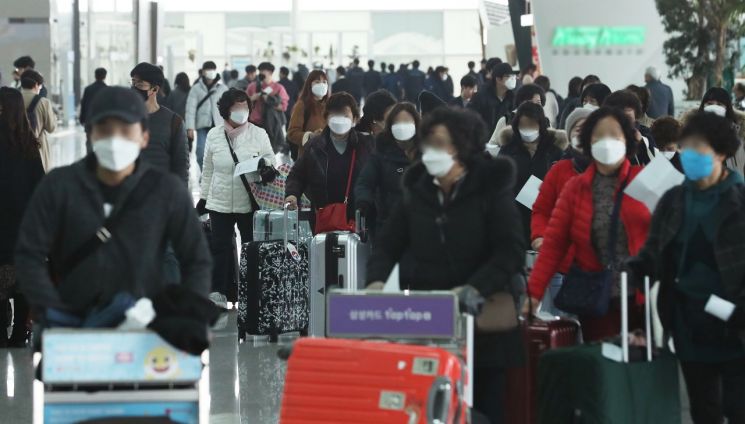 On the afternoon of the 2nd of last month, when concerns about the spread of the novel coronavirus infection were rising, passengers wearing masks were moving through Terminal 2 of Incheon Airport. Photo by Yonhap News
[Asia Economy Reporter Kim Gayeon] # A (27), who went on a working holiday to Ireland, recently changed her flight reservation. A said, "According to the original plan, I should have left for a trip by now and returned to Korea next month," adding, "As the situation worsened, my family urged me to come back, and due to the high risk of infection, I ended up canceling the entire trip." She continued, "I had booked a flight with a layover to enter Korea, but there were rumors that even that would be canceled," and added, "I changed my flight three or four times and plan to return to Korea next week."
As the COVID-19 pandemic prolongs, concerns are rising among Korean students studying abroad, exchange students, and working holiday participants. Some students are rushing to return home, while others are struggling to find flights to Korea due to soaring prices.
Due to the spread of COVID-19, more than 50 countries, including Canada, have closed their borders by banning foreign nationals from entering. According to the Ministry of Foreign Affairs, as of the 19th, 55 countries have banned entry to all foreigners. Additionally, as of 10 a.m. on the 21st, 174 countries have banned or restricted entry for those staying or transiting in Korea.
The European Union (EU) agreed on a 30-day travel ban on the 17th (local time). Accordingly, 30 countries, including 26 member states except Ireland, Norway, Switzerland, Iceland, and Liechtenstein, are restricting foreign nationals' entry. Charles Michel, President of the European Council, held a press conference the same day, stating, "We have agreed to temporarily restrict non-essential EU travel to strengthen our external borders."
The United States has effectively closed its borders. After banning entry of foreigners from Europe, the U.S. government raised its travel advisory for all countries to Level 4, "Do Not Travel."
On the 19th, the State Department issued a recommendation stating, "Due to the global impact of COVID-19, we advise Americans to avoid all international travel," warning, "Travelers may face serious disruptions to their plans and could be forced to remain outside the U.S. indefinitely."
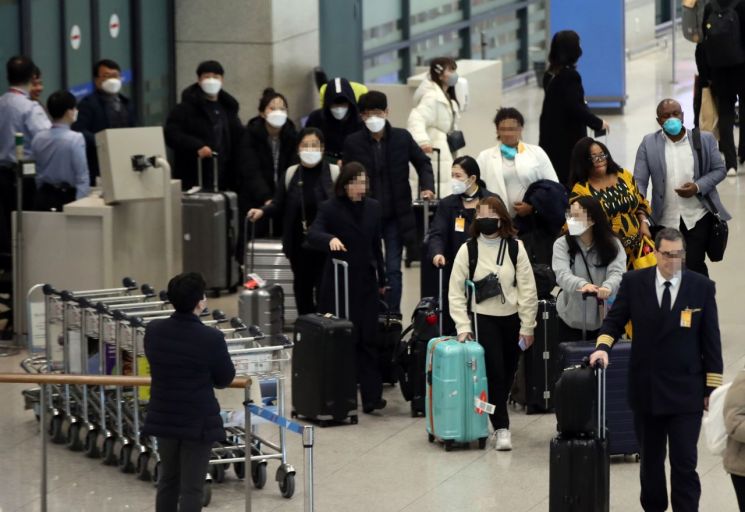 On the afternoon of the 3rd, arriving passengers wearing masks are leaving the departure hall at Incheon International Airport Terminal 1. Photo by Yonhap News
Given this situation, Korean students currently residing abroad are rushing to return home. However, many students remain overseas despite infection concerns. This is because major countries are controlling not only foreigners but also their own citizens' entry and exit, raising the possibility of being unable to re-enter or facing visa issues later.
B (23), a university student who recently returned after studying in Germany, said, "The spread of COVID-19 seems faster and more dangerous in Germany than in Korea, so I stopped my studies and came back," expressing, "I feel powerless and angry because my plans were disrupted."
She added, "Some Koreans still remain there because they worry about re-entry issues," and said, "I thought it was safer to come back to Korea than to stay and risk infection."
Meanwhile, the government is reportedly not yet considering entry bans. The quarantine authorities are expanding special entry procedures for all incoming foreigners and Koreans to prevent the spread of COVID-19.
As confirmed cases surge across Europe, quarantine procedures for all arrivals from Europe will be strengthened starting at midnight on the 22nd. Asymptomatic arrivals will stay at temporary living facilities for about 24 hours and then be transferred to hospitals or living treatment centers based on test results or placed under 14-day self-quarantine.
Jung Eun-kyung, Director of the Korea Centers for Disease Control and Prevention Central Disaster and Safety Countermeasure Headquarters, said at a regular briefing held in Osong, Chungbuk, on the 20th, "Arrivals from Europe will be managed through self-quarantine, so please follow the quarantine authorities' measures," and recommended, "Other arrivals should also stay at home as much as possible for 14 days and minimize contact."
She continued, "We ask that non-urgent overseas travel be postponed or canceled," and added, "If unavoidable, please thoroughly practice personal hygiene such as handwashing and avoid visiting enclosed multi-use facilities or medical institutions."
© The Asia Business Daily(www.asiae.co.kr). All rights reserved.
![User Who Sold Erroneously Deposited Bitcoins to Repay Debt and Fund Entertainment... What Did the Supreme Court Decide in 2021? [Legal Issue Check]](https://cwcontent.asiae.co.kr/asiaresize/183/2026020910431234020_1770601391.png)