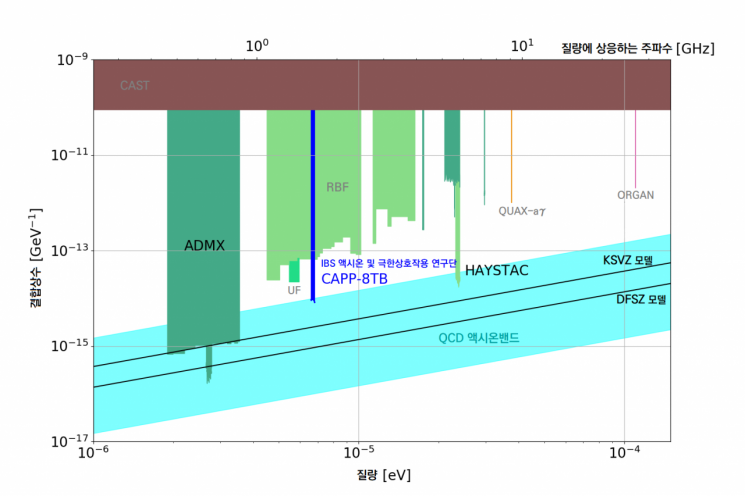
 This shows the possible parameter space for axions and the current status of axion search experiments. The x-axis represents the axion mass (or the corresponding microwave frequency), and the y-axis represents the coupling constant for axion-to-photon conversion (the signal strength of photons converted from axions). The light blue area labeled "QCD Axion Band" indicates the theoretical range where axions can exist. KSVZ and DFSZ are predictions from two models describing the properties of axions. The blue CAPP-8TB represents the results from the current experiment.
[Asia Economy Reporter Junho Hwang] The 'axion,' one of the candidates for dark matter, a hypothetical substance that makes up the universe, is known to convert into light (photons) when it encounters a strong magnetic field. As researchers worldwide are searching for axions to unravel the mysteries of dark matter, a domestic research team has announced their axion search results.
On the 20th, the Institute for Basic Science revealed the axion search results from a research team led by Yanis Semertzidis, head of the Axion and Extreme Interaction Research Group.
The team searched for axions in the mass range of 6.62 to 6.82 microelectronvolts (μeV) and confirmed the absence of axions within this range. This is the first time axions have been searched for in this mass range. The University of Washington has detected signals in the 1.9 to 3.53 μeV range, and Yale University in the 23.15 to 24 μeV range.
The signal strength included in the QCD axion band is about 10^24 times smaller than that of a fluorescent lamp. Highly advanced technology is required for detection. The research team constructed an experimental setup by implementing a cylindrical superconducting magnet generating an 8-tesla magnetic field, which is 160,000 times stronger than Earth's magnetic field, and placing a metal cylinder with an antenna inserted at the magnet's center.
The discovery of axions is expected to solve major problems in modern physics. It is known that the universe we live in is made of matter because the Big Bang initially produced much more matter than antimatter. If axions are discovered, this hypothesis can be verified. Additionally, some scientists claim that axions are a type of 'dark matter' filling the universe, so this claim could also be confirmed.
First author Suhyung Lee, Research Technology Committee member, stated, "We plan to search a mass range twice as wide within six months." He also mentioned plans to improve the detector to scan smaller signal regions more quickly.
The research results were published on the 14th (Korean time) in the American Physical Society journal Physical Review Letters.
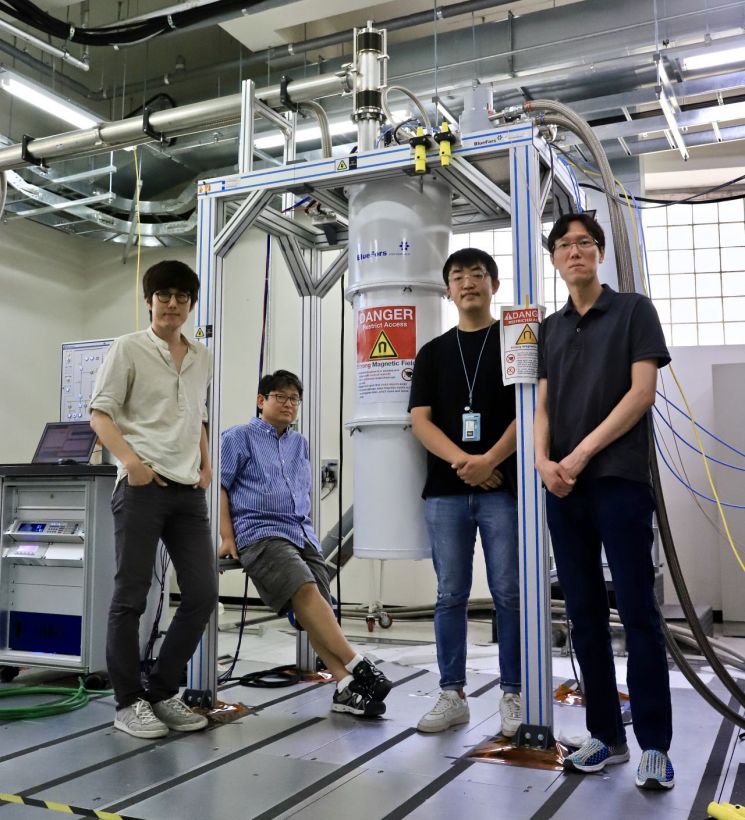 The research team of the ultra-low temperature cryostat and dark matter search experiment 'CAPP-8TB.' From the left, first author Soo-Hyung Lee, research technology committee member; corresponding author Byung-Rok Ko, research committee member; Sae-Byuk Ahn, Ph.D. candidate at Korea Advanced Institute of Science and Technology; and Ji-Hoon Choi, former IBS research committee member.
© The Asia Business Daily(www.asiae.co.kr). All rights reserved.
![User Who Sold Erroneously Deposited Bitcoins to Repay Debt and Fund Entertainment... What Did the Supreme Court Decide in 2021? [Legal Issue Check]](https://cwcontent.asiae.co.kr/asiaresize/183/2026020910431234020_1770601391.png)
















