Frequent Network Failures and Lack of Parts
Government Unable to Set Service Termination Date
Overseas Markets Already Moving On, 5G Strategy Dominates
High Operating Costs for Legacy Networks
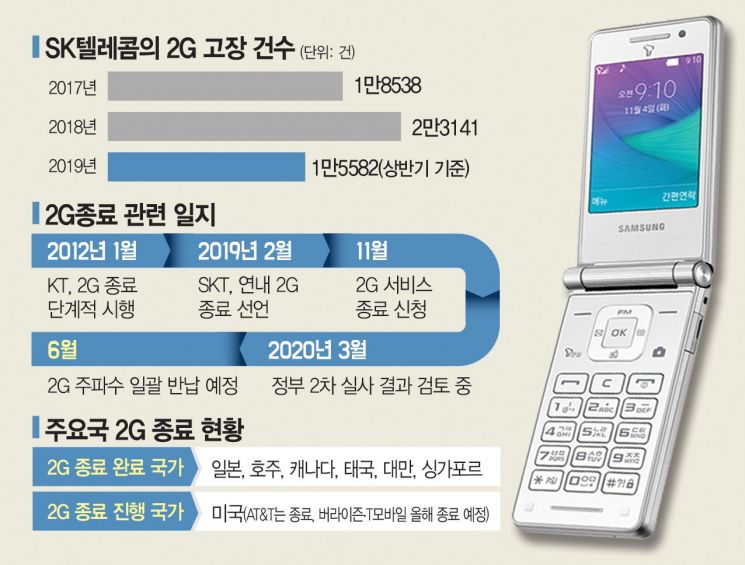
[Asia Economy Reporter Koo Chae-eun] The termination of SK Telecom's 2nd generation (2G) mobile communication service has been repeatedly delayed. The originally planned termination date, the end of last year, has long passed, and there has been no news for nearly three months. The telecommunications industry says that since major countries around the world have already phased out 2G services and to ensure the successful establishment of 5G services in South Korea, a swift decision is necessary. Given that telecommunication services must use the limited resource of 'frequency,' there are calls for the government to promptly establish an 'exit strategy' for ending 2G.
◆ Approval for 2G termination 'repeatedly delayed' = According to the industry on the 20th, the Ministry of Science and ICT received SK Telecom's application for approval to terminate 2G service in November last year, requested supplementary materials once, and conducted two on-site inspections, but has yet to finalize the timing for termination approval. SK Telecom is growing increasingly anxious. The termination of 2G means that disaster messages related to COVID-19 cannot be received, and network failures are frequent. According to data obtained by Representative Byun Jae-il (Democratic Party) from the Ministry of Science and ICT last year, the number of faults in SK Telecom's 2G base stations and repeaters rapidly increased from 18,538 cases in 2017 to 23,141 in 2018, and in just the first half of 2019, there were 15,582 cases. Production of core 2G equipment stopped around 2005, making it difficult to procure additional parts. The release of 2G handsets also ceased after Samsung's 'Master Dual' in 2014.
◆ Global 2G termination is the 'trend' = The industry holds the view that since major countries worldwide are boldly phasing out older generation communication services such as 2G and 3G in preparation for 5G, the South Korean government needs to make a quick decision. Japan, which will launch 5G services from the 25th, ended 2G services in 2012 through its three major carriers: SoftBank, NTT Docomo, and KDDI. In the United States, AT&T terminated 2G services in 2017, and Verizon and T-Mobile plan to end theirs by this year. Additionally, Australia, Canada, Thailand, Taiwan, and Singapore all terminated 2G services by last year. Similar to South Korea, these countries require government approval for 2G termination, and their governments have proactively announced 2G termination plans or expressed active approval policies to demonstrate their commitment to transitioning to 5G. An industry official said, "To achieve the goal of completing nationwide 5G network construction by 2022, a decisive move toward generational change is necessary."
◆ Resistance from remaining subscribers is a variable = The number of remaining subscribers and the resistance from existing users who still want to use 011 and 017 numbers are important variables. SK Telecom's 2G line users numbered 442,141 (as of the end of last year), accounting for 1.5% of total subscribers. SK Telecom is encouraging transition by offering handset purchase subsidies and discounted plans to facilitate 2G termination, but demands to continue using existing numbers persist. However, since the cost burden of operating legacy networks is shared by the majority of users, decision-making needs to reflect both user demands and operator choices. Professor Shin Min-soo of Hanyang University's Business School said, "Due to equipment failures and difficulties in parts supply, it is difficult to continue investing in 2G services, and even if continued, consumer welfare inevitably declines. SK Telecom should find reasonable measures that allow remaining 2G subscribers to transition to LTE or 5G under acceptable conditions."
© The Asia Business Daily(www.asiae.co.kr). All rights reserved.