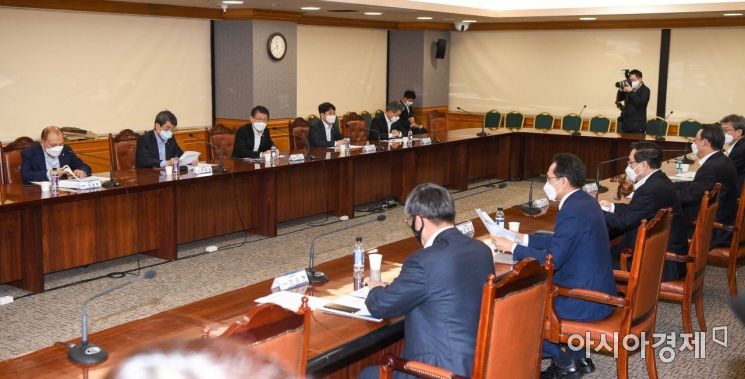
 Eun Sung-soo, Chairman of the Financial Services Commission, along with heads of major banks, are attending a meeting between the Financial Services Commission Chairman and bank presidents held on the 20th at the Bankers' Hall in Jung-gu, Seoul, exchanging opinions. Photo by Kang Jin-hyung aymsdream@
[Asia Economy reporters Kangwook Cho and Eunmo Koo] Financial authorities and heads of banks have agreed to actively participate in the establishment of a 10 trillion won-scale Bond Market Stabilization Fund (Cha-an Fund). The fund will purchase corporate bonds and financial bonds to alleviate the funding difficulties faced by companies and the financial sector. They also agreed to cooperate in increasing the fund size if necessary. Additionally, they will collaborate in creating the Securities Market Stabilization Fund (Jeung-an Fund), which will operate temporarily until the stock market recovers.
On the 20th, the Financial Services Commission (FSC) announced that Chairman Eun Sung-soo held a meeting with Kim Tae-young, Chairman of the Korea Federation of Banks, and heads of eight major banks to discuss follow-up measures for implementing the livelihood and financial stability package program announced by the government the previous day.
At the meeting, participants agreed that resolving the funding difficulties of small and medium-sized enterprises (SMEs) and small business owners, who have been hit hard by the COVID-19 pandemic, to prevent bankruptcy risk is fundamental to the recovery of the real economy and, ultimately, financial stability. The banking sector will play a central role in establishing the 10 trillion won-scale Cha-an Fund. Chairman Eun emphasized, "It is important for banks to take responsible roles to ensure the smooth reactivation of the Bond Market Stabilization Fund, which was jointly established by the financial sector in December 2008 to overcome the global financial crisis." Accordingly, the bank heads agreed to contribute to the establishment of the 10 trillion won fund as the banking sector, as previously agreed, and to actively cooperate in increasing the fund size if necessary, based on the fund's expenditure trends.
They will also actively participate in the creation of the Jeung-an Fund. Domestic banks hold the largest share in the Korean financial market and play a leading role in the financial market. Therefore, they are expected to take responsibility and actively engage in stabilizing the stock market.
However, opinions in the market are divided regarding the policy effects of the large-scale Cha-an Fund and Jeung-an Fund. While there are expectations that investment sentiment in the domestic stock market will improve and that support for corporate funding difficulties will be helpful, some analyses are skeptical about how much the foreign sell-off can be curbed.
The establishment of the Cha-an Fund is seen as a meaningful measure. As the number of companies facing critical situations increases, it is necessary at this point to support crisis overcoming through liquidity supply.
Hwang Se-woon, a research fellow at the Korea Capital Market Institute, stated, "The number of companies at risk of bankruptcy is increasing, and if these companies default, the crisis paradigm could completely shift. It is necessary to concentrate resources on liquidity supply mechanisms and credit enhancement devices, such as the Cha-an Fund, that can prevent corporate bankruptcies."
On the other hand, doubts are raised about the effectiveness of the Jeung-an Fund. While the fund's establishment itself is positive, its effects are expected to be limited. During the 2008 financial crisis, four related organizations, including the Korea Securities Dealers Association, established a 515 billion won-scale 'Stock Market Stabilization Fund.'
Kim Young-hwan, a researcher at KB Securities, said, "Since the demand for cash, stemming from global recession concerns, is exerting strong downward pressure on stock prices, the Jeung-an Fund can only play a role in moderating the speed of the decline. As cash holdings have become critical for a company's survival, policy support that can reduce the possibility of credit crunches, such as credit guarantees, is most important."
© The Asia Business Daily(www.asiae.co.kr). All rights reserved.
![User Who Sold Erroneously Deposited Bitcoins to Repay Debt and Fund Entertainment... What Did the Supreme Court Decide in 2021? [Legal Issue Check]](https://cwcontent.asiae.co.kr/asiaresize/183/2026020910431234020_1770601391.png)















