'Korea-US Currency Swap Agreement' After 10 Years and 11 Months
Lee Ju-yeol and Jerome Powell, Fed Chair, Hold Regular Meetings... "Able to Exchange Opinions on Market Conditions Frequently"
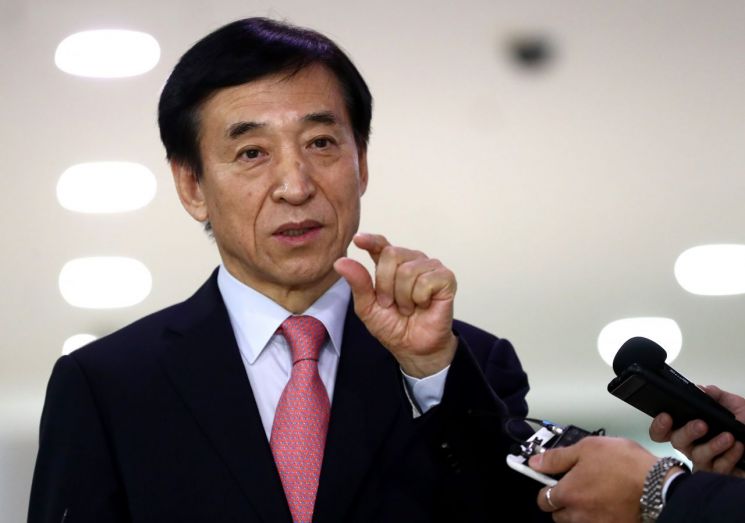
[Asia Economy Reporters Eunbyeol Kim and Sehee Jang] The background behind the Bank of Korea (BOK) and the U.S. Federal Reserve (Fed) suddenly signing a currency swap agreement involved Lee Ju-yeol, Governor of the Bank of Korea, and Hong Nam-ki, Deputy Prime Minister and Minister of Economy and Finance. It is also reported that the swift decision-making regarding recent market conditions, including the Fed's interest rate cuts and the extension of currency swap agreements with major countries including Korea, played a significant role.
According to the BOK and the Ministry of Economy and Finance on the 20th, the recent Korea-U.S. currency swap negotiations were conducted in the currencies of the BOK and the U.S. Fed. On the 19th, the BOK signed a bilateral currency swap agreement with the U.S. Fed worth $60 billion. The current agreement is for a minimum of six months, but it is expected to be extendable depending on market conditions. Notably, this currency swap is significant as it was resumed after 10 years and 11 months.
Governor Lee Ju-yeol's network played a crucial role in concluding this currency swap. As a director of the Bank for International Settlements (BIS), Governor Lee has met with Jerome Powell, Chairman of the U.S. Fed, approximately every two months at BIS Governors' meetings, exchanging views on the international financial market. On the morning of the announcement, Governor Lee told reporters, "We agreed to exchange opinions frequently on issues such as Korea's market conditions," adding, "We also had conversations during BIS conference calls, and a relationship has been established where I can exchange views with Chairman Powell regularly." Thanks to this pre-established system, the Korea-U.S. currency swap was quickly concluded through just a few days of working-level consultations.
On the 22nd and 23rd of last month, during the G20 Finance Ministers and Central Bank Governors Meeting held in Riyadh, Saudi Arabia, Governor Lee and Chairman Powell held a private meeting. It is known that Governor Lee mentioned the global financial market instability caused by COVID-19 and conveyed the necessity of concluding a Korea-U.S. currency swap. Analysts suggest that both sides likely reached a consensus on the need for a Korea-U.S. currency swap to mitigate the economic shock caused by the COVID-19 pandemic.
Deputy Prime Minister Hong Nam-ki and the Ministry of Economy and Finance also provided comprehensive support. Earlier this week, Deputy Prime Minister Hong sent a letter directly to U.S. Treasury Secretary Steven Mnuchin to assist negotiations. The letter reportedly emphasized that "global international cooperation is crucial to overcoming COVID-19" and that "a financial safety net like the Korea-U.S. currency swap is necessary." Additionally, Heo Jang, Director General of International Economic Affairs, reportedly called the U.S. Treasury Deputy Assistant Secretary to express Korea's situation.
Deputy Prime Minister Hong has experience working as a counselor at the Korean Embassy in Washington, D.C., when Korea and the U.S. first signed a currency swap agreement in October 2008. After persuading the U.S. for two to three years, Deputy Prime Minister Hong succeeded in having Korea included among the major countries eligible for currency swaps.
There is also analysis that the Korea-U.S. currency swap accelerated due to the U.S.'s faster decision-making regarding global markets. Following a dramatic 1.00 percentage point cut in the benchmark interest rate on the 15th, the U.S. Fed also signed swap agreements with central banks of Denmark, Norway, Sweden, Australia, New Zealand, Brazil, Mexico, and the Monetary Authority of Singapore, in addition to Korea.
Governor Lee said about the U.S. Fed, "Ultimately, the most prominent phenomenon in the international financial market right now is risk aversion sentiment. Since there is a shortage of U.S. dollars in the international market, the Fed, as the issuer of the key currency, judged that it was facing constraints and thus took action." A Ministry of Economy and Finance official also stated, "The Fed's decision-making regarding market conditions has become very fast. The purchase of commercial paper (CP) within a day or two is in the same context."
Meanwhile, the BOK plans to supply dollars to the market immediately after drafting the contract.
© The Asia Business Daily(www.asiae.co.kr). All rights reserved.
![User Who Sold Erroneously Deposited Bitcoins to Repay Debt and Fund Entertainment... What Did the Supreme Court Decide in 2021? [Legal Issue Check]](https://cwcontent.asiae.co.kr/asiaresize/183/2026020910431234020_1770601391.png)
















