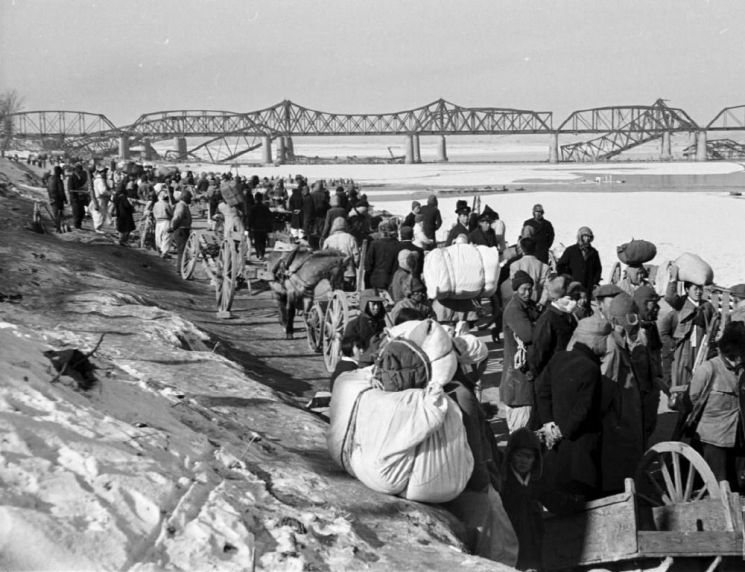
 Refugees waiting for a ferry boat to go south near the Han River railroad bridge, which was cut off during the January 4th retreat. The intervention of the Chinese Communist forces was a shock that completely changed the course of the war.
[Nam Dohyun, Military Columnist] Since entering the war on October 25, 1950, our forces were in disarray and retreating in panic due to the successive offensives by the Chinese People's Volunteer Army (PVA), and morale had plummeted to its lowest point. The will to fight had vanished, and the troops sought to avoid contact with the PVA as much as possible. This is evident from the fact that during the retreat to near the 38th parallel just fifteen days after abandoning Pyongyang on December 4, there was not a single proper engagement in the area under the responsibility of the U.S. 8th Army.
However, there was no hope of stopping the PVA even at the 38th parallel. On January 4 of the following year, Seoul was quietly handed back to the enemy, and our forces established their next defensive line near the 37th parallel, between Pyeongtaek and Samcheok. Yet the United Nations forces were not confident that they could halt the southward advance of the PVA here either. The sudden appearance of the PVA shattered the illusions of unification that our forces had been clinging to, leaving them resigned.
This was true not only for frontline soldiers but also for the Washington authorities directing the war from behind the scenes. In fact, pessimism was even greater there. Just two months earlier, they had been so confident of victory that they requested reduced supply shipments to the homeland. But as those expectations vanished like mist, the U.S. secretly prepared a plan to completely withdraw from the Korean Peninsula without hesitation if the line retreated 50 km further south from the 37th parallel to the Geum River line.
The United States had deployed troops to the Korean Peninsula immediately after the outbreak of the Korean War under President Truman’s decision to contain the spread of communism. However, from the beginning, the goal was only to restore the status quo ante at the 38th parallel, with no intention of escalating the conflict to China. Therefore, the situation in January 1951 was completely unexpected. Although the Soviet Union was surprised by the rapid U.S. intervention, it would not have been strange for the U.S. to suddenly withdraw.
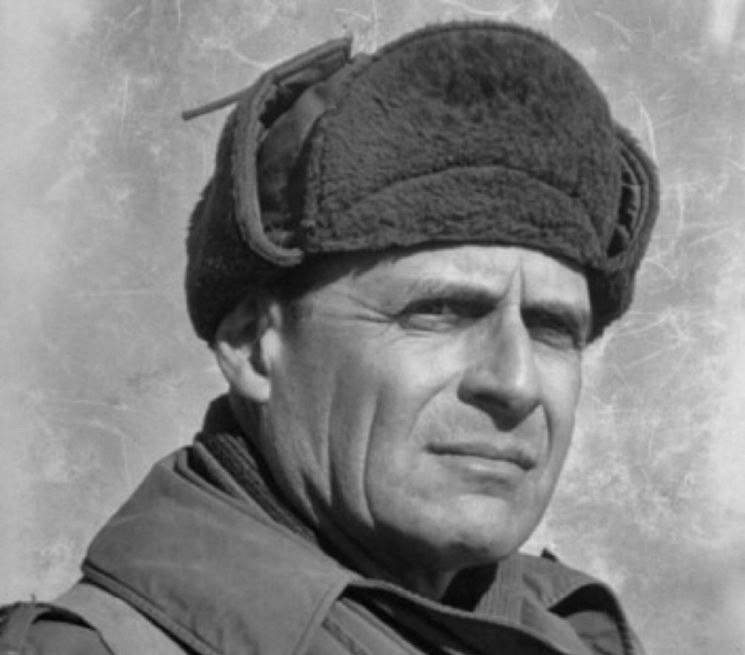 General Ridgeway, who was appointed as the new commander of the U.S. Eighth Army, was unaware of Washington's decision to withdraw troops. Meanwhile, a small-scale reconnaissance operation conducted during this time became a significant turning point.
What is often overlooked is that this was the greatest crisis of the Korean War. Had the U.S. followed Washington’s plan to withdraw, the Republic of Korea would have met its end. Because of the gravity of the matter, no indication was given to the South Korean government to avoid causing unrest, and only a very small number of the highest-ranking U.S. military officials were aware of the plan. Consequently, the U.S. 8th Army, unaware of this, was preparing to abandon the 37th parallel and fall back to the Nakdong River to establish a defensive line if the PVA offensive resumed.
Gloomily, given the circumstances at the time, if the PVA launched another offensive, this worst-case scenario was entirely possible. At this desperate moment, Matthew B. Ridgway, who had just been appointed as the new commander of the U.S. 8th Army following the sudden death of his predecessor, noticed that the PVA seemed to hesitate after capturing Seoul, contrary to expectations, and decided to conduct a powerful reconnaissance operation. A regimental-sized reconnaissance unit was sent on a small-scale operation, though at this point there were no high expectations; the goal was merely to determine when the enemy’s next offensive might begin.
For this operation, named Wolfhound, the reinforced 27th Regiment of the U.S. 25th Division, augmented by one tank battalion, artillery, and engineers, set out on January 15, 1951. The 27th Regimental Combat Team, fully prepared, advanced slowly northward along Highway 1 to Suwon, where the PVA was believed to be preparing an offensive. In retrospect, this operation, initially conducted as a test, became another critical turning point in the Korean War.
The next morning, upon entering Suwon, the 27th Regimental Combat Team encountered a large PVA force but, since the mission was not to engage, they withdrew calmly under air cover. However, the results obtained were quite encouraging. They found the PVA troops to be extremely exhausted and, in particular, discovered significant logistical problems. Ridgway judged that the PVA would find it difficult to launch an immediate follow-up offensive, so there was no need to be overly fearful.
© The Asia Business Daily(www.asiae.co.kr). All rights reserved.
![User Who Sold Erroneously Deposited Bitcoins to Repay Debt and Fund Entertainment... What Did the Supreme Court Decide in 2021? [Legal Issue Check]](https://cwcontent.asiae.co.kr/asiaresize/183/2026020910431234020_1770601391.png)
















