Due to the Impact of COVID-19, Universities Actively Conduct Online Lectures
Providing Videos and Publications as Class Materials Sparks Copyright Infringement Controversy
Copyright Commission States "Partial Use of Works for School Educational Purposes is Permitted"
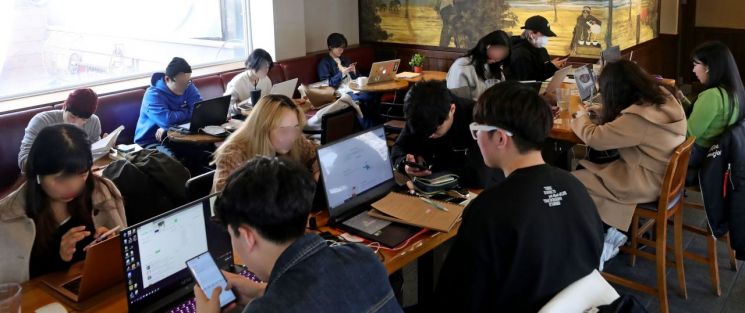 To prevent the spread of the novel coronavirus infection (COVID-19), on the second day of online lectures conducted by major universities in Seoul, on the afternoon of the 17th, university students and citizens were spending time at a cafe near Hongik University in Mapo-gu, Seoul. Photo by Yonhap News
[Asia Economy Reporter Kim Ga-yeon] "Isn't the movie file posted by the professor a copyright infringement?"
Universities, which had been postponing the start of the semester due to the impact of the novel coronavirus infection (COVID-19), are now choosing online semester openings one after another after much deliberation. However, after adopting real-time video conferencing classes and lecture video uploads, controversies over copyright infringement related to copyrighted materials provided as class materials have emerged.
As the COVID-19 situation prolongs, universities are fulfilling class days through online lectures using real-time video conferencing and lecture video uploads. The Ministry of Education announced the 'Academic Management Measures Related to COVID-19' last month, recommending universities to delay the semester start by up to four weeks. Additionally, it urged the expansion of online lectures while maintaining 15 weeks of class completion time.
In situations where face-to-face lectures are impossible, professors have started teaching online and are using audio or video materials as supplementary teaching aids during lectures. They also upload related files to the online classroom so that students can download them. These are all phenomena occurring while streaming real-time video lectures.
As a result, some are concerned about copyright infringement. Due to the lack of proper guidance on the use of copyrighted materials, students are showing anxiety or confusion. One university student argued, "Since it is used as educational material, it cannot be considered copyright infringement," while others raised their voices saying, "Even if it is for educational purposes, distributing copyrighted materials online is illegal," continuing the debate.
A 21-year-old student A attending a university in Seoul said, "The professor uploaded a documentary file on the online classroom page as a reference for an assignment," adding, "It's convenient for me because I don't have to look for it separately, but I'm curious if there is any copyright issue."
He continued, "If you download it, the students will have the file, right? And if students want, they can redistribute it, so I wonder if this act might cause another controversy," he added.
Meanwhile, a 25-year-old student B said, "I understand that there is no copyright issue when used for educational purposes, but many around me say 'of course it's copyright infringement,' so I am confused."
B said, "I think these criticisms arise because of a lack of awareness about copyright and no related guidance. Even among professors, there are differing opinions," adding, "Whether copyrighted materials can be used legitimately or not, I think the school should provide accurate explanations."
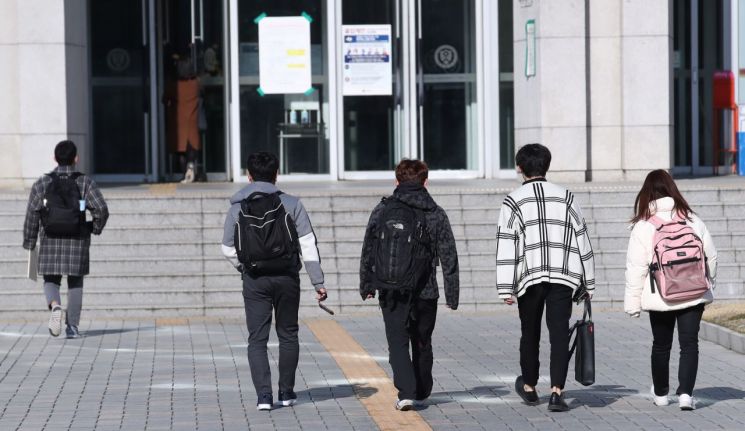 Due to the impact of the novel coronavirus infection (COVID-19), major universities in Seoul started the semester on the 16th through online and other non-face-to-face lectures. Students are entering the Central Library of Yonsei University in Seodaemun-gu, Seoul. Photo by Yonhap News
Recently, when it became known that a famous Japanese volleyball animation was used as class material at a university in Seoul, copyright infringement controversies continued on social media. Netizens responded with comments such as "They are blatantly doing illegal things," "How are they handling copyright?" "Isn't distribution allowed for educational purposes?" and "I know there is no problem if it is not for commercial use."
Experts explained that the use of copyrighted materials for educational purposes is permitted under copyright law.
An official from the Korea Copyright Commission Counseling Center stated, "Using copyrighted materials for school education purposes is allowed under Article 25 of the Copyright Act," adding, "In principle, only partial use is appropriate, but in unavoidable cases, the entire work can be used exceptionally."
According to the official, it is difficult to allow full use of videos, and full use is permitted for poems, paintings, photographs, etc.
The official said, "The problem arises when sharing materials via file download methods, where anti-copying measures must be taken," adding, "If access to the online classroom is restricted to enrolled students only or minimal anti-copying measures are implemented, it may not be a problem, but it is difficult to definitively say whether it is illegal. Each case needs to be examined."
He continued, "Showing parts of movies during real-time video lectures is less problematic," and "When published works are used as class materials, paying a certain compensation fee resolves the issue. Each university handles the compensation fees."
Meanwhile, Article 25 of the Copyright Act (Use for School Education Purposes, etc.) stipulates that educational institutions and educational support institutions under special laws or the Early Childhood Education Act, Elementary and Secondary Education Act, and Higher Education Act may reproduce, distribute, perform, exhibit, or publicly transmit parts of published works when deemed necessary for teaching or support purposes.
However, if it is unavoidable to use the entire work considering the nature of the work and the purpose and form of use, the entire work may be used. The Higher Education Act includes universities, industrial universities, education universities, junior colleges, broadcasting universities, correspondence universities, cyber universities, and technical colleges.
© The Asia Business Daily(www.asiae.co.kr). All rights reserved.


















