"GDP Growth Rate Expected to Decline Significantly"
[Asia Economy Phnom Penh Correspondent An Gil-hyun] Cambodia's economy has been identified as the most vulnerable to the spread of the novel coronavirus infection (COVID-19) among the Association of Southeast Asian Nations (ASEAN) countries. Analysis shows that Cambodia's gross domestic product (GDP) growth rate is expected to decline the most among ASEAN member states.
According to local Cambodian media on the 17th, the Asian Development Bank (ADB) recently released a report titled "Economic Impact of COVID-19 on Emerging Asia," forecasting that if COVID-19 persists for six months, Cambodia's GDP growth rate will decrease by 3.49%. This amounts to $856.5 million.
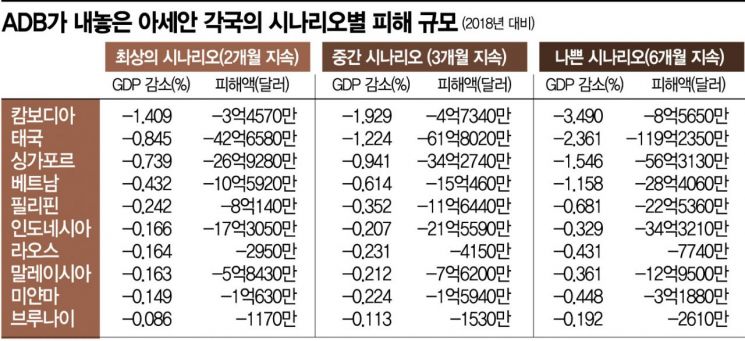
Based on data as of late January, ADB categorized scenarios as follows: the 'best-case scenario' assumes the COVID-19 situation will calm down and related restrictions will be lifted by the end of this month; the 'middle scenario' assumes a three-month duration until the end of April; and the 'worst-case scenario' assumes a six-month duration until the end of July, estimating the economic damage to emerging Asian countries accordingly.
ADB projected that under the best-case and middle scenarios, Cambodia's growth rate would decline by 1.409% and 1.929%, respectively, resulting in unavoidable GDP contractions of $345.7 million and $473.4 million. The economic damage from COVID-19 is significant in areas such as tourism revenue's share of GDP, the proportion of Chinese tourists among all foreign visitors, exports to China, and the extent of exposure to global value chains linked to China.
Following Cambodia, ADB forecasts that Thailand and Singapore will experience the largest GDP declines within ASEAN.
Under the 'worst-case scenario,' Cambodia's GDP growth rate is the most vulnerable at -3.49%. Thailand follows at -2.361%, Singapore at -1.546%, Vietnam at -1.158%, and the Philippines at -0.681%. The amount of damage correlates with economic size, with Thailand estimated at $11.9235 billion, Singapore at $5.6313 billion. Indonesia and Vietnam are estimated to suffer $3.4321 billion and $2.8406 billion in damages, respectively, while Cambodia's damage is estimated at $856.5 million.
Since Cambodia's first confirmed COVID-19 case on January 27, the country has been on high alert after a second case was confirmed on the 7th of this month. Following the second case, six additional cases were confirmed at intervals of 2 to 3 days until the 15th. Consequently, schools in Phnom Penh and Siem Reap were closed. Since all but one confirmed case are foreigners, it is assessed that the situation has not yet progressed to community transmission.
The Cambodian government had been passive regarding the spread of COVID-19. However, following the consecutive confirmed cases, it banned cruise ship entries via the Mekong River starting from the 13th, and from the 17th announced a 30-day entry ban on travelers from Italy, Germany, Spain, France, and the United States, followed by a 30-day entry ban on Iranians starting the 18th.
Prime Minister Hun Sen instructed all ministries and agencies to reduce expenditures by up to 50%, including postponing infrastructure projects funded by government resources to next year and refraining from overseas business trips. Additionally, to prevent economic recession caused by a decline in foreign tourists and supply disruptions of raw materials from China, he announced that if COVID-19 persists for one year, up to $2 billion in contingency funds will be injected to stimulate the economy.
© The Asia Business Daily(www.asiae.co.kr). All rights reserved.
![User Who Sold Erroneously Deposited Bitcoins to Repay Debt and Fund Entertainment... What Did the Supreme Court Decide in 2021? [Legal Issue Check]](https://cwcontent.asiae.co.kr/asiaresize/183/2026020910431234020_1770601391.png)