Fighterchi Institute Analysis 'Impact of COVID-19 on the National Economy'
[Asia Economy Reporter Kim Daeseop] A study has found that if annual consumer activity contracts by 10% due to the novel coronavirus infection (COVID-19), the total real production of small and medium-sized enterprises (SMEs) will decrease by approximately 18 trillion won, and about 30,000 jobs will be lost.
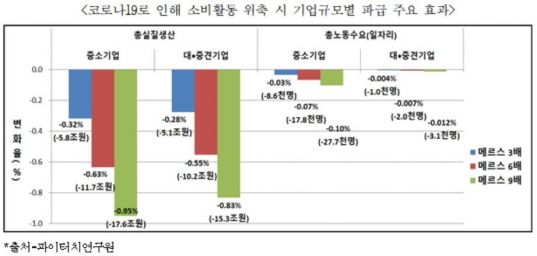
On the 16th, the FightTech Research Institute Foundation analyzed in its report titled "The Impact of COVID-19 on the National Economy" that if annual consumer activity contracts by 10% due to COVID-19, the total real production and total labor demand (jobs) of SMEs will decrease by 0.95% (17.6 trillion won) and 0.10% (27,700 people), respectively.
The institute projected that the total real production and total labor demand of large and medium-sized enterprises will decrease by 0.83% (15.3 trillion won) and 0.012% (3,100 people), respectively.
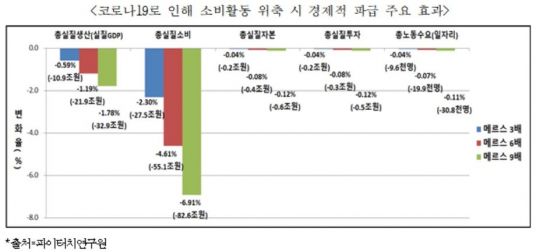
Overall, total real gross domestic product, total real consumption, and total labor demand will decrease by 1.78% (32.9 trillion won), 6.91% (82.6 trillion won), and 0.11% (30,800 people), respectively. Total real capital will decline by 0.12% (600 billion won), and total real investment will decrease by 0.12% (500 billion won).
This report incorporated cash and credit cards as payment methods into the model to concretely analyze transactional behavior between buyers and sellers. Through this, it presented how the contraction in consumer activity caused by COVID-19 affects the entire economy.
The annual contraction in consumer activity was divided into cases where it is 3 times (-3.36%), 6 times (-6.72%), and 9 times (-10.08%) greater than during the Middle East Respiratory Syndrome (MERS). The degree of annual consumer activity contraction during MERS was analyzed based on the average annual decrease rate of monthly retail sales in 2015. Since retail sales sharply declined over three months (June to August 2015) due to MERS, lowering the annual average retail sales by 1.12%, the annual contraction in consumer activity due to MERS was determined to be 1.12%.
When the annual contraction in consumer activity due to COVID-19 is three times that of MERS, the quantity of goods purchased with cash and credit cards decreases by 0.18% and 0.01%, respectively. At six times, they decline by 0.38% and 0.03%, respectively. At nine times, they decrease by 0.60% and 0.04%, respectively.
Looking at company size, when the annual contraction in consumer activity due to COVID-19 is three times that of MERS, the total real production and total labor demand of SMEs decrease by 0.32% (5.8 trillion won) and 0.03% (8,600 people), respectively. For large and medium-sized enterprises, total real production and total labor demand decrease by 0.28% (5.1 trillion won) and 0.004% (1,000 people), respectively.
At six times, SMEs see decreases of 0.63% (11.7 trillion won) and 0.07% (17,800 people), respectively. For large and medium-sized enterprises, the decreases are 0.55% (10.2 trillion won) and 0.007% (2,000 people), respectively.
Changes in macroeconomic variables are also observed. When the annual contraction in consumer activity is three times that of MERS, total real gross domestic product, total real consumption, total real capital, total real investment, and total labor demand decrease by 0.59%, 2.30%, 0.04%, 0.04%, and 0.04%, respectively. At six times, they decline by 1.19%, 4.61%, 0.08%, 0.08%, and 0.07%, respectively.
Ra Jung-joo, director of the FightTech Research Institute, said, "To recover the economy, it is necessary to actively execute the 2020 government budget and supplementary budget while closely monitoring the livelihoods of low-income groups, and to lower the base interest rate so that fiscal policy can have a synergistic effect through close cooperation. Efforts to improve business conditions, such as expanding the unit period of flexible working hours, should also be pursued together."
© The Asia Business Daily(www.asiae.co.kr). All rights reserved.


















