Restaurant Industry Business Index Hits Lowest... COVID-19 Variable This Year
More Severe Impact Than MERS... Recovery Impossible Within the Year
COVID-19 Shock Lasts at Least 6 Months... Government Support Urged
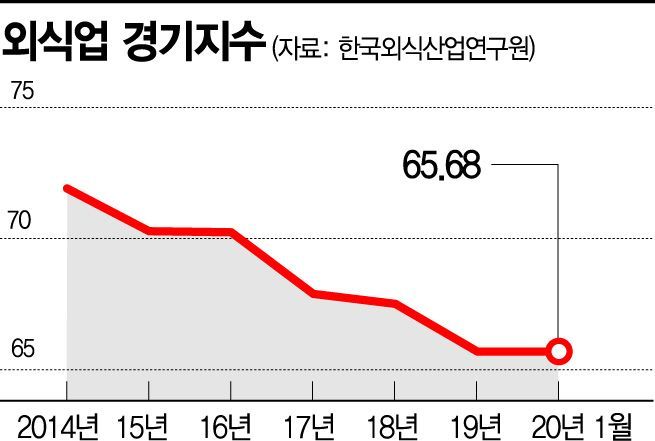
[Asia Economy Reporter Lee Seon-ae] The dining-out industry is on a downward spiral. The dining industry business index recently recorded its lowest level in six years, and the outlook is even more pessimistic. Amid struggles with skyrocketing labor costs, rent, and various raw material price increases, the unexpected variable of the novel coronavirus infection (COVID-19) has raised concerns that the dining-out industry recession will accelerate.
According to the March dining industry statistics from the Korea Foodservice Industry Research Institute on the 16th, the dining industry business index for January was 65.68, marking the lowest level in comparable public statistical indicators ever recorded. Looking at the figures over the past six years, it was 71.91 in 2014, 70.28 in 2015, 70.24 in 2016, 67.89 in 2017, and 67.51 in 2018. Last year, it fluctuated between 65.97, 65.08, and 66.01, then dropped to 65.68 from October, averaging 65.69. The dining industry business index is based on a scale of 50 to 150, where exceeding 100 indicates growth and below 100 indicates contraction. The Korea Foodservice Industry Research Institute cited soaring rent, labor costs, and raw material prices as factors sustaining the downward trend in the mid-60s.
The market conditions in January for small business owners operating restaurants and self-employed individuals running eateries in traditional markets were recorded at 60.9 and 62.4, respectively. A figure above 100 indicates improvement, while below 100 indicates deterioration. The situation is particularly severe for self-employed operators of eateries within traditional markets. Compared to 68.3 in 2014 and 67.3 in December last year, this represents a sharp decline.
The outlook is even more pessimistic due to the sharp drop in sales caused by the spread of COVID-19. However, with forecasts suggesting the COVID-19 shock will last at least six months, evaluations indicate that the dining industry indicators have not yet hit bottom. The accommodation and food service industry business outlook index was 72.8 in January, a steep drop compared to 92.2 in December last year. An index below 100 means many companies expect further deterioration in the future.
This phenomenon was clearly revealed in the results of five surveys conducted by the Korea Foodservice Industry Research Institute on the impact of COVID-19. Since the first confirmed case on January 20, customer numbers at dining establishments have steadily declined. In the fifth survey conducted over four days from March 3 to 6, targeting 600 member establishments of the Korea Foodservice Industry Association, 95.2% of dining businesses responded that customer numbers decreased after the domestic confirmation of COVID-19 cases. The cumulative customer decrease rate across all establishments was confirmed to be 65.8%. Previously, the average customer decrease rates after confirmed cases were 29.1% in the first survey, 26.1% in the second, 32.7% in the third, and 59.2% in the fourth.
Seo Yong-hee, senior researcher at the Korea Foodservice Industry Research Institute, emphasized, "The dining industry suffered an average sales decline of about 34% during the Middle East Respiratory Syndrome (MERS) outbreak, but the current impact is far greater than during the MERS or Severe Acute Respiratory Syndrome (SARS) crises." He continued, "It took 4 to 5 months to recover from the damages caused by the MERS outbreak, but recovery from the COVID-19 impact seems unlikely within this year. The government must promptly prepare and implement effective and concrete support measures for frontline dining businesses."
© The Asia Business Daily(www.asiae.co.kr). All rights reserved.

















