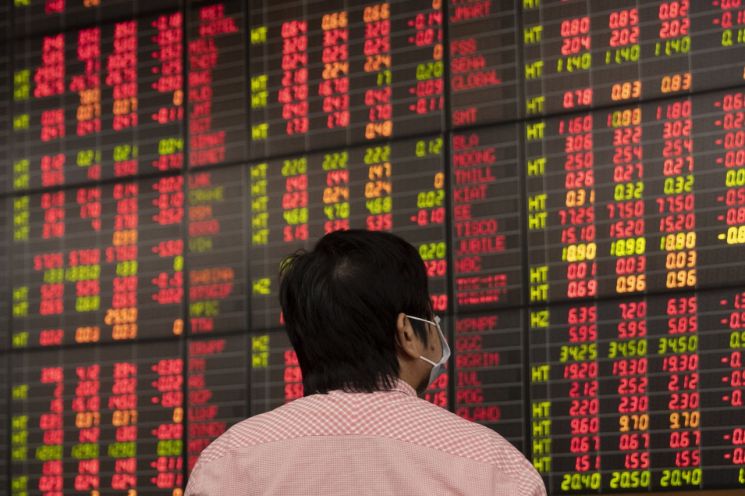
[Asia Economy Reporter Jeong Hyunjin] Amid the ongoing global stock market crash caused by the spread of the novel coronavirus infection (COVID-19), on the 13th, Japan's Nikkei 225 index closed down more than 6%. Following the U.S. and Europe, the Asian stock markets are also experiencing consecutive days of COVID-19-induced plunges.
On this day, the Nikkei 225 index on the Tokyo Stock Exchange closed at 17,431.05, down 6.08% (1,128.58 points) from the previous trading day. This marked the lowest level in 3 years and 4 months since November 2016. The Nikkei 225 index, which started the day down 2.02%, saw its intraday decline widen to nearly 10%, breaking below the 17,000 level. The Nikkei 225 index fell about 16% over the course of a week. The TOPIX index also closed down 4.98% (66.18 points) at 1,261.70.
Nihon Keizai reported, "As concerns over a global economic recession due to the spread of COVID-19 intensified, investors sought to withdraw assets from risky assets," adding, "Not only hedge funds but also institutional investors managing mid- to long-term funds sold off on the Tokyo Stock Exchange, causing prices to fall sharply."
With the Tokyo Stock Exchange plunging and financial market volatility increasing, the Japanese government and the Bank of Japan (BOJ) held an emergency meeting in the morning. This was the second emergency meeting held this week following the one on the 9th. They stated, "We will closely monitor market and economic trends and work together as one if necessary." They also announced plans to further strengthen coordination with the Group of Seven (G7) and others.
On this day, stock markets worldwide, including major Asian countries, all plummeted. South Korea's KOSPI and KOSDAQ indices closed at 1,771.44 and 524.00, down 3.43% and 7.01%, respectively. Sidecars and circuit breakers were simultaneously triggered in both the KOSPI and KOSDAQ markets, but these measures were insufficient to halt the rapidly falling indices. As of 3:17 PM Korean time, China's Shanghai Composite Index and Hong Kong's Hang Seng Index were trading down 1.63% and 3.48%, respectively, compared to the previous trading day.
Earlier, on the 12th (local time), the Dow Jones Industrial Average on the New York Stock Exchange closed at 21,200.62, plunging 9.99% (2,352.60 points) from the previous close. The S&P 500 and Nasdaq indices also fell 9.51% and 9.43%, respectively. The Dow recorded its largest single-day drop since the so-called "Black Monday" in 1987, when it fell more than 22%.
On the same day, European stock markets also crashed. The pan-European STOXX 600 index fell 11.48%, while Germany's DAX and the UK's FTSE indices dropped 12.24% and 10.87%, respectively. France's CAC index also fell 12.28%. Despite the European Central Bank (ECB) keeping its key interest rates and deposit rates unchanged, announcing a temporary additional net asset purchase of 120 billion euros until the end of the year, and introducing a low-interest long-term refinancing operation (LTRO) to fill the gap until the targeted long-term refinancing operation (TLTRO III) begins in June, the downward trend did not stop.
© The Asia Business Daily(www.asiae.co.kr). All rights reserved.
![User Who Sold Erroneously Deposited Bitcoins to Repay Debt and Fund Entertainment... What Did the Supreme Court Decide in 2021? [Legal Issue Check]](https://cwcontent.asiae.co.kr/asiaresize/183/2026020910431234020_1770601391.png)
















