$13.8 billion loan borrowed last month
All withdrawn to secure liquidity
Unable to deliver due to 737 Max production ban
Air travel demand plummets amid COVID-19 spread... order cancellations continue
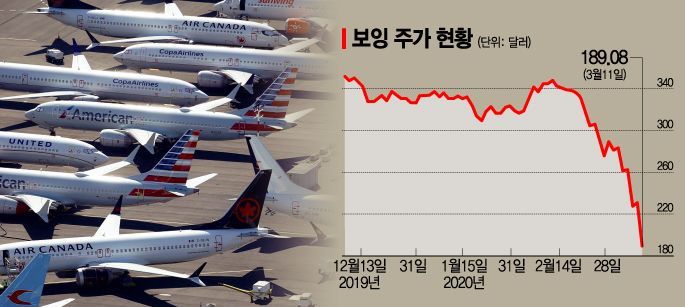
Stock price plunges over 18% due to overlapping adverse factors
[Asia Economy Reporter Kwon Jaehee] Boeing announced that it plans to withdraw the entire balance of the $13.8 billion loan it received last month to secure liquidity. The urgent need for cash arose as adverse factors piled up, including consecutive crashes and the global pandemic of COVID-19 causing a sharp decline in worldwide air travel demand. Boeing's liquidity crisis, as a leading U.S. company, draws attention as it could become another trigger for the U.S. economy.
According to U.S. media such as The Wall Street Journal (WSJ) on the 11th (local time), Boeing announced that it plans to withdraw the entire loan balance as early as the 13th. Boeing had approved a bank loan of $13.8 billion last month. In addition to withdrawing the full loan amount to secure liquidity, Boeing stated it would implement cost-cutting measures such as freezing hiring and unnecessary business trips and limiting overtime work.
Boeing's rush to secure the loan stems from the urgent need to secure liquidity for survival. The ban on production of the 737 Max model increased the debt size, and the compensation Boeing must pay due to two crashes has ballooned to astronomical amounts. Furthermore, with the declaration of the COVID-19 pandemic, global air travel demand has sharply declined, leading to successive cancellations of airline orders. Currently, Boeing's debt size reaches $27.3 billion (approximately 32.7 trillion KRW).
David Calhoun, Boeing's Chief Executive Officer (CEO), said, "Holding cash during difficult times is important for any company."
The biggest problem was the fatal blow from being unable to deliver the new Max aircraft due to consecutive crashes. Previously, Boeing's flagship model, the 737 Max, was grounded in over 40 countries worldwide after crashes involving Indonesia's Lion Air passenger plane in October 2018 and Ethiopian Airlines passenger plane in March 2019, resulting in a total of 346 deaths. Consequently, production has been halted since January. Boeing had announced plans to resume 737 Max operations in June, but the U.S. Federal Aviation Administration (FAA) pointed out wiring configuration defects in the model for safety reasons. Therefore, the resumption of operations is widely expected to be delayed further.
Additionally, the spread of COVID-19 led countries to impose entry restrictions, causing a sharp decline in global air travel demand. The decrease in air travel demand negatively affects aircraft orders. Boeing announced that 46 aircraft orders were canceled last month, including 11 from Air Canada. In contrast, Boeing delivered only 17 aircraft last month. Over 200 aircraft orders were canceled last year.
AeroCap Holdings, the world's largest aircraft leasing company, said, "Global travel restrictions have made it impossible to deliver aircraft."
Due to consecutive adverse factors, Boeing's stock price also plummeted. According to CNBC on the day, Boeing's stock price fell more than 18%. This is the largest drop in 46 years since 1974. U.S. media analyzed that Boeing's stock price decline had a significant impact on the Dow Jones Industrial Average's plunge that day.
© The Asia Business Daily(www.asiae.co.kr). All rights reserved.

















