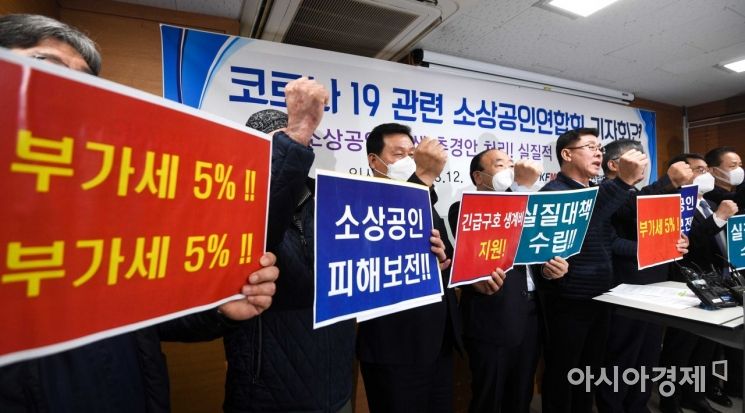
 Kim Im-yong, Acting President of the Korea Federation of Micro Enterprise Associations, along with other association officials, held an emergency press conference on the 12th at the Korea Federation of Micro Enterprise Associations in Dongjak-gu, Seoul, regarding COVID-19 damage cases among small business owners, shouting slogans demanding the guarantee of their right to survival. Photo by Kang Jin-hyung aymsdream@
[Sejong=Asia Economy Reporter Kim Hyunjung] Amid growing concerns over an economic downturn caused by the novel coronavirus infection (COVID-19), voices calling for urgent discussions on tax cuts are increasing. As the consumption coupons, already proposed as a countermeasure through the government's supplementary budget plan, face growing criticism of ineffectiveness, these calls seem to be gaining momentum. With recommendations to refrain from external contact for quarantine and health reasons, providing tax reduction benefits tailored to each economic actor is considered more effective in defending the economy than cash handouts.
According to the National Assembly's Planning and Finance Committee on the 12th, lawmakers from both ruling and opposition parties have consecutively submitted resolutions earlier this month demanding that the government implement tax cuts targeting small and medium-sized enterprises (SMEs) and small business owners to alleviate damages caused by the spread of COVID-19. The resolutions mainly call for ▲corporate tax reductions for SMEs such as export companies affected by COVID-19 ▲comprehensive income tax reductions for small business owners who have suffered the most damage ▲employment stability demands through support for the four major insurances including employment insurance for export companies, SMEs, and small business owners. Eleven lawmakers from the Democratic Party of Korea, seven from the United Future Party, and three independents signed these resolutions. This is an unusually bipartisan voice ahead of the general election. On the same day (the 12th), Hwang Kyo-ahn, leader of the United Future Party, also mentioned at the Supreme Council meeting held at the National Assembly main building, "Supplementary budgets are not a panacea. Drastic measures such as corporate tax cuts and differentiated minimum wage application by industry should be temporarily implemented."
However, no specific legislative bills reflecting these demands have been proposed yet, and regarding tax cuts, only an amendment to the Restriction of Special Taxation Act (RSTA), which is scheduled for approval at the plenary session on the same day, has been proposed so far. This amendment includes provisions to compensate tenants with income and corporate tax credits for rent reductions and to reduce value-added tax payments for small business owners.
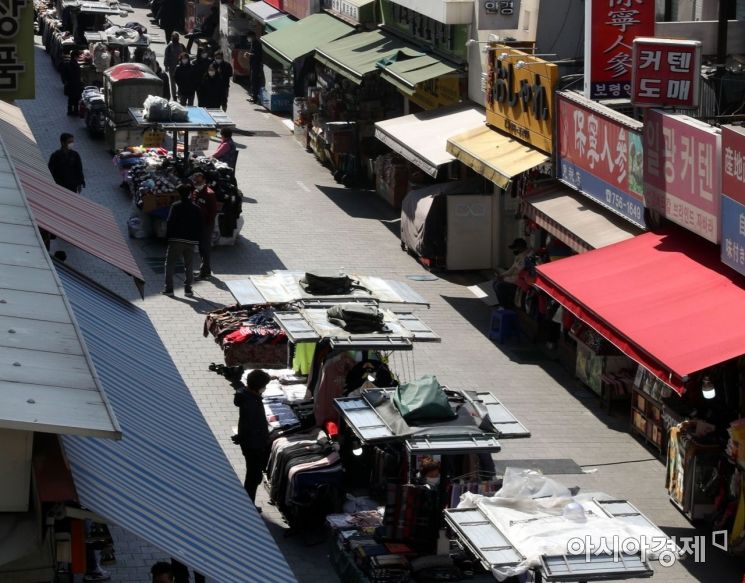 On the 8th, marking the weekend, Namdaemun Market, Seoul's representative traditional market, showed a quiet scene due to the impact of COVID-19. Photo by Yoon Dong-joo doso7@
One of the backgrounds for additional tax cut demands is the criticism from inside and outside that the 'consumption coupons,' which the government presented as a core support measure in the COVID-19 supplementary budget, are unlikely to have a significant effect on stimulating actual consumption. Previously, the Ministry of Economy and Finance announced through the supplementary budget plan that it would provide gift certificates worth a total of 2.2 trillion won to basic livelihood security recipients, child-rearing households, elderly job participants, and others to stabilize livelihoods and enhance consumption capacity.
Regarding this, the National Assembly Budget Office pointed out the effectiveness in its 'Analysis of the 2020 First Supplementary Budget' report released on the 11th. The office stated, "Local love gift certificates are promoted by each local government through ordinances, making systematic and efficient management difficult. Considering that the gift certificates have a validity period of five years, immediate consumption stimulation effects may not appear through the increase in gift certificates under the 2020 supplementary budget." It also criticized, "The variety of affiliated stores where gift certificates can be used and the products that can be purchased are not diverse, and accessibility is low, making it difficult to achieve the project goal of revitalizing the local economy." Joo Won, head of research at Hyundai Research Institute, also said, "Increasing the supplementary budget size or providing cash-like support to consumers through consumption coupons is cumbersome to budget and cannot guarantee effectiveness. Rather, drastically cutting taxes is more precise and faster in terms of effectiveness."
In response, a Ministry of Economy and Finance official explained, "Significant tax cuts, unlike deferrals of corporate or income tax payments, require changing the law," adding, "Currently, tax cut discussions related to COVID-19 are focused on the existing proposed RSTA amendment." Another official said, "Now is the time to concentrate all efforts on responding based on the supplementary budget that has been prepared."
© The Asia Business Daily(www.asiae.co.kr). All rights reserved.


















