[2020 New Year Project - Generational Coexistence, Building Society Together]
<9>Our Future Is Not Your Present
'Age=Class' Older Generation with Strong Self-Assertion
Emotions Flare Due to Blatantly Rude Behavior
Misunderstanding of Generation Without Infinite Competition Like Employment
Adults Challenging and Striving Are the Subject of 'Respect'
Intergenerational Respect Based on Horizontal Structure Is Distant
[Asia Economy Reporter Lee Jung-yoon] Adults teach the youth, and the youth respect those adults. Social experience is passed down from generation to generation in this way. But these days? "Adults scold, and the youth rebel."
At some point, the relationship between elders and juniors in our society began to change. The current generation does not blindly follow the path laid out by their elders. They even deny and mock it. What kind of change has come to the values and common sense that have supported this society? Are today's youth, symbolized by the millennial generation, sudden mutants who appeared out of nowhere, or are the current older generations much "worse" people compared to their predecessors? Or is the current "gap" just a replay of the recurring conflicts between the new and old generations?
"We don't want to grow old like that"
The millennial generation unanimously answers "no" when asked if they want to become like the older generation. They say living like them would not be happy. This is because they see adults trapped in their own frameworks, acting irritable too easily. University student Shabu Shabu (23, nickname) defined the "older generation" as "people who act as if age is a rank or refuse to listen to others." He added, "I even hate encountering adults who only assert their own opinions." Slam Dunk (22) gave a stronger response: "Honestly, I often feel frustrated. Seeing people who act as if being older is a privilege, I sometimes feel they lack manners more than we young people."
The young people's resentment toward adults stems from very everyday, trivial actions. Adults who use their age as a weapon to demand priority on public transportation or speak informally to part-time caf? or restaurant workers. At first, these were dismissed as minor issues. But as such rudeness repeats endlessly, rebellious feelings inevitably arise. Let's hear more from Slam Dunk: "I am a person with feelings too. When I worked part-time at a caf?, I initially tolerated men who ordered using informal speech or women who pushed and cut in line on public transport. But living among such people continuously, I couldn't help but develop feelings of dislike."
"My pain is caused by the world you created"
Adults might ask these young people if they are responding emotionally. Millennials answer that the pain they are experiencing now stems from the world created by adults.
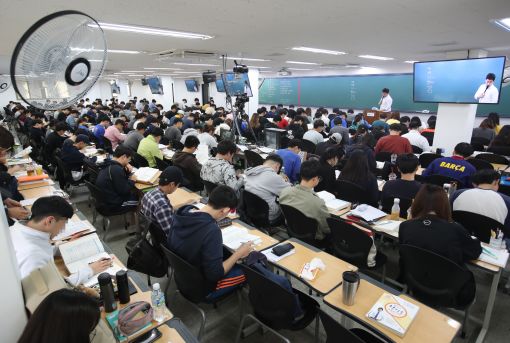
The biggest pain for millennials living today is the employment crisis. Brutal employment rates and crowded classrooms in civil service exam academies. Of course, compared to the poverty experienced by older generations, the physical hardship is less. But in the past, the phrase "If you try, you can succeed" was possible.
What about now? Even if you diligently undergo early education and advanced learning to enter so-called good universities, or get a job at a coveted company, the end of the tunnel is not in sight. The endless competition of building credentials begins again. This competitive structure is the game rule created by the older generations who led society in the past or present.
Youth have never voted in favor of this endless competition system. Exhausted millennials even imagine living through the time when the older generation was young. Alice (25) said, "I want to go back to when the older generation was preparing for employment and compare which generation is struggling more in the tough job market." Bulgama Jjimjilbang (33) also said, "I prepared for three years to become a level 9 civil servant. I imagined that in the older generation's time, I might have become a civil servant right after graduating from university."
"Of course, there are adults I want to resemble"
That said, millennials do not hold unconditional resentment toward adults. They say they want to be like older generations who are not "kkondae" (authoritarian) and have something special. Kim Jakga (27) said, "There is an adult around me who enjoys camping and extreme sports, and seeing them continue to challenge themselves even as they age inspired me to want to grow old like that." He added, "I also remember my middle school history teacher. Although he was about to retire, he was so passionate that he made teaching materials every year." Millennials find such adults attractive.
When they see someone superior, they naturally want to resemble that person. Listening to millennials, it seems that "age" no longer holds persuasive power as a reason for respect. Something special is required. Growing old does not naturally make one special. Therefore, rather than those who treat age as a rank, they choose role models who strive not to be left behind despite their age and want to emulate them. Change and effort are no longer virtues demanded only of the youth but have become societal expectations.
"It's time to consider the youth's criticism"
The voices demanding change may feel harsh. As people age, changing something is not easy, and for the older generation, words like change and passion do not easily resonate. But when one questions what was taken for granted and does not shy away from difficult paths, respect and esteem follow. Let's hear from Professor Choi Hang-seop of the Department of Sociology at Kookmin University: "If our society in the past valued efficiency based on vertical structures, now is the time for intergenerational respect in equal relationships. The criticism from millennials can bring behavioral changes in the older generation and help break away from vertical and hierarchical structures." Professor Choi added, "At a time when horizontal communication and free exchange of opinions have become important virtues for creativity, millennials' criticism of adults is a healthy signal sent to Korean society."
Indeed, today's generational conflicts are not fundamentally different from those in the past. Only the environment has changed significantly. As with every new generation, today's millennials are simply more honest, and the harshness of life has made them more aggressive. And the responsibility lies with the older generation. Even if they protest that it is not their responsibility, the previous generation to share that responsibility is no longer in this world. Whether to acknowledge responsibility and accept the changed environment, whether to choose coexistence with millennials or not?the question has been posed by the youth, and the choice now rests with the older generation.
© The Asia Business Daily(www.asiae.co.kr). All rights reserved.
![From Hostess to Organ Seller to High Society... The Grotesque Scam of a "Human Counterfeit" Shaking the Korean Psyche [Slate]](https://cwcontent.asiae.co.kr/asiaresize/183/2026021902243444107_1771435474.jpg)
















