Emergency Loan Fund of 500 Billion Yen Secured... Retroactive Application to Existing Borrowing Companies
[Asia Economy Reporter Jeong Hyunjin] The Japanese government is preparing a loan system targeting small and micro businesses, including sole proprietors, as a measure to prevent the deterioration of corporate liquidity caused by the novel coronavirus infection (COVID-19). Prime Minister Shinzo Abe appears to be hastening economic measures amid ongoing criticism over COVID-19 response actions, such as the sudden nationwide school closures and entry restrictions on travelers from Korea and China.
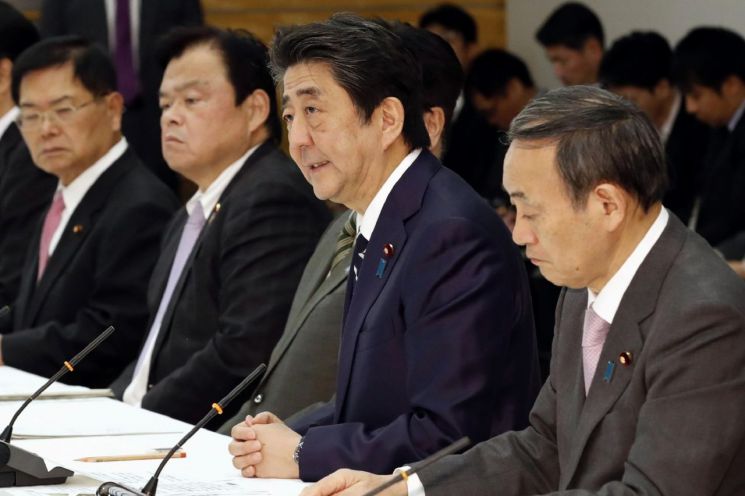
According to NHK and other sources on the 8th, Prime Minister Abe held a COVID-19 response headquarters meeting at the Prime Minister’s Official Residence the previous day to discuss these matters. The Abe administration plans to announce a second emergency COVID-19 countermeasure on the 10th, including these measures.
Earlier, on the 13th of last month, the Japanese government introduced a low-interest emergency loan program worth 500 billion yen (approximately 5.646 trillion won) targeting small and medium-sized enterprises (SMEs) whose financial conditions had worsened as part of COVID-19 countermeasures. At that time, the loan program was implemented for the tourism industry suffering from a decline in inbound tourists, but this time it is being expanded to respond to the impact spreading across various industries.
The upcoming loan program, to be offered through Japan Finance Corporation and others, will effectively provide interest-free and unsecured loans to support small and micro businesses facing closures and unemployment. This measure comes amid concerns that corporate liquidity will deteriorate by the end of the year due to the increasing possibility of an economic downturn caused by the spread of COVID-19.
The interest amount will be compensated by the national treasury, aiming to operate the loans with a practically interest-free structure. There is also discussion about retroactively applying the interest-free benefits to businesses that have already received emergency loans.
For large corporations and others, Prime Minister Abe has instructed consideration of a special loan system called "Crisis Response Loans," which provides low-interest loans in the event of disasters. NHK reported that operating funds are expected to be loaned immediately through government-affiliated financial institutions.
Prime Minister Abe stated, "We will prioritize employment retention and business continuity from an economic perspective," and urged, "Please promote strong liquidity measures for medium-sized and large companies as well." According to Nihon Keizai Shimbun, Japanese financial authorities have also requested private financial institutions to report on how they are responding to companies whose financial conditions are deteriorating.
Prime Minister Abe has recently faced domestic criticism over COVID-19 response measures. The sudden announcement of full school closures for elementary, middle, and high schools at the end of last month caused significant confusion. The closures were announced unilaterally without preparing measures for dual-income families during the shutdown, leading to internal criticism that the decision was hasty. In particular, Koichi Hagiuda, the Minister of Education, Culture, Sports, Science and Technology, who was in charge, opposed the measure but it was announced without further explanation, causing confusion at schools.
The entry restrictions targeting Korea and China announced on the 5th have also been criticized. Since COVID-19 was already spreading within Japan, the measure was seen as belated and was criticized as a move by Prime Minister Abe to solidify his political base among conservatives. Asahi Shimbun reported that Abe gave instructions to his close aides on the morning of the 4th, one day before the announcement, and that the measure was implemented without sufficient review.
© The Asia Business Daily(www.asiae.co.kr). All rights reserved.

















