After completing the status inspection of environmental and marine payloads in March, precision calibration will be conducted from April.
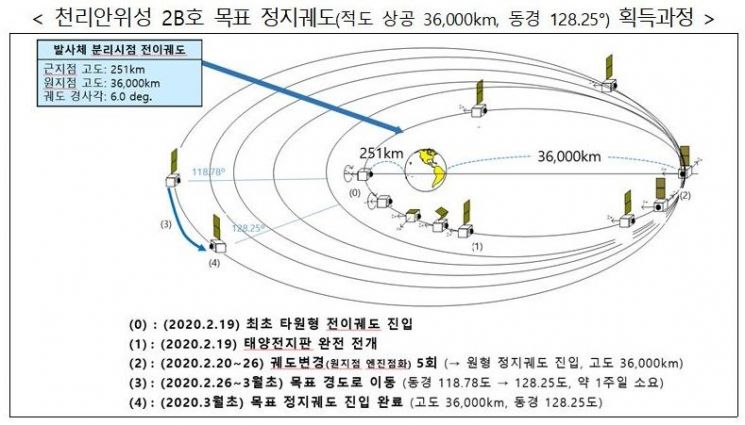
[Asia Economy Reporter Kwangho Lee] The Ministry of Science and ICT, the Ministry of Environment, and the Ministry of Oceans and Fisheries announced on the 8th that the Geostationary Korea Multi-Purpose Satellite 2B (3.4-ton class, hereinafter referred to as Cheollian Satellite 2B) successfully reached its target geostationary orbit (altitude 35,786 km, longitude 128.25°) safely around 7:30 PM on the 6th.
Launched on February 19, Cheollian Satellite 2B underwent a total of five orbit adjustments over seven days from the 20th to the 26th, transitioning from its initial elliptical transfer orbit to a circular geostationary orbit at an altitude of 35,680 km and longitude 118.78° East.
Subsequently, from the 27th to the 6th, it moved to and successfully settled into the target geostationary orbit at longitude 128.25° East. The geostationary orbit at longitude 128.25° East is the closest geostationary orbit above the equator secured by South Korea (Seoul is at longitude 127° East).
Cheollian Satellite 2B is equipped with the world's first hyperspectral environmental payload capable of continuous observation of fine dust and other air pollutants, as well as an ocean observation payload that performs enhanced ocean monitoring missions compared to Cheollian Satellite 1.
The environmental payload of Cheollian Satellite 2B observes fine dust by utilizing 'hyperspectral technology,' which exploits the characteristics of fine dust-causing substances such as sulfur dioxide and nitrogen dioxide?produced during fossil fuel combustion?that absorb and scatter light at specific wavelengths.
The hyperspectral observation equipment of the environmental payload was jointly developed by the Korea Aerospace Research Institute and the United States, while the algorithm for calculating concentrations of fine dust and other air pollutants was developed purely with domestic technology.
Cheollian Satellite 2B plans to actively participate in global environmental monitoring alongside upcoming geostationary atmospheric environment observation satellites from the United States (post-2022) and Europe (post-2023), and to provide atmospheric environment information to Asian countries, thereby contributing to the international community.
Ryu Jae-hyung, Director of Marine Industry Policy at the Ministry of Oceans and Fisheries, stated, "The successful settlement of Cheollian Satellite 2B into its target geostationary orbit is considered the final success of the launch." He added, "We thank the on-site researchers who made their best efforts for this achievement, and we will actively support Cheollian Satellite 2B to fulfill the expectations of the public."
© The Asia Business Daily(www.asiae.co.kr). All rights reserved.

















