[Asia Economy reporters Naju-seok and Jeong Hyunjin] Russia and Turkey have agreed to a 'ceasefire' regarding the military clashes that occurred in the Idlib area of Syria. International attention is focused on whether the flow of refugees crossing the border to escape attacks by the Syrian government forces will stop.
On the 5th (local time), Russian President Vladimir Putin and Turkish President Recep Tayyip Erdogan met in Moscow and, after a six-hour summit, agreed to halt all military activities in the Idlib area. The ceasefire agreement took effect at midnight on the same day.
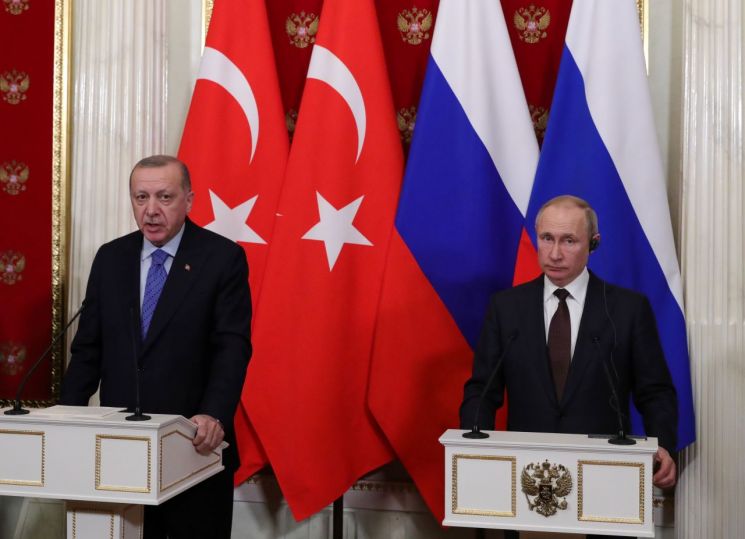
The Idlib area, the last stronghold of the Syrian rebels, has recently seen a surge in casualties due to military clashes between Turkey and Syria. This is because the Syrian government forces have intensified their offensive on the Idlib area, the last rebel stronghold, since the end of last year to bring an end to the nine-year civil war. According to the Turkish government, 58 Turkish soldiers lost their lives in this process, and 3,200 Syrian government soldiers were killed by Turkish forces.
Regarding the ceasefire agreement, both Russia and Turkey appear to have taken a step back. Turkey had insisted that the Syrian government forces should retreat to the border line agreed upon in 2018, but this was omitted from the ceasefire agreement. On the other hand, Turkey confirmed its stance to retaliate if the Syrian government forces launch an attack. President Erdogan stated, "Turkey has the right to respond most strongly to any attack by the Syrian government forces."
With the ceasefire established, attention is focused on whether the conflict between Turkey and Europe over the Syrian refugee issue can also ease. About one million refugees fled the area centered around Idlib due to the military clashes. In particular, Turkey's active response to the Idlib issue was to prevent Syrian refugees from crossing the Turkish border to escape the government forces. Turkey has already accepted 3.6 million Syrian refugees and has taken the position that it cannot accept any more. President Erdogan has recently used the refugee issue to pressure Europe to gain political support for Turkey. Having agreed in 2016 to help resolve the refugee issue in exchange for 6 billion euros (8 trillion won) in European refugee aid, he declared on the 28th of last month that "the period of unilateral sacrifice is over" and decided not to block refugees from heading to Europe. Because of this, the refugee issue resurfaced in Europe for the first time in four years.
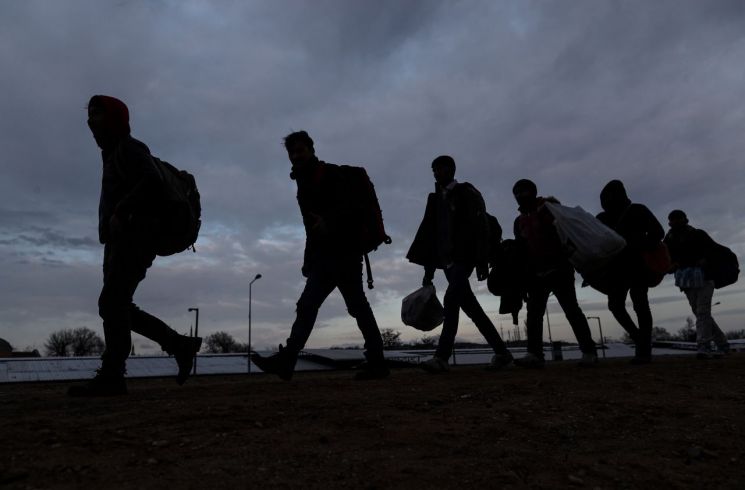
Russia and Turkey have recently agreed to support refugees who fled due to military clashes to return, but Europe still expresses concerns about the refugee issue. One foreign media outlet cited Greek government sources reporting that 35,000 refugees were denied illegal entry attempts in the past week. Tens of thousands of refugees are still gathering at the Turkey-Greece border.
The EU strongly criticized Turkey's actions and decided to provide 700 million euros to protect the Greek border and 170 million euros to assist vulnerable groups in war-torn Syria.
© The Asia Business Daily(www.asiae.co.kr). All rights reserved.
![From Bar Hostess to Organ Seller to High Society... The Grotesque Con of a "Human Counterfeit" [Slate]](https://cwcontent.asiae.co.kr/asiaresize/183/2026021902243444107_1771435474.jpg)

















