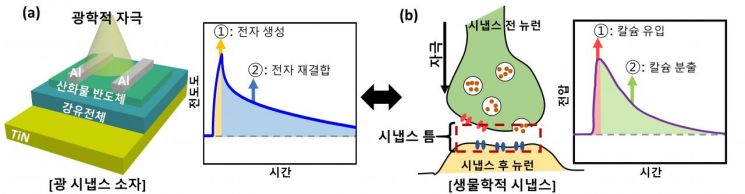
 An illustration depicting the similarity between the photoresponsiveness of an optical synapse device and the neurotransmitter responsiveness observed in synapses
[Asia Economy Reporter Junho Hwang] Domestic researchers have developed a neuromorphic chip capable of simultaneously performing memory and computation like the brain. This chip consumes less electricity than conventional semiconductors and can adjust the strength of signal transmission. It enables efficient processing of unstructured data such as images and videos, and is expected to be used as a semiconductor that functions as the brain for artificial intelligence, autonomous vehicles, and more. The National Research Foundation of Korea announced these recent research results from the team led by Professor Jang-Sik Lee of Pohang University of Science and Technology on the 3rd.
Neuromorphic Semiconductor 'Neuromochip' Inspired by the Brain
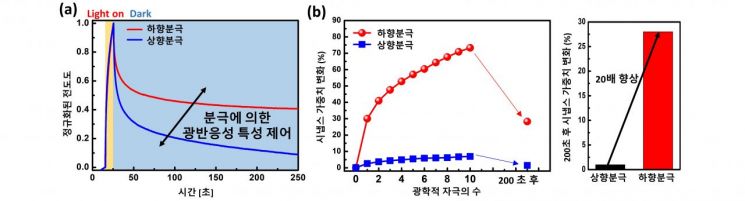 Graph illustrating the regulation of photoresponsiveness according to the polarization state of the ferroelectric layer and the resulting modulation of synaptic plasticity
The research team implemented the 'Neuromochip' using ferroelectric materials. This chip is a semiconductor that mimics the brain's synapse (the site where information transmission between nerve cells occurs), where information storage and processing are performed in parallel.
The team created an artificial synapse that operates by light by layering ferroelectric hafnium oxide (HfZrOx), which can maintain polarization characteristics on its own without external electrical stimulation, on a photoreactive oxide semiconductor layer used in displays (indium-gallium-zinc oxide, IGZO).
This chip operates by electrons generated by light recombining with each other when the light disappears. It processes information through the intensity of the current. In particular, the team was able to control electron recombination in the oxide semiconductor by utilizing ferroelectric materials. This means that the signal transmission strength of the device can be controlled by light.
Utilization as the Brain of Autonomous Vehicles

The research team stated, "It is significant that we not only mimicked synaptic plasticity using the photoreactive properties of oxide semiconductors but also overcame the limitations of existing oxide semiconductor-based photonic synapse devices by controlling synaptic plasticity characteristics through the polarization properties of the ferroelectric layer."
They added, "For practical application, it is necessary to further enhance the photoreactivity of oxide semiconductors to realize greater synaptic weight changes and to develop device integration technology. If commercialized, it is expected to be utilized in various fields such as facial recognition, autonomous vehicles, the Internet of Things (IoT), and intelligent sensors."
© The Asia Business Daily(www.asiae.co.kr). All rights reserved.
![Clutching a Stolen Dior Bag, Saying "I Hate Being Poor but Real"... The Grotesque Con of a "Human Knockoff" [Slate]](https://cwcontent.asiae.co.kr/asiaresize/183/2026021902243444107_1771435474.jpg)


















