End of Diagnostic Fee Increase Competition
Starting This Month, Efforts to Manage Loss Ratio Begin
[Asia Economy Reporter Oh Hyung-gil] The property and casualty insurance industry is beginning to reduce coverage limits. Starting this month, most insurers have lowered the diagnostic benefit for carcinoma in situ to 10 million KRW, effectively ending the competition over carcinoma in situ diagnostic benefits.
Just a year ago, insurers were promoting coverage up to 50 million KRW, sparking a surge in carcinoma in situ subscriptions. The situation has drastically changed due to the urgent need to strictly manage loss ratios, even if it means reducing coverage limits.
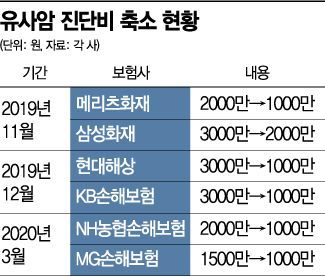
According to the property and casualty insurance industry on the 3rd, NH Nonghyup Property & Casualty Insurance reduced the carcinoma in situ diagnostic benefit from 20 million KRW to 10 million KRW starting this month. MG Insurance also lowered the maximum carcinoma in situ diagnostic benefit from 15 million KRW to 10 million KRW. Samsung Fire & Marine Insurance, which currently offers coverage up to 20 million KRW, is also expected to reduce its limit soon.
An industry insider said, "Customers who wanted to subscribe with a carcinoma in situ coverage limit of 20 million KRW completed their applications by the 28th of last month," adding, "From this month, not only the reduction of carcinoma in situ coverage but also cuts in vascular diagnostic benefits are being discussed."
Carcinoma in situ refers to thyroid cancer, other skin cancers, borderline tumors, and carcinoma in situ. Compared to general cancers, it has a higher incidence rate and features lower coverage amounts. Thyroid cancer, for example, ranks first in incidence among women in Korea but has a survival rate close to 100%, indicating excellent treatment outcomes.
Therefore, carcinoma in situ generally involves shorter treatment periods, lower treatment costs, and higher cure rates compared to general cancers. Previously, only 10-20% of the general cancer diagnostic benefit was paid for carcinoma in situ. For example, if the general cancer coverage was 30 million KRW, only 3 million KRW was paid upon a thyroid cancer diagnosis.
However, last year, insurers encouraged sales by separating carcinoma in situ diagnostic benefits as a special rider and maximizing coverage limits to expand market share. Increasing carcinoma in situ coverage became a key factor in the long-term insurance sales competition.
In the second half of last year, overheated competition emerged with products offering up to 50 million KRW in carcinoma in situ diagnostic benefits even for seniors aged 60 and above.
Financial authorities, concerned about the overheated competition among insurers, recommended reducing coverage limits. Consequently, from the second half of last year, major property and casualty insurers began significantly lowering carcinoma in situ coverage.
Meritz Fire & Marine Insurance reduced its carcinoma in situ diagnostic benefit from 20 million KRW to 10 million KRW starting November last year.
Hyundai Marine & Fire Insurance and KB Insurance also reduced their carcinoma in situ diagnostic benefits to 10 million KRW around the end of last year. Some insurers have even lowered the cumulative industry subscription limits, refusing additional subscriptions for carcinoma in situ diagnostic benefits from consumers who have already subscribed with other insurers.
Reducing carcinoma in situ diagnostic benefits is expected to directly impact future long-term insurance sales. This move is interpreted as an effort to strengthen loss ratio management and reduce losses, even if it means lowering sales. While loss ratios have been surging in automobile and indemnity insurance, relatively stable long-term insurance is now also facing stricter management.
An insurance industry official explained, "The competition to raise diagnostic benefits, which overheated as insurers focused on protection-type insurance products, is ending, shifting toward loss ratio management," adding, "From the consumer's perspective, since coverage details have decreased compared to the past, increasing coverage limits will inevitably lead to higher premium burdens."
© The Asia Business Daily(www.asiae.co.kr). All rights reserved.

















