20th Death, '2nd Death While Waiting for Hospitalization'... Following the 13th Death
Daegu City Reports 1,661 Self-Quarantined Individuals Waiting for Hospitalization as of 9 AM
 On the morning of the 1st, a firefighter supporting patient transport at Duryu Water Purification Plant in Dalseo-gu, Daegu, is adjusting his protective gear.
 [Image source=Yonhap News]
[Asia Economy Reporter Jeong Dong-hoon] The number of deaths in South Korea due to the novel coronavirus infection (COVID-19) has increased to 20. On Sunday, the 1st, three more deaths were reported in a single day, including a case of a person who died while in self-quarantine without being able to go to the hospital again. As the government has decided to change the COVID-19 treatment system to provide inpatient treatment starting with patients of moderate severity or higher, attention is focused on whether rapid treatment for severely ill patients waiting for hospitalization will become possible.
According to Daegu City on the same day, an 80-year-old man died at Chilgok Kyungpook National University Hospital at around 2:25 p.m., followed by an 86-year-old woman who died while receiving treatment at Daegu Catholic Hospital at 4:18 p.m.
The 19th COVID-19 fatality, the man, was confirmed positive on the 28th of last month and was hospitalized at Chilgok Kyungpook National University Hospital on the same day, where he died during treatment. It is known that this man had hypertension as an underlying condition. The 20th COVID-19 fatality, an 86-year-old woman, was also confirmed positive on the 28th of last month but was pushed back in the queue and was waiting for hospitalization at home. Her respiratory distress worsened, and she was transferred to Daegu Catholic University Hospital on the same day but died at the hospital.
In particular, the case of the 20th fatality raises concerns as she died after her condition worsened while quarantined at home waiting for hospitalization. This is the second death while waiting for hospitalization, following the 13th fatality on the 27th of last month, who also died after her condition deteriorated during hospitalization waiting. As the number of patients waiting for hospitalization is increasing due to a shortage of beds and medical personnel, there are calls for more meticulous management of patients waiting for hospitalization. As of 9 a.m. on the same day, the number of confirmed cases in Daegu, the region with the highest number of confirmed cases, was 2,569. Among them, 898 patients (773 in Daegu, 125 from other regions) were hospitalized. 1,661 patients were waiting for hospitalization at home. Among those waiting for hospitalization, 19 patients were identified as severe cases requiring priority admission.
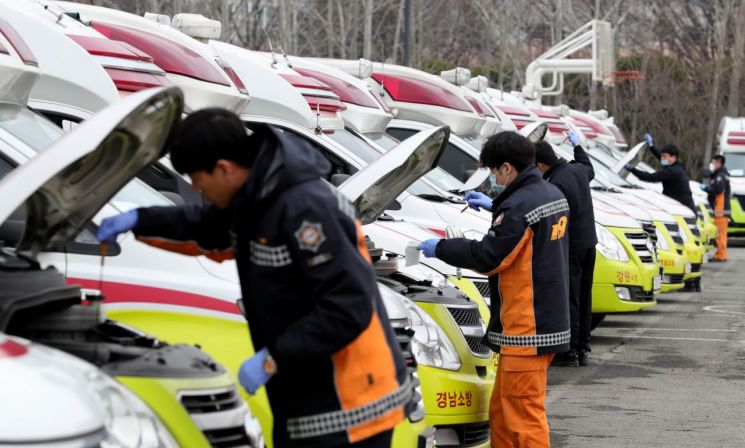 On the morning of the 1st, 119 firefighters supporting patient transport at Duryu Water Purification Plant in Dalseo-gu, Daegu, are inspecting their vehicles.
 [Image source=Yonhap News]
Earlier, the 18th fatality was an 83-year-old man who died at 11:20 a.m. while receiving treatment in a negative pressure isolation room at Kyungpook National University Hospital. This man was tested at a screening clinic on the 27th of last month and confirmed positive the next day, the 28th, after which he was moved to a negative pressure isolation room. It was reported that this patient was in poor health from the time of hospital admission, suffering from underlying conditions such as cerebral infarction, hypertension, and diabetes.
Meanwhile, the government decided on the same day to revise guidelines to convert to a treatment system according to severity. Patients with underlying conditions and poor health who require immediate treatment will receive inpatient care, while patients with relatively mild symptoms will be isolated and treated through government-operated facilities or lodging facilities.
Under the new treatment system, confirmed cases are classified into four stages of severity: mild, moderate, severe, and critical. Patients with moderate or higher severity will be promptly admitted to negative pressure isolation rooms or dedicated infectious disease hospitals for treatment. Mild cases will live and receive treatment at regional 'Living Treatment Centers' utilizing government-operated or lodging facilities. However, if inpatient treatment is deemed necessary, patients will be promptly admitted to hospitals. Living Treatment Centers are selected by province and operated in a way that establishes a medical support system with nearby medical institutions.
First, starting from the 2nd, the Ministry of Education's Central Education Training Institute in Daegu will be operated as a Living Treatment Center. Kyungpook National University Hospital will be responsible for medical management.
© The Asia Business Daily(www.asiae.co.kr). All rights reserved.


















