[Asia Economy Reporter Ki-min Lee] As eco-friendliness and human-centeredness emerge as key themes in new industries, major domestic companies such as Doosan, Hyundai, and Hanwha are focusing on finding new industries that align with these trends.
In Korea, hydrogen power, which can replace coal fuel, is gaining attention, drawing industry interest not only from the complete vehicle sector but also from the machinery industry in developing and launching mobility equipped with hydrogen power.
Additionally, as the labor force declines due to aging and industries advance and become more detailed, the industry is accelerating efforts in collaborative robots that combine efficiency, safety, and convenience.
From Automobiles to Construction Machinery and Drones: The Hydrogen Power Wave
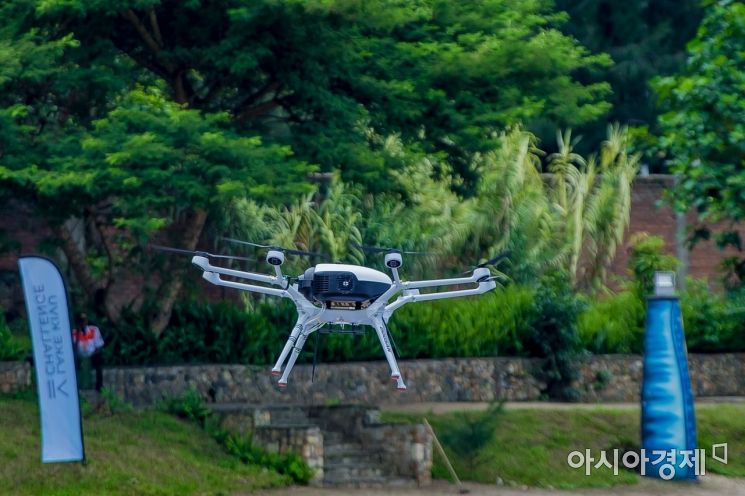
Recently, as complete vehicle companies like Hyundai Motor Company have introduced hydrogen cars, the machinery industry is also developing and launching mobility using hydrogen power.
First, Doosan Group’s subsidiary Doosan Mobility Innovation (DMI) has released drones equipped with hydrogen fuel cell packs, receiving positive market responses. Previously, Doosan established DMI in December 2016 and conducted research and development for over two years before unveiling the hydrogen fuel cell pack for drones for the first time at the 'Inter Drone' exhibition held in Las Vegas, USA, in September 2018. DMI’s hydrogen drone can fly for two hours on a single charge, significantly outperforming drones using electric-based batteries. To pioneer industries utilizing hydrogen drones, DMI has also signed business agreements with telecommunications and software companies. In January this year, at CES 2020, the world’s largest IT and electronics exhibition, DMI signed a 'Hydrogen Fuel Cell Drone Solution Development' agreement with Microsoft (MS) and others. The goal is to produce drones excellent in various information collection tasks such as facility management, pest and natural disaster monitoring, emergency transport, and traffic surveys by combining the long flight capability of hydrogen drones with MS’s software. Doosan expects sales of 10 billion KRW in the drone sector this year.
Hyundai Construction Equipment, together with Hyundai Motor Company and Hyundai Mobis, has embarked on developing hydrogen forklifts and medium-to-large hydrogen excavators. Hyundai Motor Company and Hyundai Mobis will design and manufacture hydrogen fuel cell systems including power packs, and Hyundai Construction Equipment plans to apply these to forklifts and excavators and begin mass production of related products from 2023. This is aimed at securing competitiveness by preempting the global hydrogen construction equipment market in line with the global eco-friendly trend.
New Human Assistants: Collaborative Robots
The collaborative robot sector, a new alternative for the manufacturing industry facing challenges of productivity increase and labor shortages, is also gaining attention. Traditional industrial robots mainly replaced tasks that are excessively dangerous or monotonous for humans. In contrast, collaborative robots can perform fine adjustments at 0.1mm units and share workspaces with humans. They also do not require safety fences like traditional robots, ensuring safety and improving work efficiency. The collaborative robot market is expected to grow steadily. According to the global market research firm Markets&Markets, the global collaborative robot market size is projected to grow at an average annual rate of 50.3% to reach 12.33 billion USD by 2025.
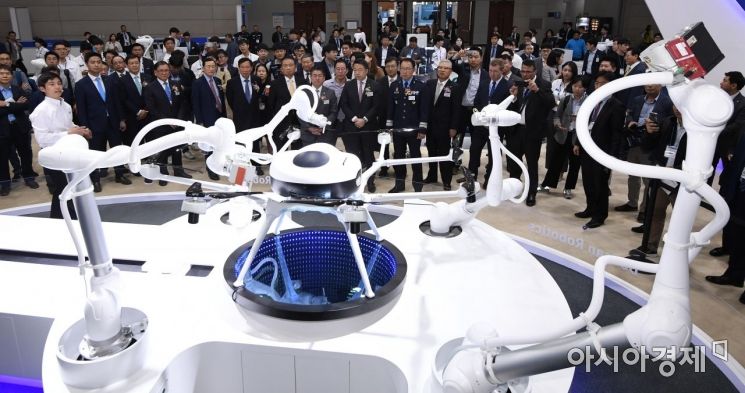 Jeong Seung-il, Vice Minister of the Ministry of Trade, Industry and Energy, is watching the process of five collaborative robots assembling an industrial hydrogen drone at the Doosan Robotics exhibition hall with Son Dong-yeon, Chairman of the Korea Machine Industry Promotion Association, and other attendees at the '2019 Korea Industry Fair' held at KINTEX in Goyang-si, Gyeonggi Province on the 22nd.
 Photo by Kim Hyun-min, Goyang kimhyun81@
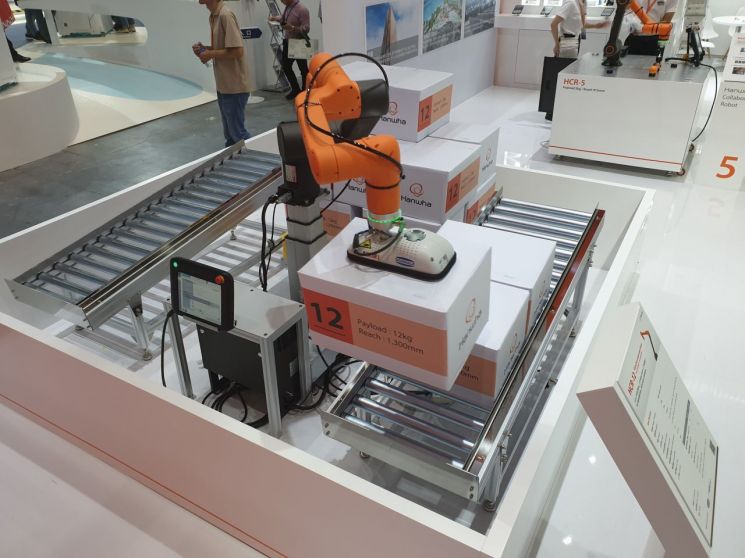
Major domestic companies entering the collaborative robot industry include Doosan Robotics and Hanwha Precision Machinery. Doosan, which announced its intention to enter the collaborative robot business in 2014, established its robot-related subsidiary Doosan Robotics in 2015. Since 2017, it has independently developed eight models including M0609 and M0617 (payload 6kg), M1013 (10kg), and M1509 (15kg). Doosan Robotics currently has sales networks in 20 countries. At the end of last year, it signed a dealership contract with Guangdong Songjing Intelligent Technology Co., Ltd. (hereinafter Songqing) for supplying collaborative robots in China at the 'Dongguan 3C (Computer, Communication, Consumer Electronics) Electronics Industry Smart Manufacturing Conference' held in Dongguan, China. It also showcased its products at Japan’s 'iREX 2019' and CES 2020.
Hanwha Precision Machinery was the first among domestic large corporations to launch collaborative robot products in March 2017. Its main products are the HCR series, including HCR-3 (payload 3kg), HCR-5 (5kg), and HCR-12 (12kg). Besides safety, the HCR series is lightweight and features easy-to-use operating software, allowing non-experts to operate the robots. Hanwha Precision Machinery entered the European market in 2018 by signing supply contracts with six European dealerships. Since then, it has expanded its business by establishing sales networks in more than 20 countries including China and India. In June this year, it plans to participate in the 'Automatica 2020' exhibition held in Munich, Germany, for marketing activities.
In addition, Hyundai Heavy Industries Group spun off its robotics division at the end of last year to establish Hyundai Robotics. Hyundai Robotics is also attracting attention in the collaborative robot business following its work in logistics robots and automobile assembly robots. Last year, Hyundai Robotics won the top prize at the 'Red Dot Design Award,' one of the world’s three major design competitions, for its collaborative robot YL012.
© The Asia Business Daily(www.asiae.co.kr). All rights reserved.
![User Who Sold Erroneously Deposited Bitcoins to Repay Debt and Fund Entertainment... What Did the Supreme Court Decide in 2021? [Legal Issue Check]](https://cwcontent.asiae.co.kr/asiaresize/183/2026020910431234020_1770601391.png)

















