Delayed Normalization of Operating Rates at Local Chinese Factories
Continued Spread Inevitably Harms Exports
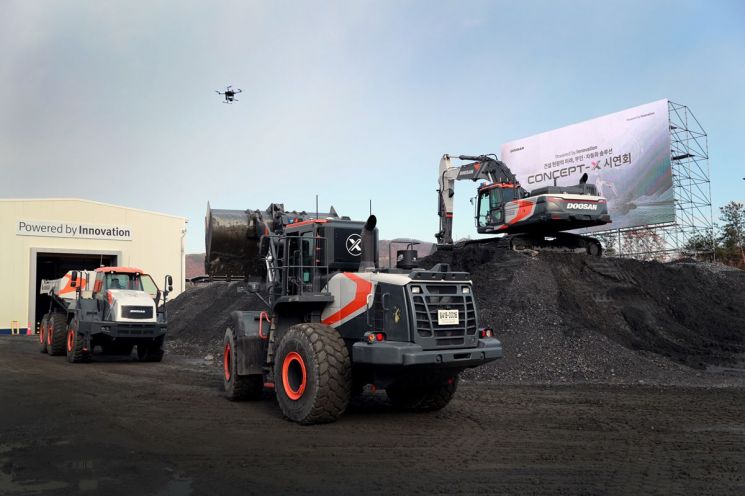
[Asia Economy reporters Dongwoo Lee and Gimin Lee] The domestic construction machinery industry is facing forecasts of decreased performance in the first quarter of this year due to the spread of the novel coronavirus disease (COVID-19). This is because the Chinese market, which still accounts for a high proportion of overseas sales, is expected to see a decline in sales volume in the first half of the year due to the impact of COVID-19.
According to the industry on the 29th, Doosan Infracore resumed operations at its Yantai factory in China on the 10th. Although production schedules delayed by the suspension are currently being caught up with the resumption of operations, the factory's operating rate has not yet reached 100% normalization.
Doosan Infracore has been reducing the proportion of sales in China annually through a policy of export diversification, but it still accounts for around 20%. If the impact of COVID-19 continues in China, it could affect overall sales performance.
Last year, the company recorded KRW 1.2536 trillion (39.8%) in sales from China out of a total sales amount of KRW 3.1484 trillion in the medium and large construction machinery (Heavy) business. This figure is higher than the sales proportion in North America and Europe (KRW 812.4 billion).
Doosan Infracore stated that it is monitoring local sales and situations in preparation for the spread of COVID-19. A company official explained, "As the local situation worsens, the market seems likely to shrink compared to previous years," adding, "If the economic slowdown in China intensifies, sales could decrease from 210,000 units to 170,000 units."
Hyundai Construction Equipment also resumed operations at its Jiangsu Province factory in China from the 14th, but the return of some workers has been delayed. The company expects that it will take more time for the operating rate to reach 100% normalization.
Hyundai Construction Equipment recently experienced a decline in sales of industrial vehicles due to decreased global market demand. Last year, sales amounted to KRW 2.8521 trillion, down 11.8% from the previous year, and operating profit decreased by 24.4% to KRW 157.8 billion. The company noted that economic slowdown factors significantly affected advanced markets such as China, India, and North America and Europe.
Last month, Hyundai Construction Equipment's excavator sales in China were 260 units, about 30% lower compared to 376 units in the same month last year. If COVID-19 continues in China, sales volume is expected to continue declining.
Hongkyun Kim, a researcher at DB Financial Investment, reported that last month, domestic construction machinery exports amounted to USD 26 million (approximately KRW 31.6 billion), a 22.1% decrease compared to the same period last year, and excavator exports to China also sharply dropped by 46.8% to USD 29.8 million (approximately KRW 36.2 billion) compared to the previous year.
The construction machinery industry plans to actively expand market diversification into Southeast Asia, North America, and Europe. Additionally, it aims to strengthen high-profit models such as smart new technologies and large equipment. In particular, Hyundai Construction Equipment plans to focus on the Indian market and launch new models to pursue large-scale and high-profit sales.
© The Asia Business Daily(www.asiae.co.kr). All rights reserved.
!["The Woman Who Threw Herself into the Water Clutching a Stolen Dior Bag"...A Grotesque Success Story That Shakes the Korean Psyche [Slate]](https://cwcontent.asiae.co.kr/asiaresize/183/2026021902243444107_1771435474.jpg)
















